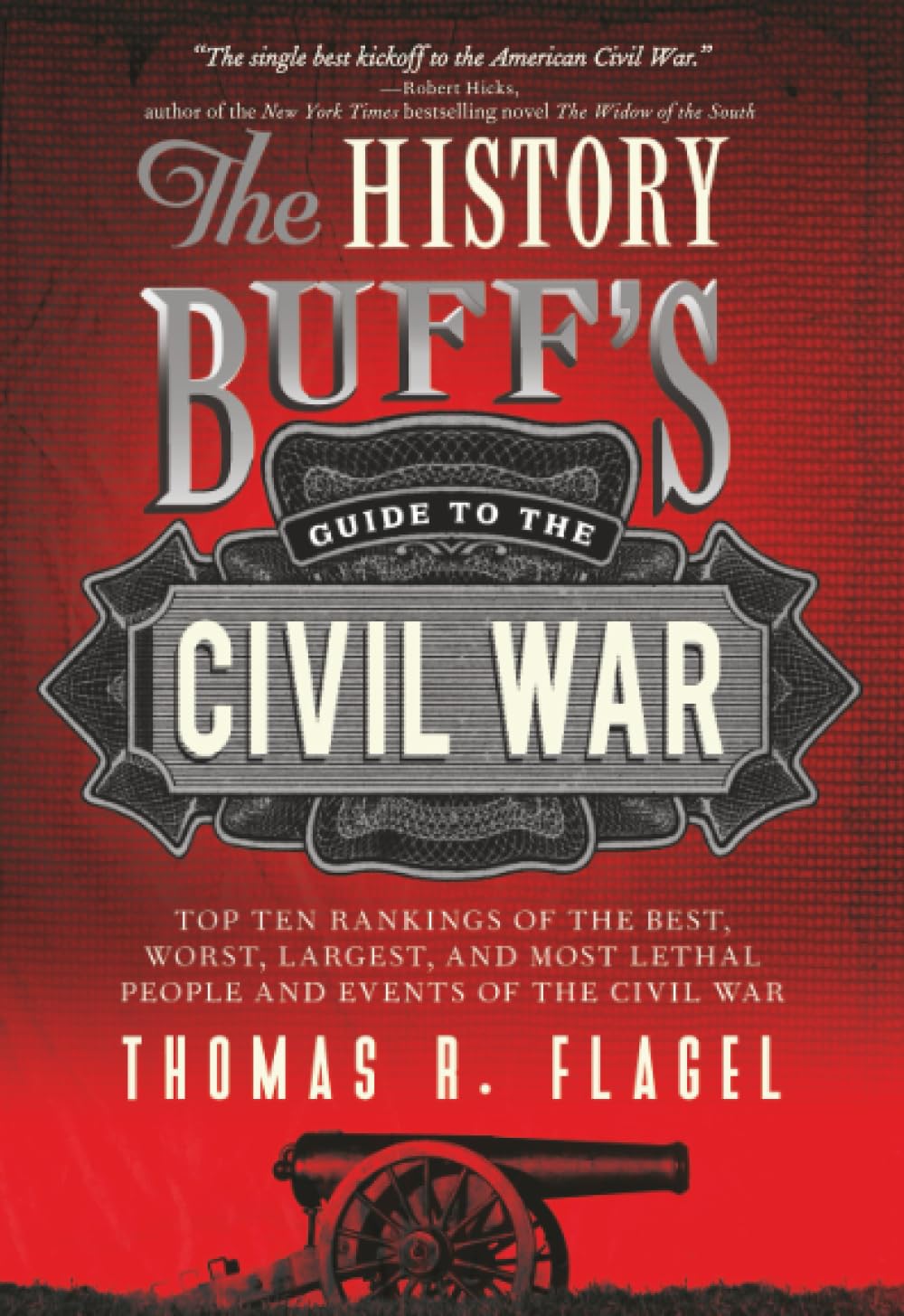
The History Buff's Guide to the Civil War: The best, the worst, the largest, and the most lethal top ten rankings of the Civil War
$14.09
by Thomas R. Flagel



Do You Think You Know the Civil War? The History Buff's Guide to the Civil War clears the powder smoke surrounding the war that changed America forever. The perfect guide for anyone looking for great history facts like: What were the best, the worst, the largest, and the most lethal aspects of the conflict? - What are the top ten causes? - The bloodiest battles? With over thirty annotated top ten lists and unexpected new findings, author Thomas R. Flagel will have you debating the most intriguing questions of the Civil War in no time. This invaluable guide to the great war between the states will delight and inform you about one of the most crucial periods in American history. The perfect gift for any history fan, student, or expert! "The single best kickoff to the American Civil War...I can't imagine a better guide for any of us, whether student or scholar." ―Robert Hicks author of the New York Times bestselling novel The Widow of the South "A detailed and enjoyable set of facts and stories that will engage every reader from the newest initiate to the Civil War saga to the most experienced historian. This book is a must have for any Civil War reading collection." ― James Lewis,Park Ranger at Stones River National Battlefield "Next year will be the 150th anniversary of what many historians consider to be the most pivotal point in our nation’s history and this book is a must-have resource to that time. Laid out in easy-to-find and easy-to-read segments, it includes the pre-war antebellum time, politics, military life and the home front. " ― BuddyHollywood.com "I have always found history to be extremely interesting. I can't believe how much I learned from The History Buff's Guide. Anyone who likes to learn about what happened in the past will appreciate this book. I give it five stars." ― Readaholic "The History Buff's Guide to the Civil War will provide a deeper clarity and perspective on every aspect of the war. The Second edition complete with new content and updated lists will have you debating the new and intriguing questions." ― New York History Thomas R. Flagel teaches American History at Columbia State Community College in Columbia, Tennessee. He holds degrees from Loras College, Kansas State University, Creighton University, and has studied at the University of Vienna. He currently lives in Franklin, Tennessee. From the Top Ten Causes of the Civil War There was no single cause of the American Civil War. From its earliest years, the batch of English colonies that became the United States were never a uniform entity. But by the middle of the nineteenth century, the relationship between the states had become surprisingly and dangerously unstable. In order to better understand why these states turned so violently upon each other, we can examine underlying differences between the warring parties and look for possible sources of those differences. The following are ten key circumstances contributing to the political, social, economic, and evolutionary division of the country. A few were centuries in the making; others were relatively new phenomena. All changed a relatively functional nation into two distinct and confrontational sections, where " e pluribus unum " devolved into "us versus them."(1) 1. Territorial Expansion By 1820 it was well established which states would be free or slave. Territories, however, were open for debate, and there would be much to fight over. Less than a million square miles in 1800, the United States nearly doubled with the Louisiana Purchase (1803) and almost doubled again after the war with Mexico (1846–48). Armed with the popular ideology of "Manifest Destiny," many citizens North and South considered the continent, if not the hemisphere, the divine right of the United States. This aggressive foreign policy against Spanish, British, French, and Native American holdings fed the ravenous appetite of an expanding population and economy. It also created a showdown of "winner take all" between slavery and free-soil sections.(2) The contrived war with Mexico was a thinly veiled attempt by Southern statesmen to secure more slave states. In the same light, Northerners pushed for homestead bills to virtually pay people to settle the Midwest and cried "54-40 or Fight" in demanding all of the vast Oregon Territory from Britain. The greed turned to warfare with the 1854 Kansas-Nebraska Act. The U.S. Constitution was not specific on whether the states or the federal government controlled the territories. With disputes escalating for and against either position, Illinois Sen. Stephen A. Douglas proposed a compromise: The residents of the territory in question would decide. Calling it "popular sovereignty," Douglas and many of the congressmen who passed the bill assumed antislavery settlers would choose Nebraska and proslavery settlers would move into Kansas. Kansas, however, was north of the traditional 36? 30' line between free and slave soil. In a prequel to the la