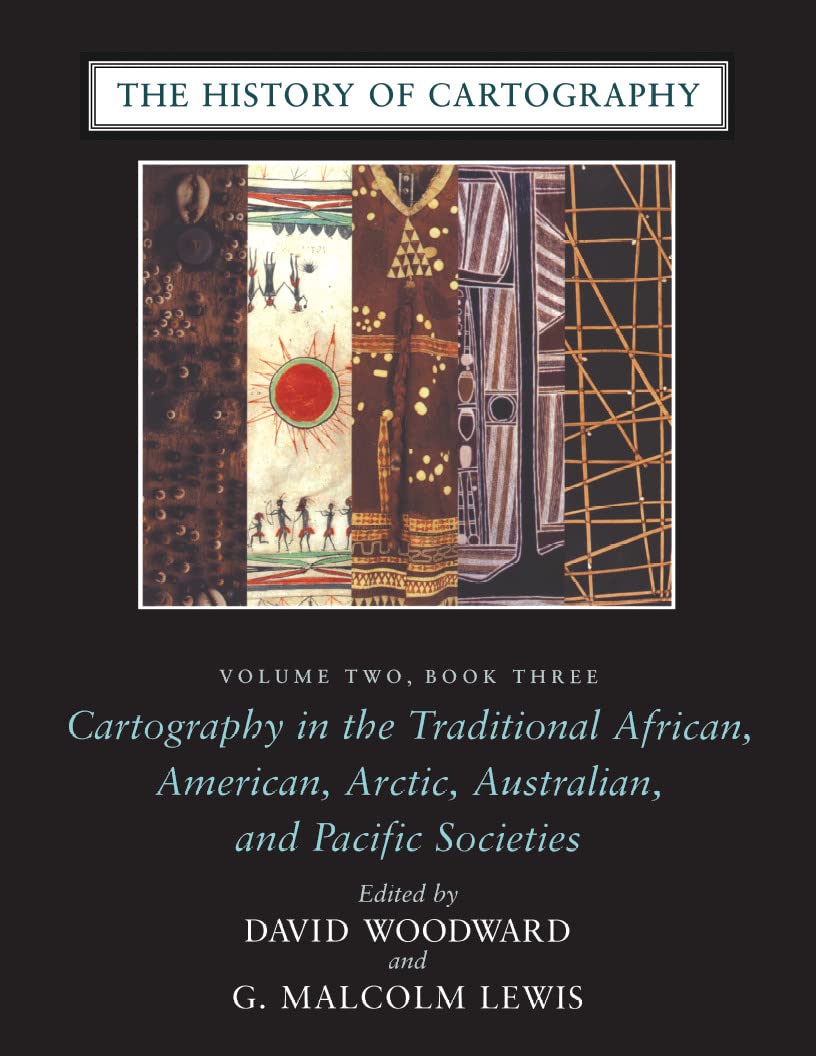
The History of Cartography, Volume Two, Book Three: Cartography in the Traditional African, American, Arctic, Australian, and Pacific Societies
$299.00
by David Woodward



"Certain to be the standard reference for all subsequent scholarship."—John Noble Wilford, New York Times Book Review , on the History of Cartography series "The maps in this book provide an evocative picture of how indigenous peoples view and represent their worlds. They illuminate not only questions of material culture but also the cognitive systems and social motivations that underpin them" (from the introduction). Although they are often rendered in forms unfamiliar to Western eyes, maps have existed in most cultures. In this latest book of the acclaimed History of Cartography , contributors from a broad variety of disciplines collaborate to describe and address the significance of traditional cartographies. Whether painted on rock walls in South Africa, chanted in a Melanesian ritual, or fashioned from palm fronds and shells in the Marshall Islands, all indigenous maps share a crucial role in representing and codifying the spatial knowledge of their various cultures. Some also serve as repositories of a group's sacred or historical traditions, while others are exquisite art objects. The indigenous maps discussed in this book offer a rich resource for disciplines such as anthropology, archaeology, art history, ethnology, geography, history, psychology, and sociology. Copious illustrations and carefully researched bibliographies enhance the scholarly value of this definitive reference. Editors Woodward (geography, Univ. of Wisconsin, Madison) and Lewis (geography, Univ. of Sheffield, England) have produced an unusual survey authored by 11 international scholars. The history of mapmaking is usually approached Eurocentrically, with the possible addition of Arab and Chinese cartographers. However, the expanded definition of "map" employed in the "History of Cartography" seriesA"graphic representations that facilitate a spacial understanding of things, concepts, conditions, processes, or events in the human world"Aallows the inclusion of artifacts made by the traditional or indigenous societies of Africa, the Americas, the Arctic, and Oceania. These unexpected and exceedingly rare sources are as varied as petroglyphs from Southern Africa and Australia; an inscribed moose antler purportedly made by Sacajawea, who accompanied Lewis and Clark; Aztec codices; Incan "quipus"; and Marshallese "mattangs" (stick charts). The map format of Western cultures is sterile when compared with the representational concepts of shamanistic traditional societies. "Cartography becomes less of a gridded stage on which life takes place and more a model of how the spiritual world and physical world interact." The well-documented and authoritative text is enriched by numerous illustrations, including 24 color plates, and an extensive bibliography and index. Academic and larger public libraries will want to acquire this for its unusual content.AEdward K. Werner, St. Lucie Cty. Lib. Sys., Ft. Pierce, FL Copyright 1999 Reed Business Information, Inc. Although they are often rendered in forms unfamiliar to Western eyes--as decorations on ceramic and textiles in the Andes, symbolic codes in the shields of the Trobriand Islanders of Papua New Guinea, lukasa memory boards among the Luba of central Africa, geohistorical screenfolds made by the Mixtecs, or toas from the Lake Eyre region of southern Central Australia--maps have existed in most indigenous cultures. In this first book-length attempt to document traditional cartography outside the Western and Asian civilizations, contributors from a broad variety of disciplines investigate the roles that maps have played in the wayfinding, politics, and religions of these diverse societies. David Woodward (1942–2004) was the Arthur H. Robinson Professor of Geography Emeritus at the University of Wisconsin–Madison, where he taught for more than twenty years. Along with the late J. B. Harley, he was founding editor of the History of Cartography Project. In 2002, the Royal Geographical Society honored him with the Murchison Award for his lifelong contribution to the study of the history of cartography.