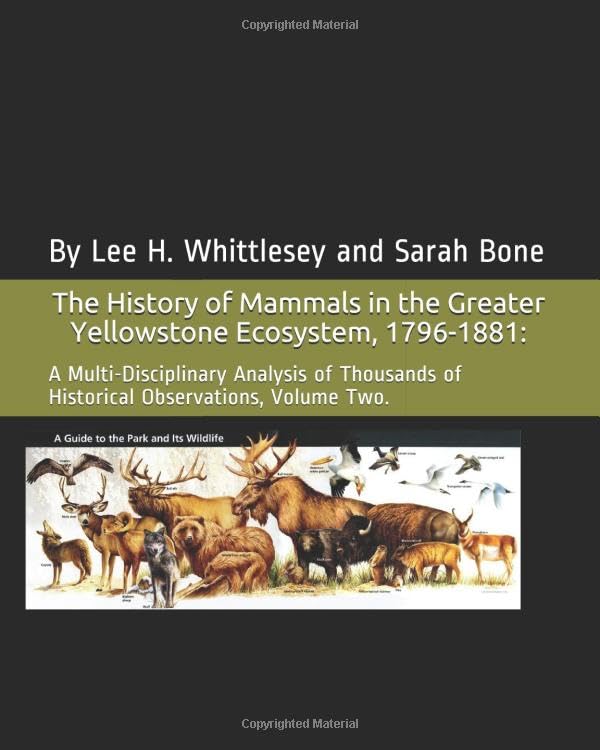
The History of Mammals in the Greater Yellowstone Ecosystem, 1796-1881:: A Multi-Disciplinary Analysis of Thousands of Historical Observations (Volume
$44.91
by Lee H. Whittlesey



The History of Mammals in the Greater Yellowstone Ecosystem, 1796-1881: A Multi-Disciplinary Analysis of Thousands of Historical Observations, volumes one and two (Volume one=793 pages; Volume two=513 pages), by Lee H. Whittlesey and Sarah Bone.This book, authored by two (originally three) professional historians all working for the National Park Service (NPS), attempts to tell the stories of all known travelers who recorded their observations of animals while on trips to the Greater Yellowstone Ecosystem (GYE)—including Yellowstone National Park and Grand Teton National Park—during the period 1796 through 1881. Their eyewitness observations of the animals they saw on these trips, with specific attention paid to 39 species of mammals—their presence, abundance, and distribution, including necessary context (volume one, pp. 1-793)—make false the claims of a few researchers that the GYE was historically a place of few or no animals. The treatment is exhaustive, because the authors spent nearly thirty years finding the sources, inputting them into a huge, NPS-owned computer-database, analyzing the data with the help of the database, writing the conclusions (volume two, pp. 794-1306), producing 71 illustrations, having the book reviewed by numerous scientists at Yellowstone National Park in the NPS’s Yellowstone Center for Resources, and finally causing the book to be reviewed by three other, professional, paid historians.All proceeds and royalties for this book are donated to the National Park Service via its cooperative association, Yellowstone Forever.The authors define this study as a multi-disciplinary, historical-geographical approach that comprehensively and systematically analyzes anecdotal, historical data in ways uniquely useful to relevant scientists and historians and also to general readers. The project takes qualitative data from journals, diaries, letters, newspapers, and other historical sources and makes it useful to personnel in national parks, national forests, state-county-city wildlife agencies, and to other natural and cultural resource-managers, historians, and scientists in a quantitative computer-database, which has been textually interpreted by these two volumes. In other words, it represents the near-complete history of mammals in the GYE for the period mentioned, with our conclusions about their presence, abundance, and spatial distribution. A long appendix includes material about the early hunting of and later commercial slaughter of many of these mammals in the GYE during the period 1805 through 1884.The authors believe that this book will become necessary reading for zoologists, paleontologists, biologists, and other general scientists; for historians of the American West; for scientists and historians who are interested in producing similar works for other locations around the world; and for anyone else who is interested in the mammals of the Greater Yellowstone Ecosystem.The book contains the following: Dedicatory, table of contents, acknowledgements, table of illustrations, two volumes, twelve chapters, discussion and conclusions, 1306 total pages, 71 figures (charts, graphs, tables, photos and other illustrations), five appendices, biographies of the authors, bibliography, and index.