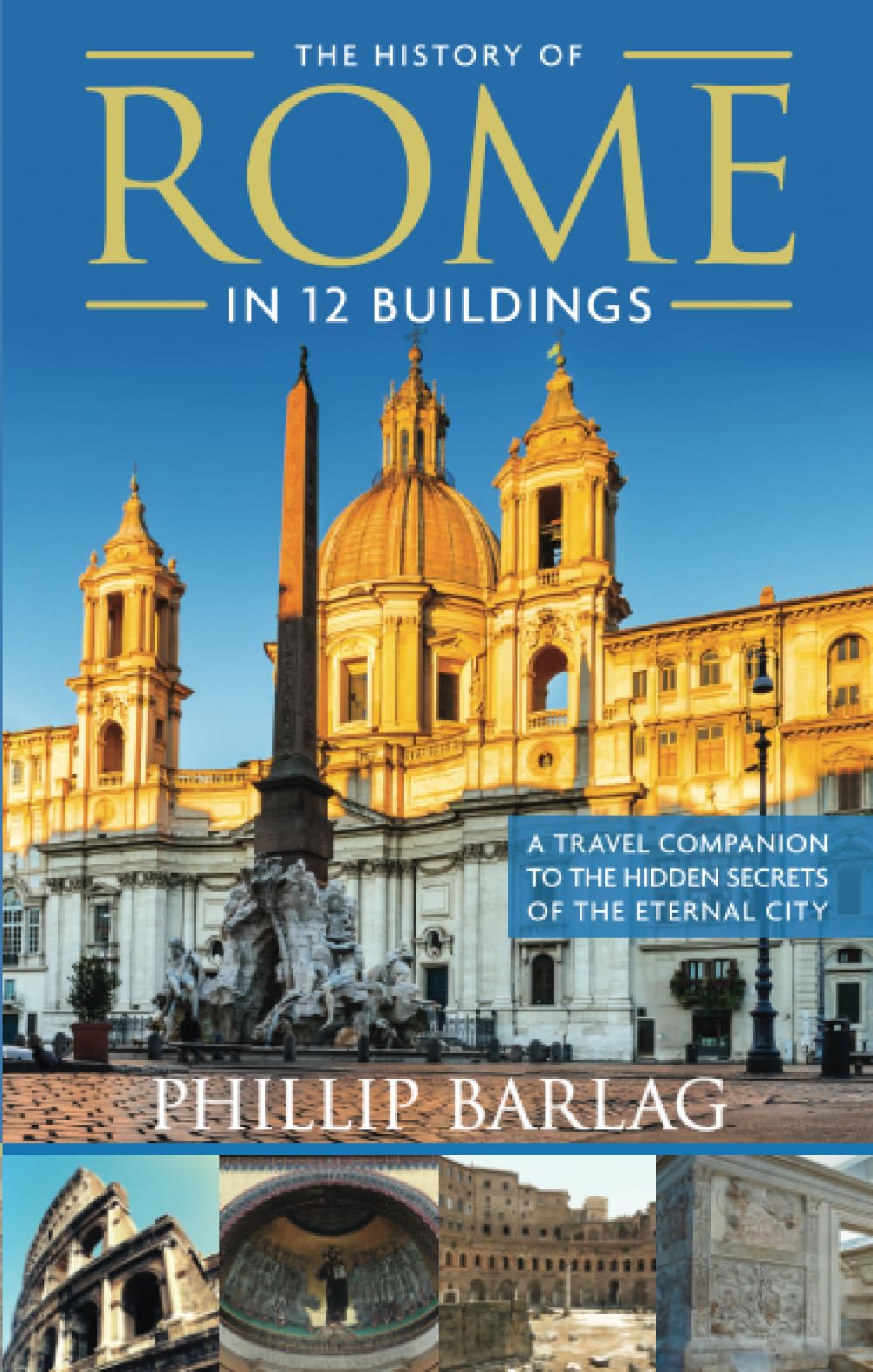
The History of Rome in 12 Buildings: A Travel Companion to the Hidden Secrets of The Eternal City
$15.99
by Phillip Barlag



Any travel guide to Rome will urge visitors to go the Colosseum, but none answers a simple question: Why is it called the Colosseum? The History of Rome in 12 Buildings: A Travel Companion to the Hidden Secrets of The Eternal City is compelling, concise, and fun, and takes you behind the iconic buildings to reveal the hidden stories of the people that forged the Roman Empire. Typical travel guides provide torrents of information but deny their readers depth and perspective. In this gap is the really good stuff--the stories that make the buildings come alive and vividly enhance any trip to Rome. The History of Rome in 12 Buildings will immerse you in the world of the Romans, one full of drama, intrigue, and scandal. With its help, you will be able to trace the rise and fall of the ancient world's greatest superpower: Find the last resting spot of Julius Caesar. - Join Augustus as he offers sacrifices to the gods. - Discover the lie on the façade of the Pantheon. - Walk in the footsteps of Jesus. - And so much more. Phillip Barlag is an executive director at World 50, which initiates and facilitates the most interesting and influential business conversations in the world. He is the author of The Leadership Genius of Julius Caesar: Modern Lessons from the Man Who Built an Empire (Berrett-Kohler, 2016), and his writing has been published in a variety of publications and blogs, including Fast Company and MIT Sloan Management Review. He lives in the Atlanta, Georgia, area with his wife and three children. The History of Rome in 12 Buildings A Travel Companion to the Hidden Secrets of the Eternal City By Phillip Barlag Red Wheel/Weiser, LLC Copyright © 2018 Phillip Barlag All rights reserved. ISBN: 978-1-63265-132-7 Contents Preface, Introduction, Chapter 1: Via Sacra, Chapter 2: Mamertine Prison, Chapter 3: The Temple of Caesar, Chapter 4: Ara Pacis, Chapter 5: The Mausoleum of Augustus, Chapter 6: The Colosseum, Chapter 7: Piazza Navona, Chapter 8: The Pantheon, Chapter 9: The Baths of Caracalla, Chapter 10: The Walls of Aurelian, Chapter 11: Scala Santa, Chapter 12: The Column of Phocas, Bibliography, Acknowledgments, Index, About the Author, CHAPTER 1 Via Sacra All roads lead to Rome — or so the saying goes. What is now a way of saying, "There are many ways to get to the same outcome," was once much closer to literal truth. The idea of empire is so deeply associated with ancient Rome it is sometimes difficult to remember a time before empire, a time when Rome was just one ambitious and expansionist city on a continent of ambitious and expansionist cities. Nothing tells the story of the rise of Rome, from its mythological founding at the teats of a wolf mother to its glorious empirical heights than its roads — and one road in particular, the Via Sacra, or Sacred Way, may tell the legend best. Let us begin with those first Romans — the twins Romulus and Remus. After being abandoned in a basket by the Tiber River by their mother, they were suckled by a benevolent she-wolf. There they were found by a kindly shepherd and his wife, who raised them until becoming aware of their origins. It turns out that Mom was a priestess and the daughter of a deposed king of a nearby city. Once the twins figured out their regal connection, they helped their grandfather reclaim his throne, then set out to create a kingdom of their own. Legend has it that Romulus wanted to found their settlement on the Palatine Hill, whereas Remus preferred the Aventine. The argument boiled over; Romulus murdered his brother and became the first king of Rome. The Palatine it was, then. From that day forward, an address on the Palatine Hill defined fashion, elegance, and power. Today, it is the origin of words such as "palace" and "palatial." It is unlikely that Romulus and Remus were historical figures, but violence and bloodshed lie at the root of the Roman legend, an appropriate foreshadowing of the Roman legacy. From the time of its founding — often given as 753 BCE — Rome existed in a near-constant state of warfare. Romulus and his descendants fought war after war, securing Rome's place as a regional power in central Italy. As Rome's power spread, so too did the Forum, a complex of buildings and public spaces that came to be the center of life for Romans of all walks of life. Rich and poor, patrician and plebian, proud and humble, people from every slice of Roman society mingled there. Part outdoor market, part gathering place, the Forum is where court cases were decided, vendors hocked their wares, and business deals were struck. As Rome grew a greater foothold, the Forum grew with it. Rome's second king, Numa Pompilius, was unusual for a Roman ruler in that he eschewed war for peace. He added the Temple of Janus to the Forum. The Roman god Janus was a deity of transitions. He looked after things such as birth, death, time, and doorways. Numa's temple doors would be opened in times