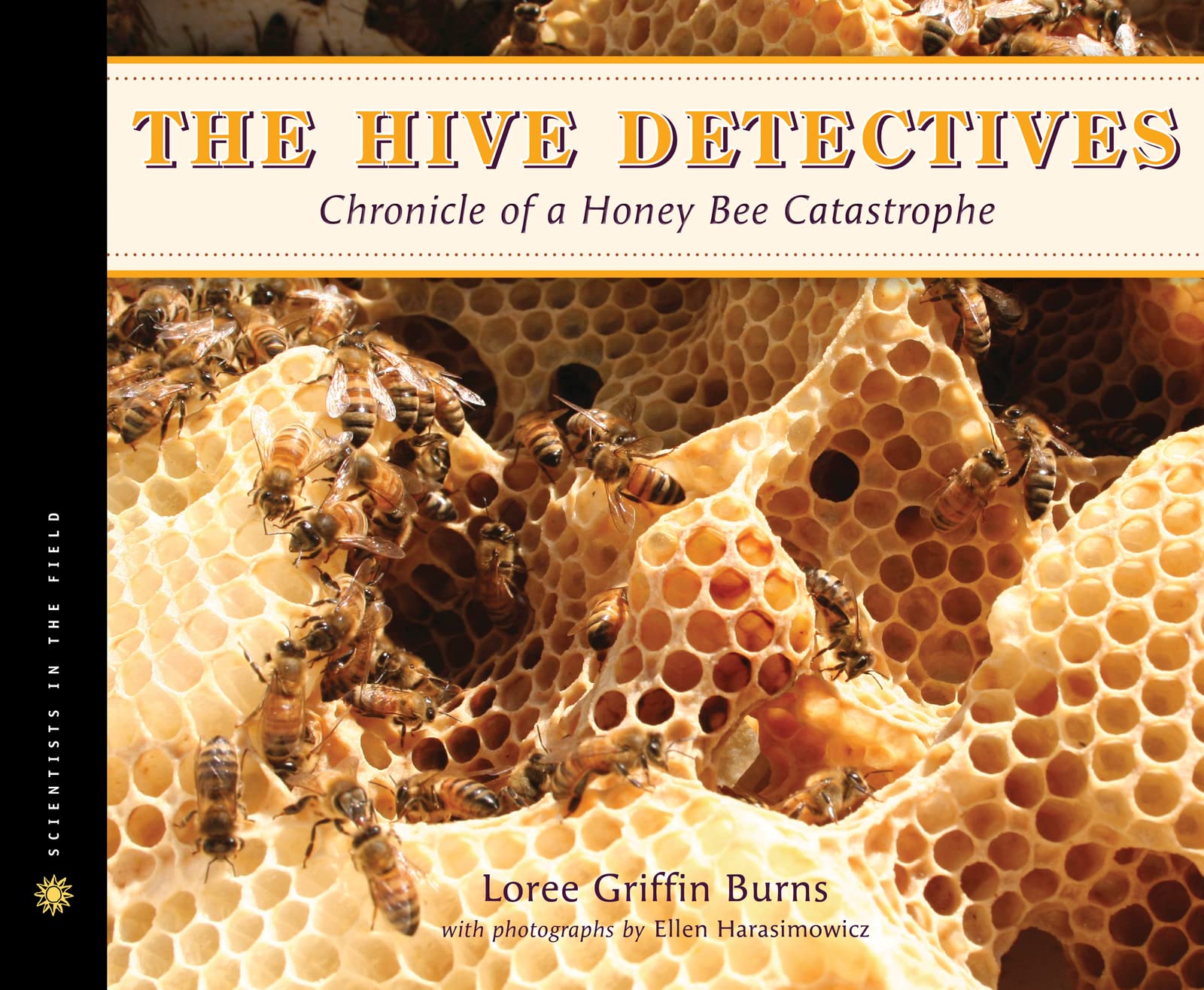



Without honey bees the world would be a different place. There would be no honey, no beeswax for candles, and, worst of all, barely a fruit, nut, or vegetable to eat. So imagine beekeeper Dave Hackenburg’s horror when he discovered twenty million of his charges had vanished. Those missing bees became the first casualties of a mysterious scourge that continues to plague honey bee populations today. In The Hive Detectives, Loree Griffin Burns profiles bee wranglers and bee scientists who have been working to understand colony collapse disorder, or CCD. In this dramatic and enlightening story, readers explore the lives of the fuzzy, buzzy insects and learn what might happen to us if they were gone. Grade 5–8—The mystery of the vanishing honeybees began in the winter of 2006 when beekeeper Dave Hackenberg inspected 400 of his 3000 hives in Florida and discovered that 20 million bees had simply disappeared. He frantically alerted state bee inspectors and other beekeepers that there was some strange new ailment affecting these insects and asked for help in finding the cause. Soon beekeepers across the country were reporting similar catastrophes. Most of this lucid, fact-filled introduction focuses on the investigation into the problem, now known as "colony collapse disorder," or CCD. Separate chapters cover each of four scientists' line of research and describe their procedures, key tools, equipment, and findings. While no definitive cause for CCD has yet been found, the researchers theorize that the disorder is caused by a combination of the usual bee ailments, the chemicals used to treat them, and a new systemic pesticide employed by farmers. Other chapters include interviews with a hobbyist beekeeper and Hackenberg; they are packed with information on beekeeping and stress the importance of bees as pollinators. Special feature pages profile the scientists and describe the physical and behavioral characteristics of honeybees; hive construction; the making of honey, etc. Clear color photographs of beekeepers, scientists, equipment, close-ups of bees, hives, etc., complement the text on every page. Youngsters concerned with the environment will find this meticulously researched title a valuable resource.— Karey Wehner, formerly at San Francisco Public Library Copyright © Reed Business Information, a division of Reed Elsevier Inc. All rights reserved. "Throughout the presentation, readers learn about the anatomy, development, and social behavior of honey bees, and observe the process of scientific investigation and its vital, real-world application. Appended are lists of recommended books, magazines, films, Web sites as well as a glossary and a source bibliography. A fascinating book from the Scientists in the Field series."— Booklist, starred review "Not long after beekeepers encountered a devastating new problem in their hives in 2006, a team of bee scientists began working to discover the causes of colony collapse disorder (CCD), now attributed to a combination of factors possibly including pesticides, nutrition, mites and viruses...Harasimowicz's clear, beautifully reproduced photographs support and extend the text."— Kirkus, starred review LOREE GRIFFIN BURNS, Ph.D., did her doctoral at the University of Massachusetts Medical School. The author of Beetle Busters , Tracking Trash , and The Hive Detectives , she is an award-winning writer whose books for young people have won many accolades, including ALA Notable designations, a Boston Globe-Horn Book Honor Book Award, an IRA Children’s Book Award, a Green Earth Book Award and two Science Books & Films (SB&F) Prizes. Loree holds a Ph.D. in biochemistry and her books draw heavily on both her passion for science and nature and her experiences as a working scientist. She lives with her husband and their three kids in a farmhouse in central New England, where she gardens, keeps chickens, and writes about science and scientists. She likes to think that one day she’ll fill the big old barn on their property with horses. Learn more about Loree at loreegriffinburns.com and follow her on Twitter @loreegburns. ELLEN HARASIMOWICZ is a freelance photojournalist who has photographed professionally since 2003. Her work has appeared in the Boston Globe , the Washington Post , and Scientific American . She photographs primarily for independent schools in Massachusetts, but her real love is travel. Her travels, on assignment and for personal projects, have taken her to more than 30 countries in Europe, Africa, Asia, North America, the Caribbean and Central America. Her love for travel stems from her curiosity, which led her to the world of children’s literature. Since 2006, Ellen has illustrated four children’s books with her photographs, including three middle-grade books with Loree Burns: The Hive Detectives , Citizen Scientist , and Beetle Buster . Ellen lives in Massachusetts with her husband, Paul; her work can be seen at ellenharasimowicz.com.