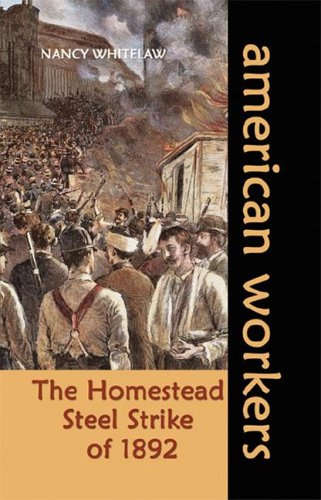



Describes the events leading up to and occurring during the lockout and strike of steel workers in Homestead, Pennsylvania, in 1892, and its impact upon American labor unions. Grade 5-9-An immigrant from Scotland, Andrew Carnegie was the epitome of the American Dream, a true rags to riches story. However, not all immigrants were as lucky or as talented. Many found jobs in the burgeoning steel industry, monopolized by Carnegie and his partner, Henry Clay Frick. Harsh working conditions and management's negative attitude toward labor unions caused friction. The Amalgamated Association of Iron and Steel Workers negotiated for its members but Carnegie and Frick were determined to destroy the union at their Homestead, PA, factory. While Carnegie vacationed in Scotland, Frick hired Pinkerton guards to break the strike. Bloodshed resulted; the union was broken. But the story didn't end there. Personal tragedy befell Frick and probably contributed to a break with Carnegie, who sold the company to J. P. Morgan. Frick received far less money than Carnegie in this sale and, further embittered, said, You can tell Carnegie I'll meet him-¦in Hell, where we both are going. This is a riveting story told in 11 well-written, lively chapters, with well-placed, good-quality reproductions and drawings throughout the text. -Patricia Ann Owens, Wabash Valley College, Mt. Carmel, IL Copyright © Reed Business Information, a division of Reed Elsevier Inc. All rights reserved. The conflict between owners and workers in the early years of American industry often became violent. The bloody events of July 1892, which pitted two of the nation's most skillful businessmen Andrew Carnegie and Henry C. Frick against the workers in their Homestead steel mill, have become emblematic of the labor unrest of the period. Carnegie and Frick were both visionary entrepreneurs. When they acquired the steel works at Homestead, they inherited a powerful labor union. The Amalgamated Association of Iron and Steel Workers, a part of the fledgling American Federation of Labor, had recently negotiated a strong contract. Carnegie and Frick were determined to force the union out, despite Carnegie's public statements of appreciation for the rights of the working man. As talks opened between labor and management, Carnegie fled to Great Britain and left Frick in charge. A few months of stalled negotiations and provocative moves on both sides led to a strike in the summer of 1892. Frick immediately called in Pinkerton guards, and on July 6, a battle erupted between Pinkertons and striking workers that left several dead on each side and forever changed the face of American labor. The Homestead Steel Strike of 1892 details the main players and issues that led to that fateful day and examines the effect the strike had on the American labor movement. The conflict between owners and workers in the early years of American industry often became violent. The bloody events of July 1892, which pitted two of the nation's most skillful businessmen—Andrew Carnegie and Henry C. Frick—against the workers in their Homestead steel mill, have become emblematic of the labor unrest of the period. Carnegie and Frick were both visionary entrepreneurs. When they acquired the steel works at Homestead, they inherited a powerful labor union. The Amalgamated Association of Iron and Steel Workers, a part of the fledgling American Federation of Labor, had recently negotiated a strong contract. Carnegie and Frick were determined to force the union out, despite Carnegie's public statements of appreciation for the rights of the working man. As talks opened between labor and management, Carnegie fled to Great Britain and left Frick in charge. A few months of stalled negotiations and provocative moves on both sides led to a strike in the summer of 1892. Frick immediately called in Pinkerton guards, and on July 6, a battle erupted between Pinkertons and striking workers that left several dead on each side and forever changed the face of American labor. The Homestead Steel Strike of 1892 details the main players and issues that led to that fateful day and examines the effect the strike had on the American labor movement. Used Book in Good Condition