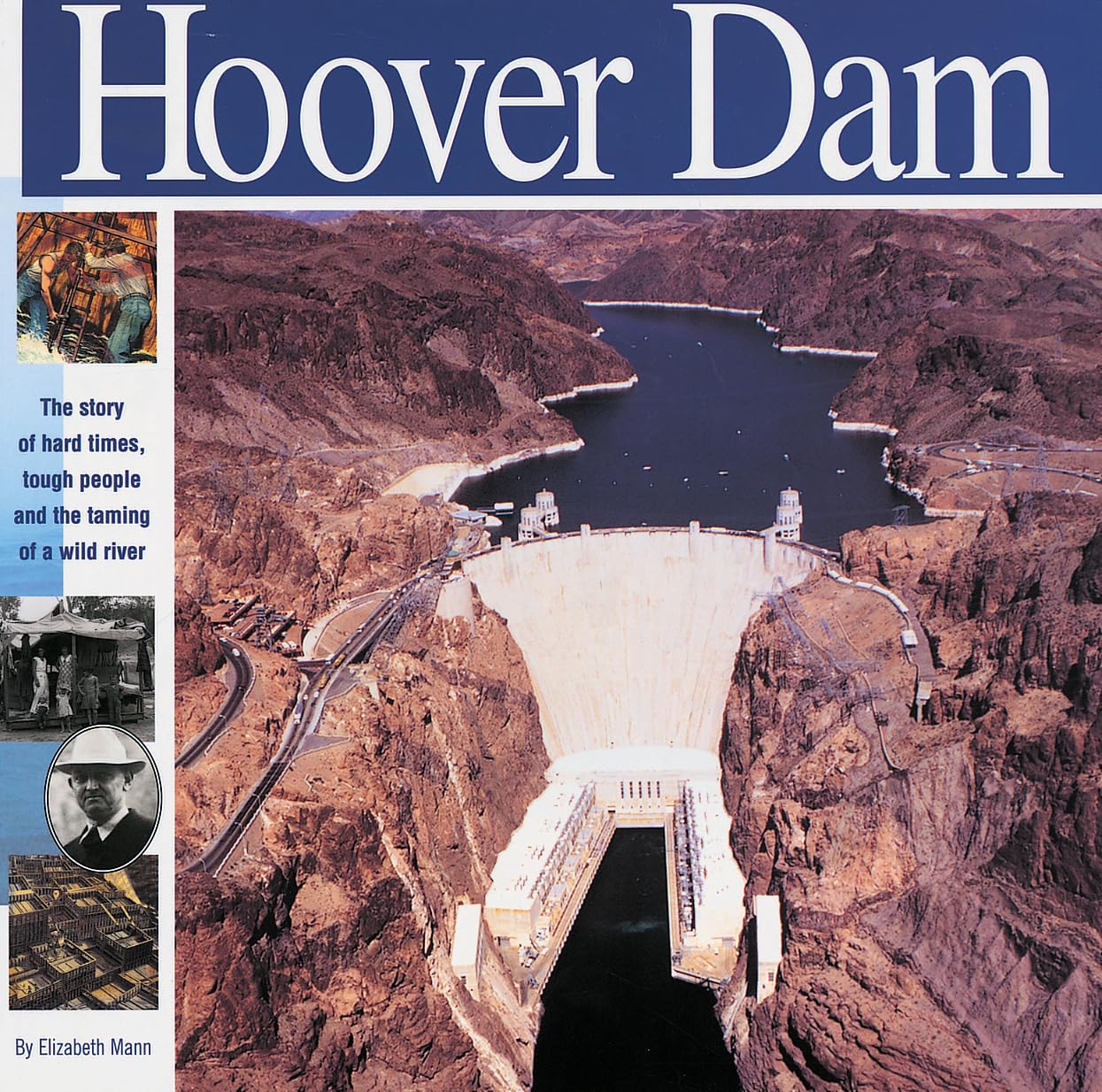
The Hoover Dam: The Story of Hard Times, Tough People and The Taming of a Wild River (Wonders of the World Book)
$22.95
by Elizabeth Mann



Now in paperback! They called the river the Red Bull. Desert silt gave the Colorado its distinctive color, but it was its power and unpredictability that made its fierce reputation. Speeding down from the high Rockies, the Colorado would flood without warning, wiping out any farmer foolish enough to settle near its banks. But what if the Red Bull could be tamed? Farmlands irrigated by the Colorado's waters could bloom in the desert. Cities electrified by the Colorado's power could grow and prosper. The Hoover Dam grew from this dream and with it much of the modern American west. Built in the middle of The Great Depression, the Hoover Dam was set in an unforgiving landscape whose climate defied habitation much less intense, backbreaking physical labor. Yet, during those hard times and in that desolate place, there rose an extraordinarily sophisticated feat of modern engineering. The Hoover Dam is the dramatic story of the danger, suffering, courage and genius that went into the building of one of America's most famous landmarks. Wonders of the World series The winner of numerous awards, this series is renowned for Elizabeth Mann's ability to convey adventure and excitement while revealing technical information in engaging and easily understood language. The illustrations are lavishly realistic and accurate in detail but do not ignore the human element. Outstanding in the genre, these books are sure to bring even the most indifferent young reader into the worlds of history, geography, and architecture. "One of the ten best non-fiction series for young readers." - Booklist Gr 4-10-The cover proclaims this a "story of hard times, tough people and the taming of a wild river." And that's exactly what it is-as well as an epic tale of adventure and danger. In bringing to life the history of this remarkable feat of modern engineering, Mann notes that at times from March 11, 1931, to February 29, 1936, more than 5000 men worked on the dam, often risking and sometimes losing their lives. Readers meet people like Frank Crowe, the obsessive superintendent of construction, who was far more interested in finishing the job quickly than in the health and safety of his workers. Insets give brief first-person accounts by workers and their families. Witschonke's illustrations are evocative of the period and add to the drama while archival photographs record activities and life in the nearby evolving communities of "Ragtown" and Boulder City. A labeled double gatefold shows the dam site in 1934, at the height of activity. There is definitely enough here to write a research paper, and plenty to keep readers interested while they're doing it. A wonderfully readable, well-organized book filled with fascinating detail. Mara Alpert, Los Angeles Public Library Copyright 2001 Cahners Business Information, Inc. An epic tale of adventure and danger ... A wonderfully readable, well-organized book filled with fascinating detail. -- Mara Alpert ― School Library Journal Published On: 2001-12-01 Elizabeth Mann is the author of the award-winning Brooklyn Bridge , and others in the Wonders of the World series. She lives in New York and has a home in the British Virgin Islands. High above the river, work of a different kind was going on. Giant grooves were being cut into the canyon walls, notches that would securely hold each end of the concrete dam. There were also areas of loose rock -- the results of years of weathering -- that had to be removed. Even a small piece of rock falling from a great height could crush the skull of a worker below. Drilling and blasting the rock on the canyon walls was the job of the "high scalers." High scalers dangled like spiders hundreds of feet above the river on little wooden swings tied to the end of a single rope. Their waist belts were heavy with tools and water bags. They lowered themselves down the cliff face, turned on their noisy jackhammers and went to work drilling the rock and placing dynamite charges. Thousands of tourists who visited the dam site every year were captivated by the daring high scalers, and the high scalers delighted in an audience. When their supervisors weren't watching, they did tricks on their swings that had the crowd gasping and applauding. Although the possibility of a plunge to certain death was always present, falling rocks and tools proved to be greater danger, and workers devised a way to protect themselves. They placed on cloth hat (like today's baseball cap) inside another, so that the brims faced in opposite directions. Then they soaked the doubled hat in tar and let it dry, creating hard hats. They worked so well that Frank Crowe ordered factory-made hard hats for everyone on the job. Voices: "But that was a good job. I got paid $5 a day to start with. Afterwards I got $5.60. I believe that was one of the safest jobs they had. I think there was less people got hurt on high scaling than there was on lots of other jobs. It wasn't worse than a