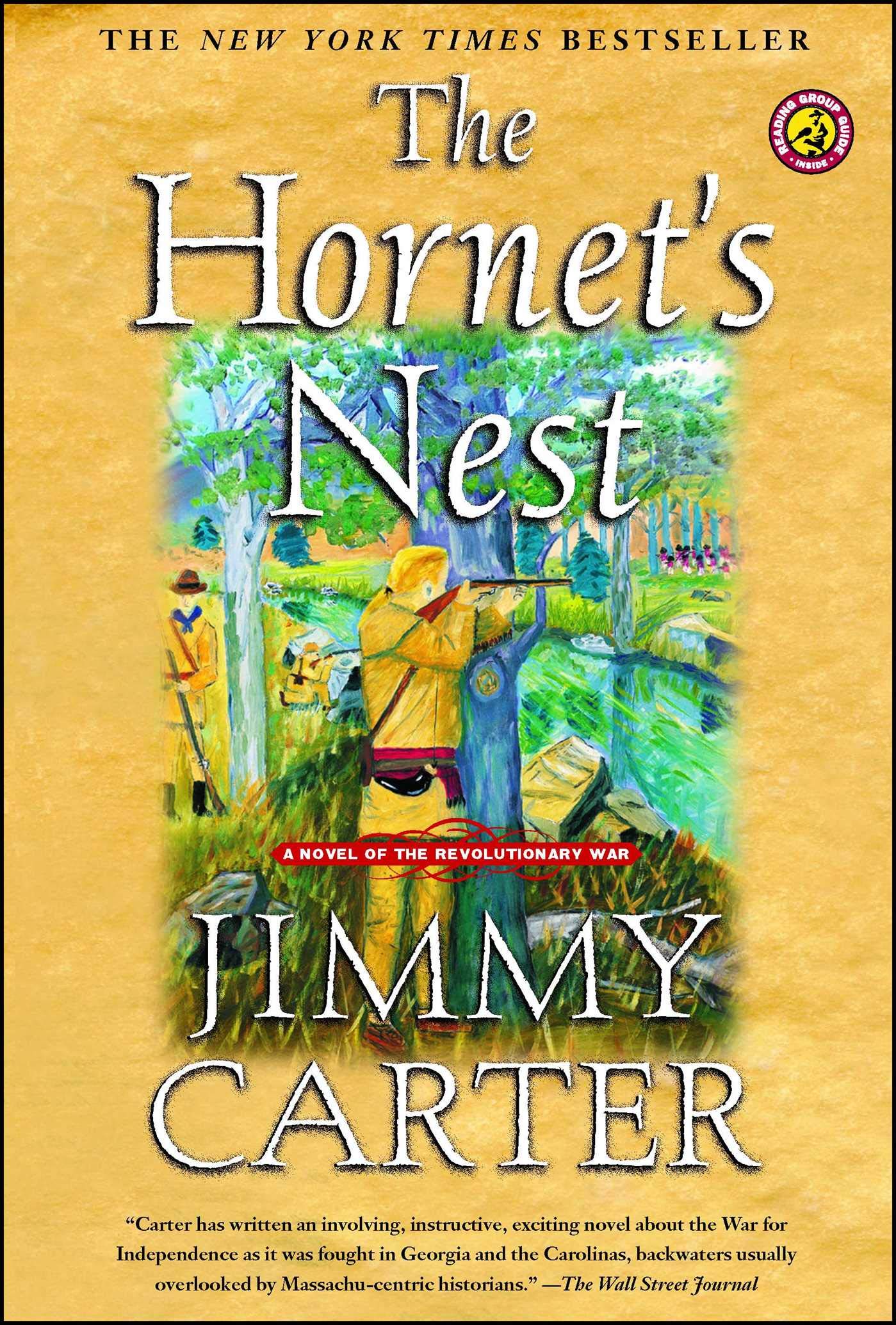



The first work of fiction by a President of the United States—a sweeping novel of the American South and the War of Independence. In his ambitious and deeply rewarding novel, Jimmy Carter brings to life the Revolutionary War as it was fought in the Deep South; it is a saga that will change the way we think about the conflict. He reminds us that much of the fight for independence took place in that region and that it was a struggle of both great and small battles and of terrible brutality, with neighbor turned against neighbor, the Indians’ support sought by both sides, and no quarter asked or given. The Hornet’s Nest follows a cast of characters and their loved ones on both sides of this violent conflict—including some who are based on the author’s ancestors. At the heart of the story is Ethan Pratt, who in 1766 moves with his wife, Epsey, from Philadelphia to North Carolina and then to Georgia in 1771, in the company of Quakers. On their homesteads in Georgia, Ethan and his wife form a friendship with neighbors Kindred Morris and his wife, Mavis. Through Kindred and his young Indian friend Newota, Ethan learns about the frontier and the Native American tribes who are being continually pressed farther inland by settlers. As the eight-year war develops, Ethan and Kindred find themselves in life-and-death combat with opposing forces. With its moving love story, vivid action, and the suspense of a war fought with increasing ferocity and stealth, The Hornet’s Nest is historical fiction at its best, in the tradition of such major classics as The Last of the Mohicans . "The Hornet's Nest is a bold book with a big cast of characters and numerous plots." Jimmy Carter was the thirty-ninth President of the United States, serving from 1977 to 1981. In 1982, he and his wife founded The Carter Center, a nonprofit organization dedicated to improving the lives of people around the world. Carter was awarded the Nobel Peace Prize in 2002, and was the author of thirty books, including A Full Life: Reflections at Ninety ; A Call to Action: Women, Religion, Violence, and Power; An Hour Before Daylight: Memoirs of a Rural Boyhood; and Our Endangered Values: America’s Moral Crisis . He died in 2024 at the age of 100. The Hornet's Nest A Novel of the Revolutionary War By Jimmy Carter Simon & Schuster Copyright © 2004 Jimmy Carter All right reserved. ISBN: 9780743255448 Chapter 16: Massacre of the Indians Having experienced troubles with doubtful land titles in the Carolinas, Elijah Clarke and his neighboring families were careful to get the proper documents when they obtained rights to settle near the Savannah River along the northern border of the 1773 land grant. Elijah encouraged the other men to locate their homesteads so that the entire group could remain in close contact with one another. All of the cabins were soon connected with a spiderweb of trails. Elijah and Hannah decided to build a new cabin and barn that almost joined each other, and to accept the constant animal sounds and odors in lieu of risking another fire being set by undetected intruders. This proximate location made possible an additional safety precaution, as they spent weeks of hard work putting up a stockade of upright poles, just large enough to encompass the two buildings and a small yard. Except for slits left as rifle ports and the large swinging entrance gate, the barricade cut off their view of the surrounding woods, but they did not trust the Indians who lived only a few miles away, and felt that the increased safety was worth the trouble. Aaron Hart and his wife had settled within a mile of the Clarkes, and within sight of where two major trails crossed. Maintaining his far-reaching trade route and not intending to farm for a living, Aaron decided to take a minimum amount of land, only fifty acres, which was to be used mostly for pasture. An extra shed was built on the side of the Harts' cabin as a storeroom for his goods, and he now cut off some of his former trading territory in North Carolina and added an equivalent area in south Georgia. When Aaron was away, his wife frequently spent nights with the Clarkes. Their decisions concerning safety seemed justified toward the end of January 1774, when Aaron came home to report that a group of Creeks had burned a homestead fifteen miles to the southwest, and murdered and scalped a man named William White, his wife, and their four children. Elijah said, "Damn the bastards! We've got to go teach 'em a lesson." By the time Elijah and Aaron arrived at White's place, a dozen men were there, looking at the smoldering ruins and already having dug six graves for the scalped and mutilated bodies. Since no one else seemed to be in charge, Aaron asked Elijah what he thought they should do, and the others seemed willing to listen to his opinion. Naturally assuming the role of leader, he decided that they should follow the war party, which they assumed had crossed the Ogeechee