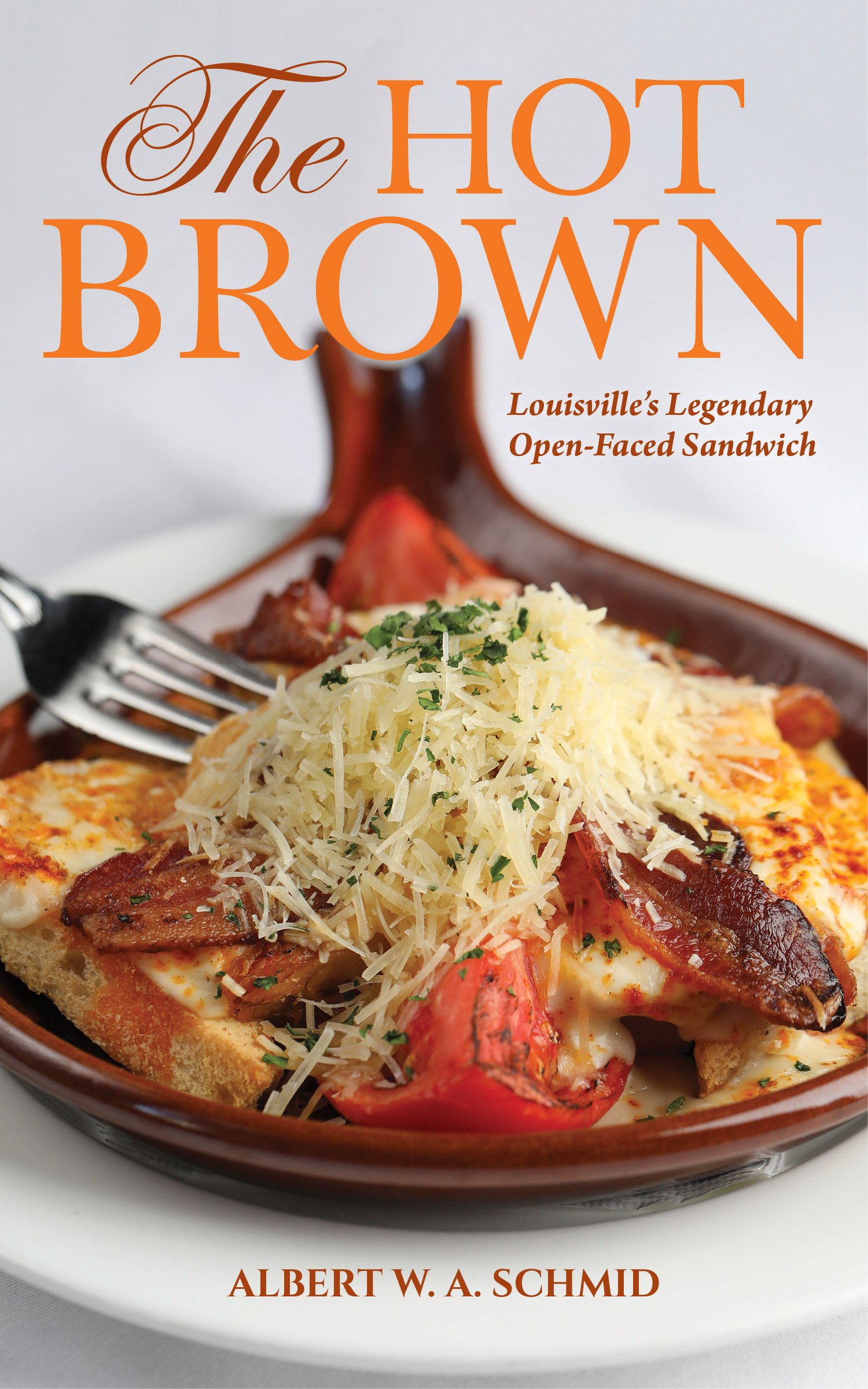



The Hot Brown Sandwich is a delicious staple of culture and heritage in Louisville, Kentucky. Originally created at its namesake the Brown Hotel, the Hot Brown began as turkey on bread covered in Mornay sauce and topped with tomato wedges and two slices of bacon, and has developed into an entire industry of fries, pizza, salads, and more. Chef Albert W. A. Schmid offers a wealth of recipes for the notorious sandwich and reveals the legends and stories that surround the dish. For example, it may have had humble beginnings as a tasty way to use up kitchen scraps, or it could have been invented to ward off hangovers―scandalous since the first Hot Browns were served during the Prohibition. Schmid treats readers to an exceptional collection of recipes for the legendary sandwich and hotel cuisine scrumptious enough to whet any appetite, including the Cold Brown (served during the summer), Chicken Chow Mein (the Brown Hotel Way), and Louisville-inspired cocktails such as the Muhammad Ali Smash. Albert W. A. Schmid is the award-winning author of many books, including The Kentucky Bourbon Cookbook, The Manhattan Cocktail, The Old Fashioned, and The Beverage Manager's Guide to Wines, Beers, and Spirits. The Hot Brown Louisville's Legendary Open-Faced Sandwich By Albert W. A. Schmid Red Lightning Books Copyright © 2018 Albert W.A. Schmid All rights reserved. ISBN: 978-1-68435-005-6 Contents Foreword by Steve Coomes, ix, Preface, xiii, Acknowledgments, xvii, 1 The Hot Brown Sandwich, 1, 2 People, Places, and Things (and the Legendary Hot Brown), 11, 3 Recipes, 20, 4 Kentucky Hotel Cuisine, 80, Notes, 87, Bibliography, 89, CHAPTER 1 The Hot Brown Sandwich THE HOT BROWN SANDWICH is an inspired culinary creation that helped to put Kentucky cuisine on the map as one of the many great cuisines in the United States. The Hot Brown sandwich, known to locals as a "Hot Brown" was created as a late fall to winter sandwich. "I never cease to be amazed that people will drive hundreds of miles (to the Brown Hotel) for a Hot Brown," said Brad Walker, the general manager and vice president of the Brown Hotel for the past fifteen years and graduate from Cornell's hotel and restaurant management program. Later in the interview, Walker referred to the culinary creation as "our lovely little sandwich." The Hot Brown attracts people from outside the hotel. Walker said it is not uncommon for "six, eight, ten people to show up at J. Graham's Café and all of them order a Hot Brown." They come from all over the United States and even overseas says Walker, who knows this fact because people post their experience on social media. "Hotels (in the Louisville area) will direct people to the Brown for a Hot Brown," said Walker, who added that other hotels directing people away from their hotel to benefit another hotel is a unique situation that does not always happen. "The Welcome Center also sends a lot our way." The Hot Brown is most likely a variation of the Welsh rarebit, although Kentucky author David Dominé observed in an interview, "I have always wondered if the Hot Brown was inspired by the Croque-Monsieur, just deconstructed." This theory stands up to scrutiny as the croque monsieur first appeared on a Paris café menu in 1910. Some soldiers from the United States would have seen this sandwich before returning home at the end of the Great War (World War I). Also, the croque monsieur is mentioned in Marcel Proust's 1919 novel, À la recherche du temps perdu: À lombre des jeunes filles en fleurs ( In Search of Lost Time: In the Shadow of Young Girls in Flower ), the second in his seven-novel masterwork. Of course, perhaps the Welsh rarebit, a sandwich dating back to sometime in the early sixteenth century, spawned the croque monsieur, which spawned the Hot Brown. Or, perhaps a direct line can be drawn from the Welsh rarebit to the Hot Brown. No one really knows for sure. In any case, the Hot Brown was invented at the Brown Hotel in 1926 by Chef Fred K. Schmidt during the height of Prohibition. Since its creation, the Hot Brown has gained worldwide fame and has been featured in newspaper articles and on television shows, and the recipe is found in many Kentucky cuisine cookbooks not to mention many other cookbooks. In fact, a Kentucky cookbook without a Hot Brown is incomplete. An incredible public relations effort and notoriety surround this open-faced sandwich, that was most likely made from nothing more than kitchen scraps — as something warm to eat on a frigid winter night during a break from dancing on the roof top at the Brown Hotel in Louisville, Kentucky, as an alternative to ham and eggs. Although another story has the Hot Brown being created to ward off a patron's hangover — which seems unlikely since the sandwich was created in the middle of Prohibition. Of course, Prohibition stopped very few people from imbibing in the United States, much less in Kentucky, the home of many bourbon distille