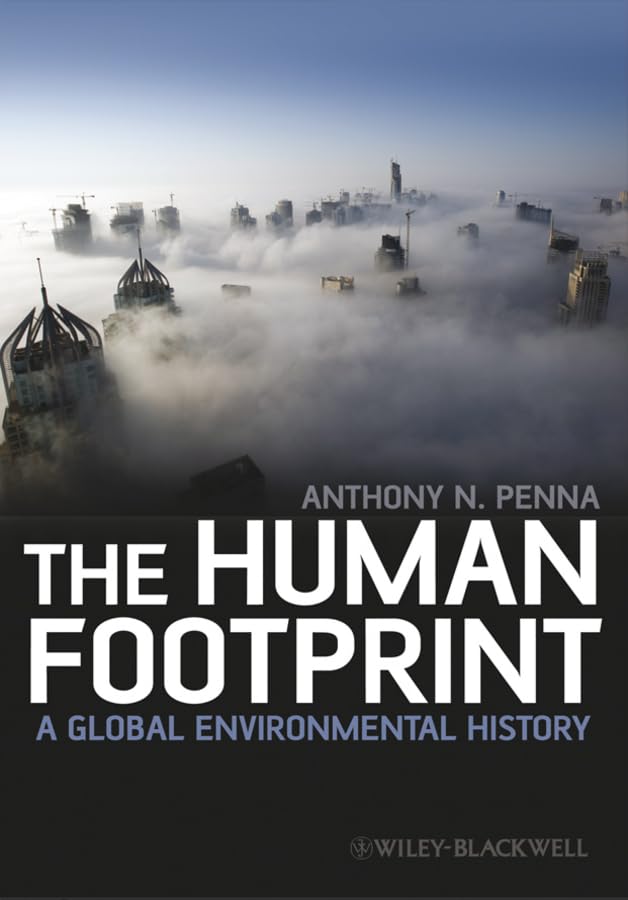



Rare book "The Human Footprint adds to the growing literature combining environmental with world history, both of which are relatively recent and vibrant subfields of history . . . His topical approach does result in an interesting, readable, and accessible set of histories that addresses issues of concern not just to world and environmental historian, but to geologists and evolutionary biologists as well, making it quite suitable for use in a range of college and university courses." (Technology and Culture, 1 January 2011) "I highly recommend this book as one that would work extremely well in an environmental history offering or as a supplementary work in any World survey." (World History Association, 1 October 2010) "An increasing number of scholar-teachers are now able to teach global survey courses, giving students an improved context for heading into a future of daunting climate change. None of the recent survey volumes is better tailored for this audience (or for a wider and equally anxious public) than Penna's Human Footprint, the fruit of two decades of teaching this subject at Northeastern University...One virtue of Penna's approach is its integration of hard sciences (archeology, climatology, epidemiology, etc.) with social and historical concepts...Penna makes clear how natural settings shaped early human cultures; this enables readers then to watch the long human effort to turn the tables on Nature, reshaping it to this species' innovative priorities." (Environmental History, 2011) "An ambitious and timely book that builds on and extends a vital field of historical research. Key attractions include the compatibility with the organization of teaching in many world history courses and the embrace not only of big changes like the advent of agriculture or industrialization, but less familiar developments such as the environmental impact of migration patterns. The result is a real sense of how humans have interacted with nature and the ways current environmental issues connect to the past." — Peter N. Stearns , George Mason University, author of The Industrial Revolution in World History "Penna is to be congratulated for producing one of the first environmental histories to embrace the entire world and all of human history. As our relationship with the world’s diverse environments deteriorates, such educational resources are becoming increasingly vital." — David Christian , Macquarie University, formerly of SDSU, author of Maps of Time: An Introduction to Big History "An insightful survey of global history . . . In clear and accessible prose, it provides a masterful synthesis of scholarship across a wide range of disciplines. Its breadth and sophistication – and its relevance to the world today – make it a compelling read. — Jeffrey K. Stine , Curator of Engineering and Environmental History , Smithsonian Institution, author of America's Forested Wetlands: From Wasteland to Valued Resource "Penna weaves human and natural history together into a single, compelling story. In his vision, human innovation, culture and exchange, nutrition, atmospheric chemistry, and plate tectonics are just a few of the many processes that come together in an endless dance of engagement and change . . . The pasts and the fates of humanity, nature, and the Earth are one and the same." — Adam McKeown, Columbia University, author of Melancholy Order: Asian Migration and the Globalization of Borders 1834–1929 "Combining wide knowledge with an eye for the essential, Penna takes a truly vast and challenging subject – the natural and human history of the earth – and distills it into a volume that is reliable, accessible, and illuminating." — William B. Meyer , Colgate University, author of Human Impact on the Earth The Human Footprint is an innovative and accessible study of transnational environmental history, which uses broad themes to highlight the long and rich history of the earth. Offering a coherent, comparative examination of the world's past, Penna's multidisciplinary approach draws on the most recent research in geology, climatology, archaeology, anthropology, and history. Flowing from the Paleolithic to the present era, each chapter contains a single theme, ranging from the global impact of agriculture and urbanization, to manufacturing, consumption, and industrialization. In recognizing how humans have fit into this history of the earth, The Human Footprint brings harmony to human history and ecology, providing a fresh, much-needed narrative of world history. Anthony N. Penna has taught at Carnegie-Mellon University and Northeastern University, where he has been teaching North American and Global Environmental history courses since 1990. He is the author of Nature’s Bounty: Historical and Modern Environmental Perspectives (1999), and he is co-editor of Remaking Boston: An Environmental History of the City and Its Surroundings (2009).