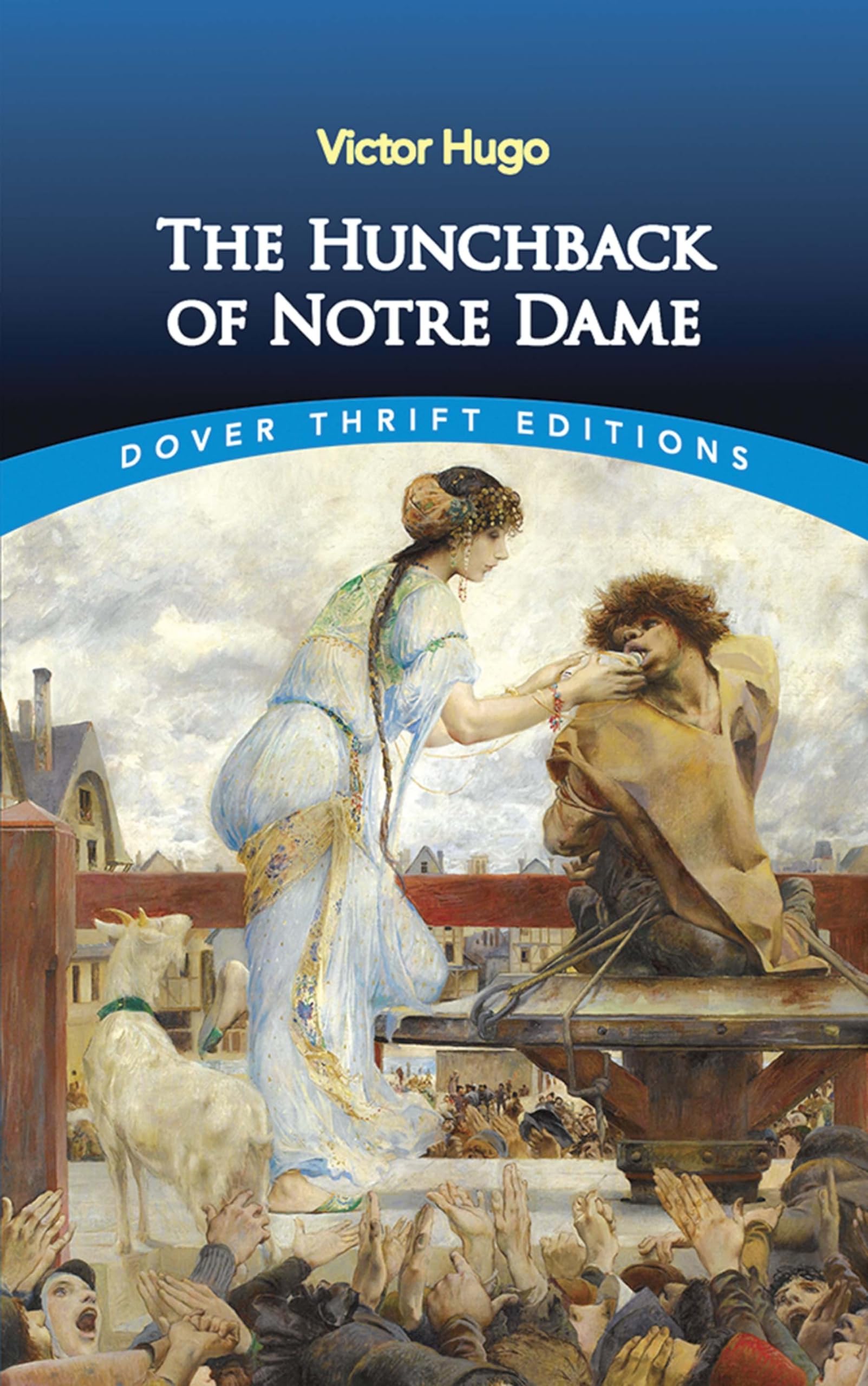



A mad priest, a vagabond playwright, a social-climbing soldier, and a deformed bell-ringer — all are captivated by a gypsy girl's beauty and charm. Two of them will betray her, but the others will remain loyal, even in the shadow of the gallows. These outlaws find sanctuary within the walls of medieval Paris' greatest monument, the grand Cathedral of Notre Dame. "What a beautiful thing Notre-Dame is!" declared Gustave Flaubert of Victor Hugo's 1837 novel. Originally published as Notre-Dame de Paris (Our Lady of Paris), it was conceived as a story of the cathedral itself, which functioned as the passionate heart of fifteenth-century city life. But Hugo's human drama rivals the Gothic masterpiece for dominance. Drawn with humor and compassion, his characters endure, both in literary history and in readers' imaginations: Frollo, the sinister archdeacon; Quasimodo, the hideous hunchback; and the enchanting outcast, Esmeralda. French poet, playwright, novelist, and activist, Victor Hugo is best known as the author of Les Miserables . A leader of the French Romantic movement, he was one of the most prolific authors in history and his career reflects a turning point in French literature. The Hunchback of Notre Dame By Victor Hugo Dover Publications Copyright © 2006 Victor Hugo All right reserved. ISBN: 9780486452425 1 It is this day three hundred and forty-eight years six months and nineteen days since that the good people of Paris were awakened by a grand peal from all the bells in the three districts of the City, the University, and the Ville. January 6, 1482, was, nevertheless, a day of which history has not preserved any record. There was nothing worthy of note in the event which so early set in motion the bells and the citizens of Paris. It was neither an assault of the Picards nor the Burgundians, nor a procession with the shrine of some saint, nor a mutiny of the students, nor an entry of our “most redoubted lord, Monsieur the king,” nor even an execution of rogues of either sex, before the Palace of Justice of Paris. Neither was it an arrival of some bedizened and befeathered embassy, a sight of frequent occurrence in the fifteenth century. It was but two days since the last cavalcade of this kind, that of the Flemish Ambassadors commissioned to conclude a marriage between the Dauphin and Margaret of Flanders, had made its entry into Paris, to the great annoyance of the Cardinal of Bourbon, who, in order to please the king, had been obliged to receive this vulgar squad of Flemish burgomasters with a good grace, and to entertain them at his hotel de Bourbon with a goodly morality, mummery, and farce, while a deluge of rain drenched the magnificent tapestry at his door. What set in motion all the population of Paris on January 6, was the double solemnity, united from time immemorial, of the Epiphany and the Festival of Fools. On that day there was to be an exhibition of fireworks in the Place de Greve, a Maytree planted at the chapel of Braque, and a mystery performed at the Palace of Justice. Proclamation had been made to this effect on the preceding day, with sound of trumpet in the public places, by the provost’s officers in fair coats of purple camlet, with large white crosses on the breast. That morning, therefore, all the houses and shops remained shut, and crowds of citizens of both sexes were to be seen wending their way toward one of the three places specified above. Be it, however, observed, to the honor of the taste of the cockneys of Paris, that the majority of this concourse were proceeding toward the fireworks, which were quite seasonable, or to the mystery which was to be represented in the great hall of the palace, well covered in and sheltered, and that the curious agreed to let the poor leafless May shiver all alone beneath a January sky in the cemetery of the Chapel of Braque. All the avenues to the Palace of Justice were particularly thronged, because it was known that the Flemish Ambassadors, who had arrived two days before, purposed to attend the representation of the mystery, and the election of the Pope of Fools, which was also to take place in the great hall. It was no easy matter on that day to get into this great hall, though then reputed to be the largest room in the world. To the spectators at the windows, the palace yard crowded with people had the appearance of a sea, into which five or six streets, like the mouths of so many rivers, disgorged their living streams. The waves of this sea, incessantly swelled by fresh accessions, broke against the angles of the houses, projecting here and there like promontories into the irregular basin of the Place. In the center of the lofty Gothic facade of the palace, the grand staircase, with its double current ascending and descending, poured incessantly into the Place like a cascade into a lake. Great were the noise and the clamor produced by the cries of some, the laughter of others, and the tramping of t