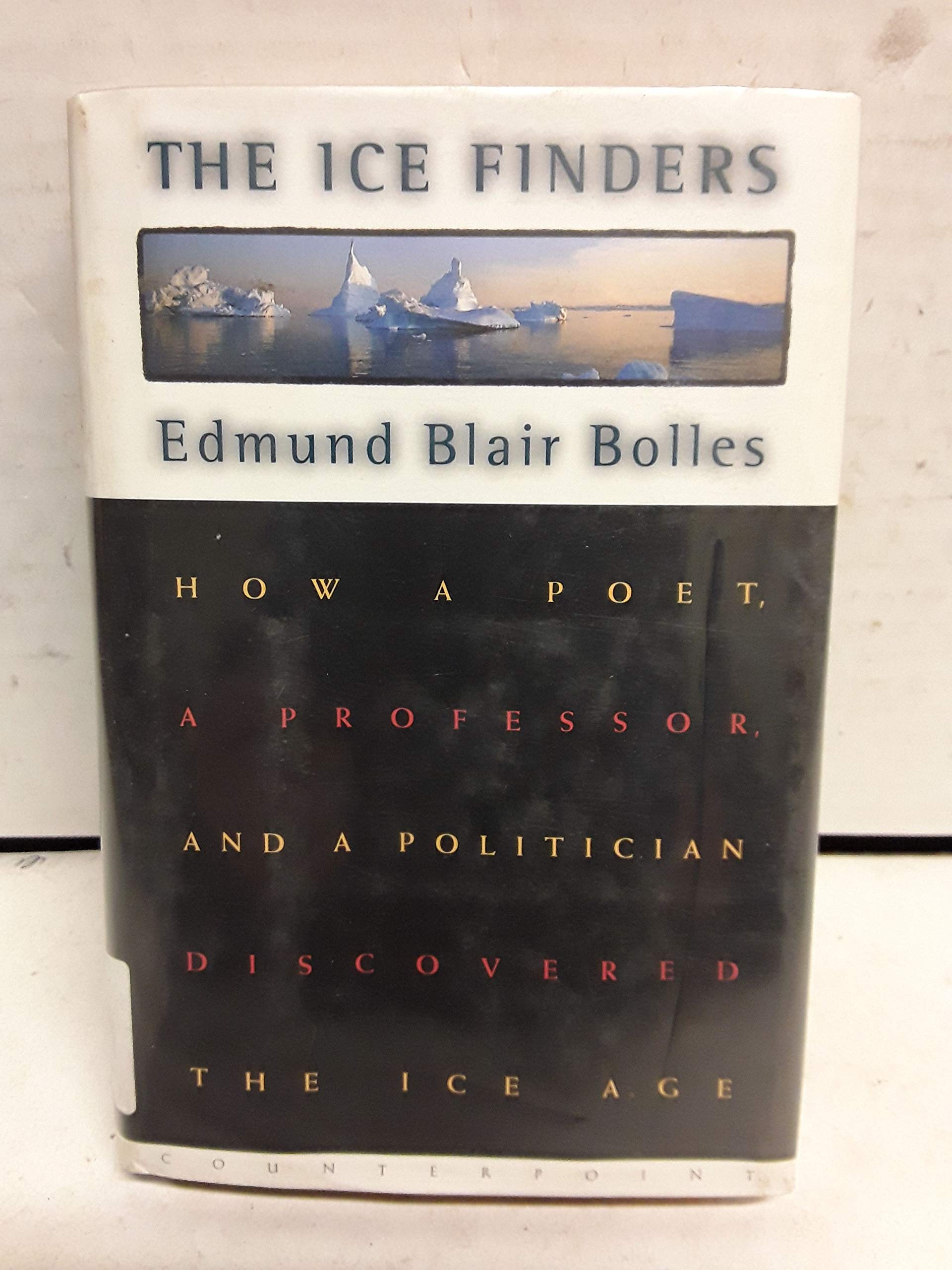
The Ice Finders : How a Poet, a Professor, and a Politician Discovered the Ice Age
$23.99
by Edmund Blair Bolles



Swiss professor Louis Agassiz (1807-73) spent decades arguing that his conception of an Ice Age was not madness. Geologist and master politician Charles Lyell (1797-1875) tried to reconcile his own observations with scientific principles that made an Ice Age impossible. Adventurer and poet Elisha Kent Kane (1820-57) was trapped at the top of Greenland for two winters and portrayed a harsh and frozen landscape that made the Ice Age credible. Bolles, a prolific and popular science writer, tells the tale. Annotation c. Book News, Inc., Portland, OR (booknews.com) Edmund Blair Bolles is investigating a mystery: human creativity. Garbage in, garbage out is the rule for even the most intelligent machines; but with human minds, the rules change. Sometimes the rule is as true for us as for any computer, but every once in a while it's Ignorance in, insight out . The example Bolles looks at is the Ice Age. Nowadays it's familiar to every schoolchild, but this familiarity has dulled our appreciation of just how wild an idea it once was. Earth-girdling floods seemed both reasonable and biblical, volcanoes unusual but not unknown. But a mile-thick sheet of ice covering much of the North Temperate Zone only 20,000 years ago was beyond anyone's experience or imagination. The professor and the politician of Bolles's title are Louis Agassiz and Charles Lyell, two of the most famous geologists of the 19th century. The unusual character in Bolles's story is the poet: Elisha Kent Kane. To call Kane a poet is both over- and understatement: he was a celebrity, a romantic, a self-promoter, a mediocre explorer, and a particularly poor leader of men. He was also a dreamer who tried to find the lost Franklin expedition, and found the far north very different from his (or anyone else's) expectations: "dreams in, nightmares out." Yet it was Kane's bestselling book about his travels that brought the reality of great ice into the minds of laypeople and scientists alike: writes Bolles, "He is the one who made the Ice Age imaginable." --Mary Ellen Curtin For a long time, no one knew that most of the northern and southern hemispheres had once been covered by gigantic ice caps more than a mile thick. In the 1850s, geographers still argued over the possibility of an Open Polar Sea. Bolles, a writer with numerous science books to his credit, attributes the discovery of the Ice Age to three men, each of whom began his quest with wrong notions but put his own theories aside when alternate facts were presented: Louis Agassiz, a Swiss professor who first formulated the Ice Age theory but was considered crazy by other scientists; Charles Lyell, the 19th century's most renowned geologist, who theorized that icebergs were responsible for the geological formations of the past; and Elisha Kent Kane, an adventurer whose ship became trapped in the frozen waters of northern Greenland. It was Kane's poetic descriptions of "great ice," which allowed scientists and lay people to understand the concept of Ice Age glaciation. Exceptionally readable, Bolles's book is on a par with Dava Sobel's Longitude and James Watson's The Double Helix. Highly recommended.AGloria Maxwell, Penn Valley Community Coll. Lib., Kansas City Copyright 1999 Reed Business Information, Inc. Thrilling scenes of arctic winter animate an episodic examination of how 19th-century scientists slowly used circumstantial evidence to conceive of a distant Ice Age. This narrative history from science writer Bolles (A Second Way of Knowing, etc.) aims higher than the sum of its parts. Focusing on, but not limiting, his short summary to the achievements of paleontologist Louis Agassiz, geologist (and mentor of Charles Darwin) Charles Lyell, and American explorer Elisha Kent Kane, Bolles shows that what passed for geology among Europe's learned scientific societies at the beginning of the 19th century were attempts to rationalize Biblical lore. In the 1830s, after making a name for himself as a scientist in an obscure Swiss village, Agassiz, whose German wife eventually left him because he neglected her for his professional obsessions, failed to find fossil evidence of Noah's flood in the debris left by receding glaciers. Scotsman Lyell provoked controversy by proposing that the key to the earth's distant past could be found by observing current natural processes. Across the Atlantic, the naively daring Kane launched a rescue mission to the far north that failed to find the lost Northwest Passage expedition of Sir John Franklin, which had been marooned for two harrowing years in massive glacial ice flows. As these and other speculators make the intuitive leaps necessary to imagine more than half of the earth's surface encased in ice, it's hard not to agree with Bolles that in matters of scientific progress, truth can be an unwelcome intruder that sneaks up on the both the foolish and the foresighted while they're searching for something else. Alternatively dry and gripping, with disorienting