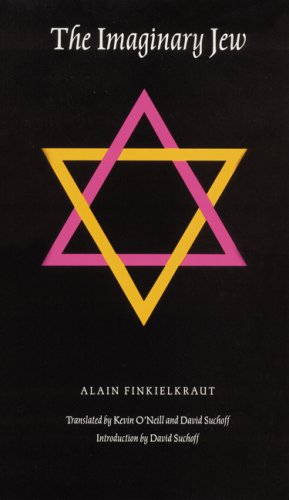



The Holocaust changed what it means to be a Jew, for Jew and non-Jew alike. Much of the discussion about this new meaning is a storm of contradictions. In The Imaginary Jew , Alain Finkielkraut describes with passion and acuity his own passage through that storm. Finkielkraut decodes the shifts in anti-Semitism at the end of the Cold War, chronicles the impact of Israel’s policies on European Jews, opposes arguments both for and against cultural assimilation, reopens questions about Marx and Judaism, and marks the loss of European Jewish culture through catastrophe, ignorance, and cliché. He notes that those who identified with Israel continued the erasure of European Judaism, forgetting the pangs and glories of Yiddish culture and the legacy of the Diaspora. Finkielkraut, one of France's most respected left-wing Jewish intellectuals, originally penned this "autobiographical work of cultural criticism" in 1980 as a meditation on Judaism, modernity, and his own tortuous path through life as an "imaginary Jew," living off a borrowed identity, to a newfound commitment to Jewish memory. Readers of this fine translation may wish that parts of the book had been updated or that a more helpful introduction had been supplied. The volume nevertheless remains valuable not only as a period piece but for its many insights on subjects that range from the contemporary condition of French Jewry to the ongoing significance of Jewish memory. For specialized university libraries. Jonathan D. Sarna, Brandeis Univ., Waltham, Mass. Copyright 1994 Reed Business Information, Inc. In this brilliant commentary on assertions of ethnic identity in the post-Holocaust era, French critic Finkielkraut's primary thesis is that memory of Jewish life before World War II has become so laden with nostalgia that the complexities of the past are no longer considered; as a glaring example of nostalgia overcoming complex reality, Finkielkraut cites the TV series Holocaust (a recent event in Europe when this book was originally published in 1980). Writing in powerful self-examination, Finkielkraut, a postmodern Jew, wonders whether he and his contemporaries now have any actual connections to the realities of the ghettos and shtetls. Another issue he raises is the historic split between Jews who feel the need to assimilate and those who outwardly express their differences from Gentile society. Still another is the connection between much of the anti-Zionism of Finkielkraut's former associates of the Left and prewar anti-Semitism. Although Finkielkraut sets his arguments within the cultural-political context of France, the issues he considers are international, relevant to any heterogeneous society. Aaron Cohen " The Imaginary Jew is brilliant and rueful and bitter at the same time. It shows the joint influence of Sartre and Philip Roth—a combination that only Alain Finkielkraut could bring off."— New Yorker "Finkielkraut’s profoundly personal account of his struggle with Jewish identity is entertaining, witty and . . . unquestionably insightful."— Jewish Chronicle "Finkielkraut is exciting to read; good to think with. He delivers sharp and smart prose. . . . [A] most compelling book."— Voice Literary Supplement Born in Paris in 1949, Alain Finkielkraut is the author of eight books, including The Wisdom of Love (Nebraska 1997). Kevin O’Neill is an associate professor of French at the University of Colorado, Denver. David Suchoff, an associate professor of English at Colby College, is the author of Critical Theory and the Novel: Mass Society and Cultural Criticism in Dickens, Melville and Kafka. Used Book in Good Condition