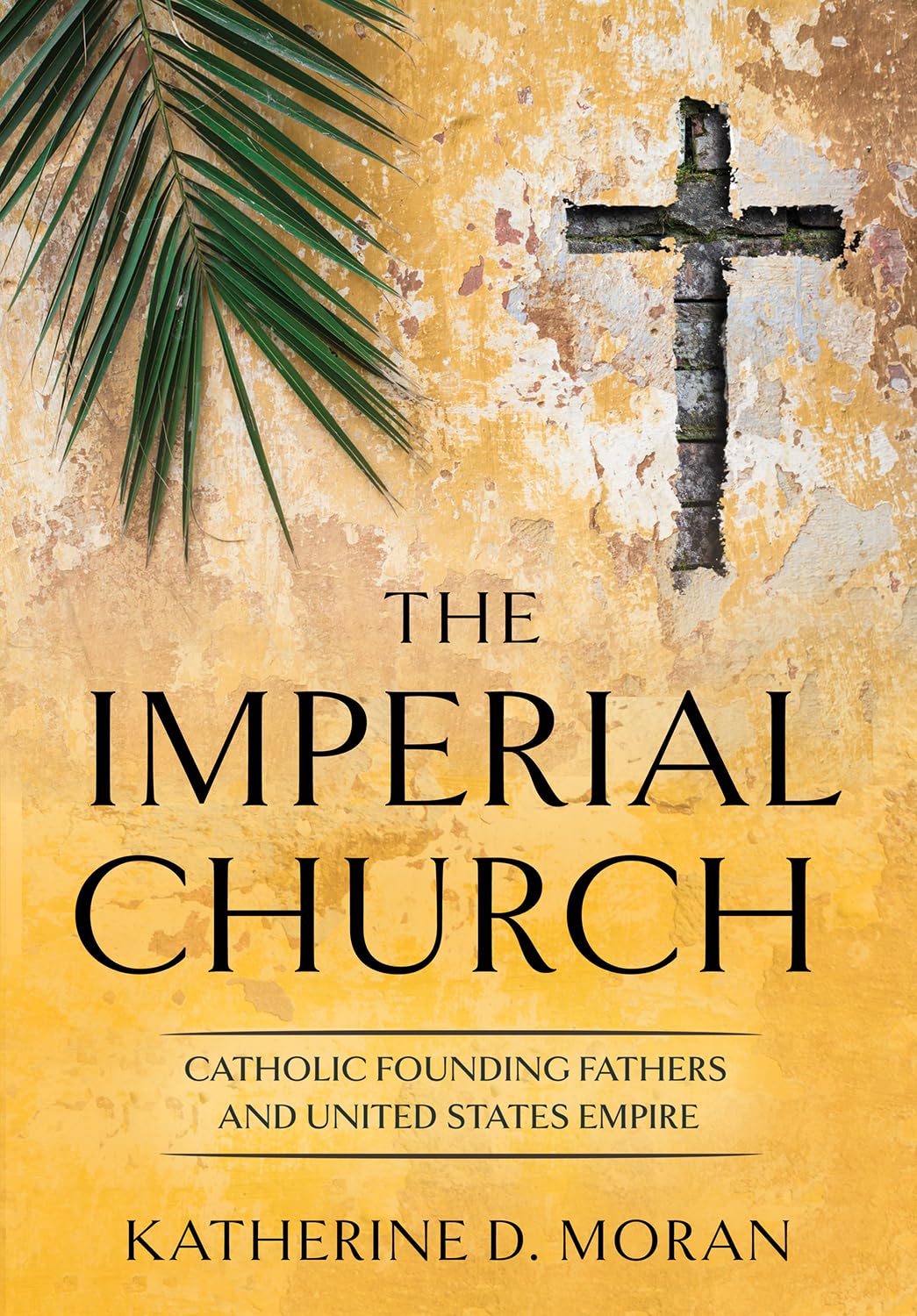
The Imperial Church: Catholic Founding Fathers and United States Empire (The United States in the World)
$35.16
by Katherine D. Moran



Through a fascinating discussion of religion's role in the rhetoric of American civilizing empire, The Imperial Church undertakes an exploration of how Catholic mission histories served as a useful reference for Americans narrating US settler colonialism on the North American continent and seeking to extend military, political, and cultural power around the world. Katherine D. Moran traces historical celebrations of Catholic missionary histories in the upper Midwest, Southern California, and the US colonial Philippines to demonstrate the improbable centrality of the Catholic missions to ostensibly Protestant imperial endeavors. Moran shows that, as the United States built its continental and global dominion and an empire of production and commerce in the Gilded Age and Progressive Era, Protestant and Catholic Americans began to celebrate Catholic imperial pasts. She demonstrates that American Protestants joined their Catholic compatriots in speaking with admiration about historical Catholic missionaries: the Jesuit Jacques Marquette in the Midwest, the Franciscan Junípero Serra in Southern California, and the Spanish friars in the Philippines. Comparing them favorably to the Puritans, Pilgrims, and the American Revolutionary generation, commemorators drew these missionaries into a cross-confessional pantheon of US national and imperial founding fathers. In the process, they cast Catholic missionaries as gentle and effective agents of conquest, uplift, and economic growth, arguing that they could serve as both origins and models for an American civilizing empire. The Imperial Church connects Catholic history and the history of US empire by demonstrating that the religious dimensions of American imperial rhetoric have been as cross-confessional as the imperial nation itself. Moran takes up a task under which other historians of American Catholicism have long labored: turning American historical memory away from East Coast Colonial hegemony and, instead, calling attention to other parts of North America that came to have a formative influence on the American national psyche before and during the American Revolution. She argues that "many American Protestants and Catholics turned to idealized visions of Catholic imperial pasts in order to talk about the past and future of U.S. empire" (p. 20). Succeeding brilliantly in illustrating this sorely needed contribution to the field, Moran's landmark text is a must read for scholarly audiences. ― Choice Katherine Moran has written a landmark book that opens a new era in the historiography of American religion and empir. To a field that long has been eager for new frames and methods of integrating Catholicism into American history―in such a way as to show Catholics as a constituent component of that history, rather than a community of individuals simply living within a Protestant civil society― The Imerial Church is a gift. ― US Catholic Historian Katherine Moran moves beyond examining United States Catholicism through the lens of what has been called the 'immigrant church,' as well the anti-Catholicism connected with this history, by focusing instead on what she calls the 'Imperial Church,' which is also an essential part of the American Catholic story. The Imperial Church should be read by all those engaged in the study of US Catholicism, even if their own scholarly interests have focused on the immigrant church. ― Review for Religious Moran has posed and answered an important historical question. In doing so, she not only demonstrates the plasticity of ideas about Catholicism in a truly revelatory fashion, but she also shows how empire drove religious changes in the American Midwest and elsewhere. This book will surprise readers and it will pique questions that strike at the core of our interpretations of the modern United States and American Catholic history. ― The Annals of Iowa As Katharine Moran reveals in her insightful and captivating new book, American Protestants not only thought about Catholics, they also thought with Catholicism as they sought to extend America's own power and influence across the continent and throughout the globe. ― Church History Beyond national Catholic narratives, The Imperial Church expands American Catholic history alongside American empire to the Philippines in the aftermath of the Spanish-Cuban-American War. Moran challenges historians to rethink how American empire and religion are assumed to interact in this era. ― American Catholic Studies The Imperial Church challenges the notion of the 'Immigrant Church' because, as Moran explains, Catholicism was central to the American concept of empire at that time. By positing the centrality of Catholicism in US imperial rhetoric, Moran shows that Americans did not completely disavow their imperial predecessors (i.e., the Spanish) but rather saw themselves as sharing similar racial and civilizational projects diametrically opposite to the savagery o