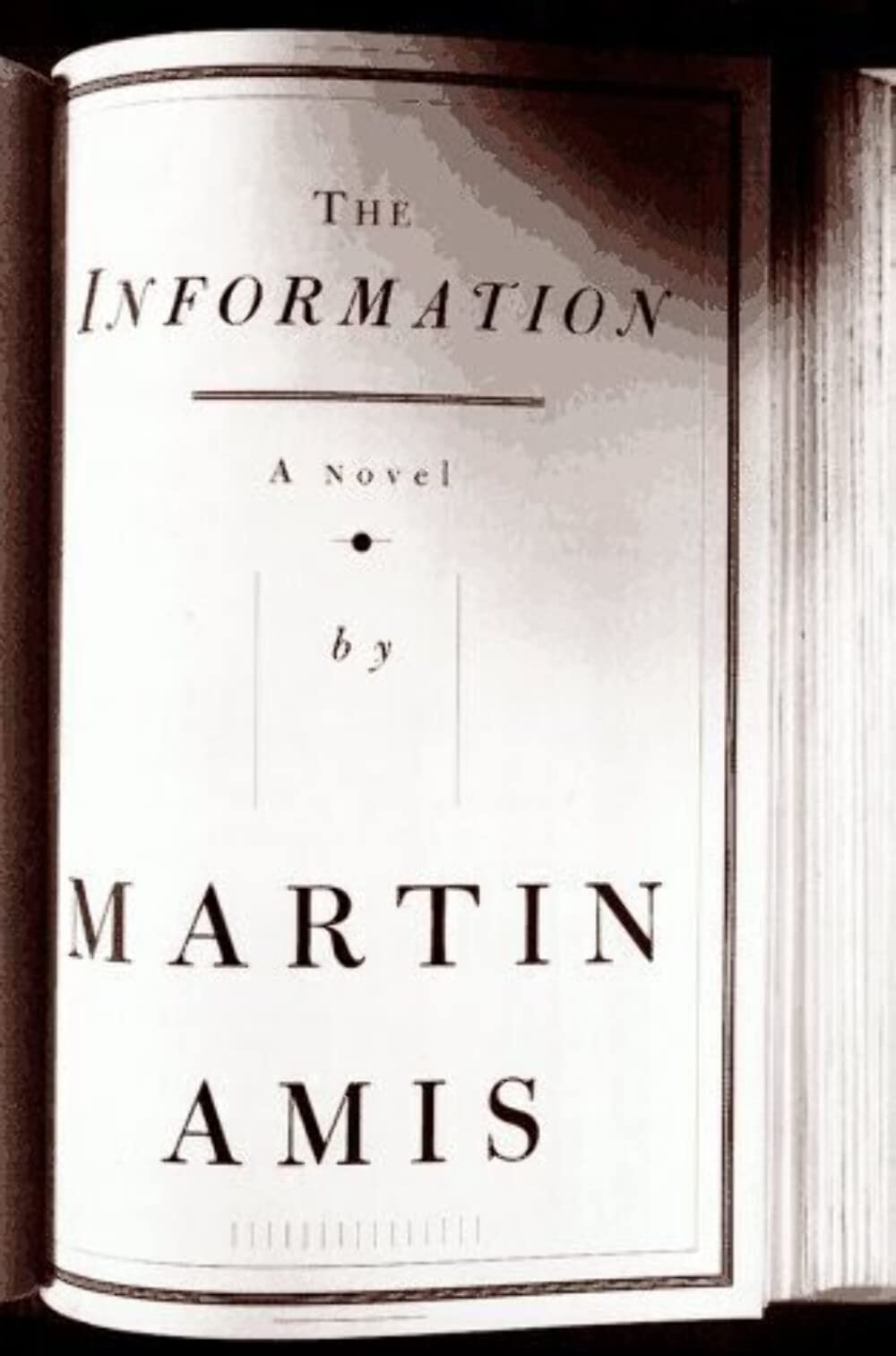



Martin Amis is at his savage best in this magnificent novel of literary envy. In The Information, the best-selling author of London Fields and Time's Arrow has written a totally mesmerizing and thoroughly entertaining novel that puts all of his extraordinary talents on display. "I've always thought of Martin Amis as the literary Mick Jagger of my generation."--Christopher Buckley, Washington Times. Richard Tull, a fortyish book reviewer and failed novelist, is driven to distraction by the effortless and unmerited success of fellow Oxonian Gwyn Barry. While Barry's simpleminded novels become overnight best sellers, Tull's dense experimental manuscripts send a succession of literary agents to the hospital with migraine. Tull finally decides it's payback time, and this novel chronicles his slapstick attempts to annihilate his friend. Amis pads the narrative with irrelevant and sometimes erroneous scientific data, presumably to justify the book's title. (In one astronomical digression, he gives the speed of light as 186,000 miles per hour.) In general, however, this is a wonderfully cantankerous send-up of the British literary scene, similar to David Lodge's satire on academia, Small World (1984). Although the book has been greeted as a roman a clef in Great Britain, no special knowledge is required to enjoy its comedy. Recommended for most fiction collections. -?Edward B. St. John, Loyola Law Sch. Lib., Los Angeles Copyright 1995 Reed Business Information, Inc. What a narrator says of this novel's main character could also be said of Martin Amis, "He didn't want to please the readers. He wanted to stretch them until they twanged." Amis leaves important facts unsaid; fractures plot, setting, and narrators; fragments his thoughts and phrases; and provides the overall experience of multimedia with its juxtaposition, variance, and shifts in emphasis. The most startling quality of the book is how accurately Amis depicts our world: its rapidly changing urban landscape, interior mind-set, and bombardment of exterior stimuli. This is attention deficit disorder. This is push and pull. This is confront, ignore, distract. And Richard, his middle-aged book-reviewer protagonist, is largely sexist, completely alcoholic, and obsessively jealous of his "friend" Gwyn Barry's literary success. Though we may expect back stabbing, adultery, revenge, even physical abuse to exist in big business, politics, celebrity, or crime-ring scenarios, one rarely expects such antics and treachery in the arts. In some ways, Amis reveals a kind of secret. On the other hand, he displays with overwhelming hyperbole a man's middle-aged dilemma: his lust, regret, and necessary testosterone surges. To compete, to win, to destroy become key goals--information serving the cause of whoever wields it. This book is at once amazing, puzzling, and sickening, but its ideas get under your skin, which is no doubt the author's main intention. JoJo March "Mr. Amis is his generation's top literary dog...Dazzling...You're never out of reach of a sparkly phrase, stiletto metaphor or drop-dead insight into the human condition...Mr. Amis goes where other humorists fear to tread...Look out, Flaubert! Look out, Joyce!" -- The New Your Times Book Review "This is Amis' best work to date...Funny, angry, caustic and brilliant." -- The Montreal Gazette "Talent of a very high order...Darkly funny...vastly sophisticated...A particularly ingenious masterpiece of comic plotting." -- The Toronto Star is at his savage best in this magnificent novel of literary envy. In The Information, the best-selling author of London Fields and Time's Arrow has written a totally mesmerizing and thoroughly entertaining novel that puts all of his extraordinary talents on display. "I've always thought of Martin Amis as the literary Mick Jagger of my generation."--Christopher Buckley, Washington Times. Martin Amis is the bestselling author of London Fields, Time's Arrow and Visiting Mrs. Nabokov . Cities at night, I feel, contain men who cry in their sleep and then say Nothing. It's nothing. Just sad dreams. Or something like that . . . Swing low in your weep ship, with your tear scans and your sob probes, and you would mark them. Women-and they can be wives, lovers, gaunt muses, fat nurses, obsessions, devourers, exes, nemeses-will wake and turn to these men and ask, with female need-to-know, "What is it?" And the men say, "Nothing. No it isn't anything really. Just sad dreams." Just sad dreams. Yeah: oh sure. Just sad dreams. Or something like that. Richard Tull was crying in his sleep. The woman beside him, his wife, Gina, woke and turned. She moved up on him from behind and laid hands on his pale and straining shoulders. There was a professionalism in her blinks and frowns and whispers: like the person at the poolside, trained in first aid; like the figure surging in on the blood-smeared macadam, a striding Christ of mouth-to-mouth. She was a woman. She knew so mu