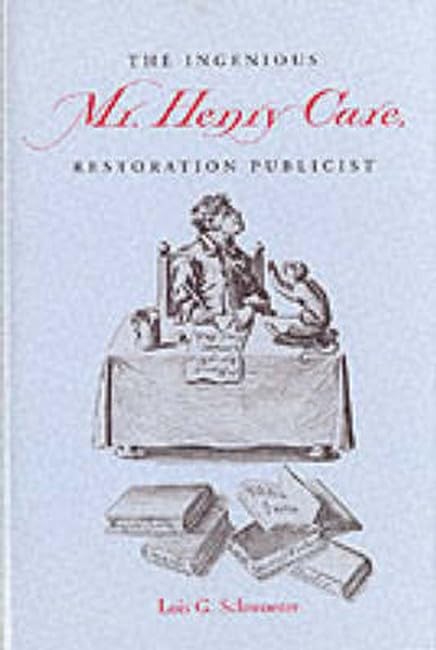



Henry Care (1646-88) was a Restoration publicist from middle-class London who made his living by his skillful pen during the Exclusion Crisis and the reign of King James II. In both eras he developed a large following in the popular press. Although he is little known today, both friends and enemies in his time regarded him as someone to be reckoned with. The Stuart kings also appreciated the influence and potential threat of Care and of the press in general, and they sought to restrain him and to tighten controls on the press, even as they themselves used propagandists to combat both. By exploring Care's life and work from his anonymous origins to his eventual celebrity as a polemicist first for the Whigs and later for James II, and by examining the influence of his ideas in the American colonies, Schwoerer offers new insights into how the nonelite participated in and affected politics. Care's career illuminates many issues currently of interest in the study of Restoration England, including print culture, the uses of law, women's history, attitudes toward religious liberty and toleration, the Exclusion Crisis, and the Revolution of 1688–89. Using Care's life as a window into the period, Schwoerer contributes significantly to the ongoing reevaluation and rethinking of the Restoration. Schwoerer skilfully traces her subject's many interests and the complexities of the society in which he operated, offering her reader accessible discussions of print culture, jurisprudence, and religious controversy... This study of the intriguing career of Henry Care is a valuable contribution to our knowledge of Restoration politics and print culture. (Kate Loveman Royal Stuart Review ) Schwoerer expresses the hope that her study will make a significant contribution to what she sees as the reworking of the Restoration era in recent historiography. In this aim she has certainly succeeded. (Bill Speck History ) [Care's] life is reconstructed with remarkable patience and skill. He emerges from this work as a fascinating and complex character. (Mark Knights Journal of Modern History ) Whether one sees Henry Care as a saint or a rogue, most readers will agree that Schwoerer has made an important addition to our understanding of the role of print and the press in the Restoration. (Victor Stater Albion ) This is an important and interesting book. It is a detailed study of the life and times of Henry Care, who wrote and published at a time when the press was beginning to come into its own as a major force in politics and in shaping public opinion and debate. The book brings a fresh perspective by concentrating on Care and his polemical opponents, and by covering the reigns of both Charles II and James II. Care is an important figure, and the book will attract the interest of Restoration historians in particular, but also seventeenth-century historians more generally. (Tim Harris, Brown University) "This is an important and interesting book. It is a detailed study of the life and times of Henry Care, who wrote and published at a time when the press was beginning to come into its own as a major force in politics and in shaping public opinion and debate. The book brings a fresh perspective by concentrating on Care and his polemical opponents, and by covering the reigns of both Charles II and James II. Care is an important figure, and the book will attract the interest of Restoration historians in particular, but also seventeenth-century historians more generally."Tim Harris, Brown University Lois G. Schwoerer is Elmer Louis Kayser Professor of History Emeritus at the George Washington University. She is the author of The Declaration of Rights, 1689; Lady Rachel Russell: One of the Best of Women; and 'No Standing Armies', all published by Johns Hopkins.