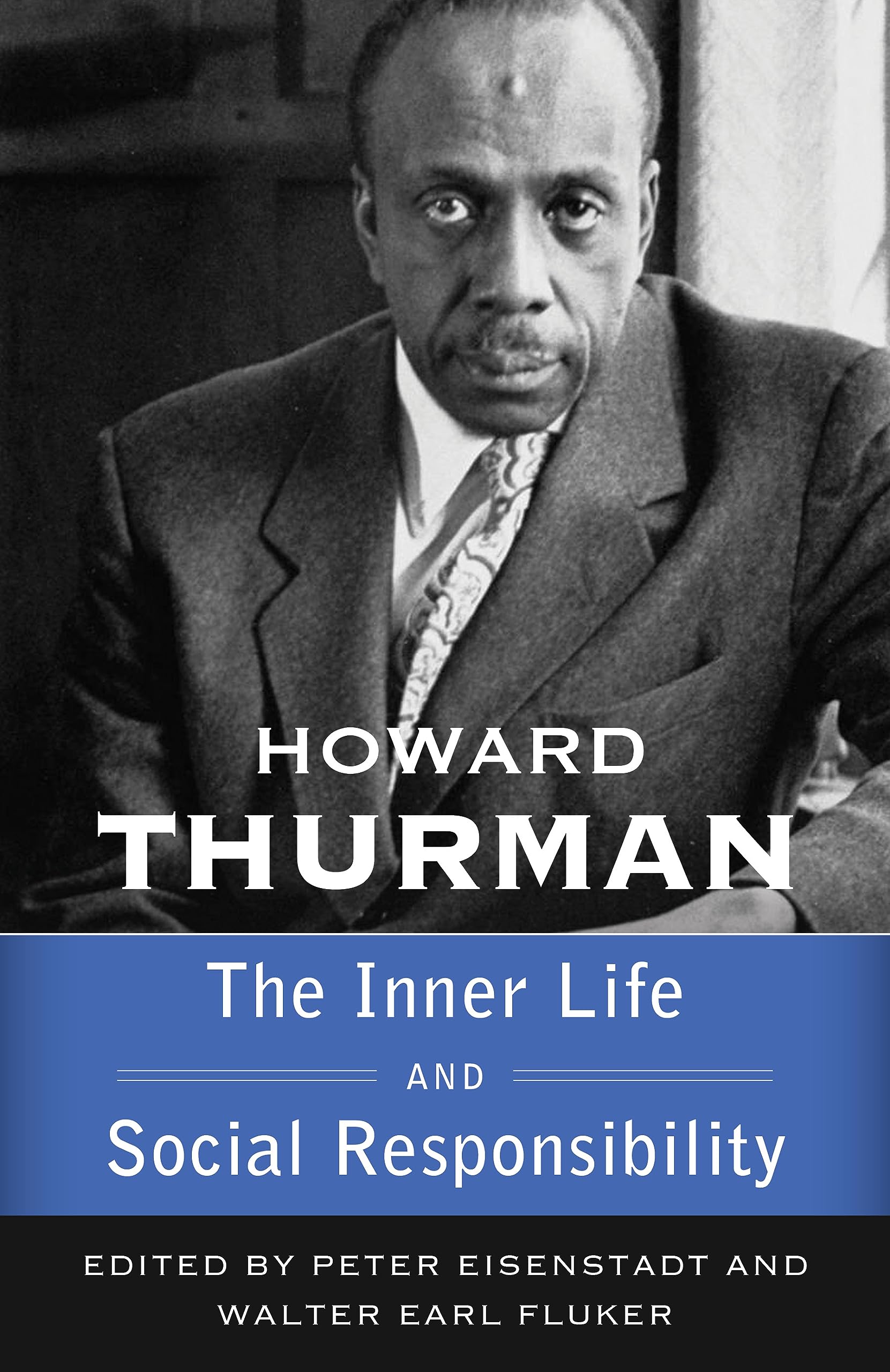
The Inner Life and Social Responsibility (Walking with God: The Sermon Series of Howard Thurman, Volume 4)
$24.23
by Howard Thurman



This final volume of his collected “sermon series,” concerns what is likely the most cherished aspect of Thurman’s thought, his emphasis on meditation, introspection, and self-discovery as the key to the religious life. He often spoke and wrote of his belief in a pervading sense of a divine presence, a presence that existed both within and outside of organized religions and religious institutions and could be found everywhere. But its most important location was within each of us. “Finding [these volumes] of Howard Thurman’s sermons is like finding the first layer of a life-changing archeological discovery―one that shifts your view of your place in the world, along with your understanding of why you are here. Read this book for its historical value or for your own soul’s health. Either way, you will not be disappointed.”― Barbara Brown Taylor, author, Holy Envy and Learning to Walk in the Dark US$30.00 RELIGION / General RELIGION / Spirituality RELIGION / Sermons / Christian Walking with God: The Sermon Series of Howard Thurman, Volume 4 Peter Eisenstadt and Walter Earl Fluker, editors Howard Thurman THE INNER LIFE AND SOCIAL RESPONSIBILITY Howard Thurman (1899-1981) was one of the leading religious thinkers of 20th century America, a mentor to Martin Luther King, Jr., and other leaders of the civil rights movement, and a mystic who pioneered influential innovations in liturgy, worship, and spirituality. Thurman’s interest in politics was always, in the words of Vincent Harding, a quest for “a liberating spirituality, a way of exploring and experiencing those crucial life points where personal and societal transformation are creatively joined.” Here, for the first time in print, are Thurman’s sermon series on the nature of democracy, and American democracy in particular, in which he explores such topics as the meaning of human property in the Declaration of Independence, loyalty oaths and the execution of the Rosenbergs for treason during the Cold War, and the Black Power movement. Throughout these reflections Thurman explores the strivings of the disinherited, how democratic ideals can enhance individual personhood, and how, as individuals and as citizens, we can deal with the conflicts and inherent contradictions of the democratic common ground. Peter Eisenstadt , associate editor of The Papers of Howard Washington Thurman, is author of Against the Hounds of Hell: A Life of Howard Thurman. Walter Earl Fluker , senior editor of The Papers of Howard Washington Thurman and director of the Howard Thurman Papers Project, is Professor Emeritus of Ethical Leadership at Boston University and Dean’s Professor of Spirituality, Ethics, and Leadership at Candler School of Theology, Atlanta, GA. The Quest for Stability I February 6, 1949 Fellowship Church “There is a sense of fear as of some impending doom around the next turning in the road. There seems to be a climate of disaster that does not quite materialize into cataclysmic incident; only a general loss of morale.” If this represented Thurman’s mood in early 1949, he was not alone. It was a feeling of unease widely shared in a postwar America in the early years of the Cold War, a so-called age of anxiety, contributing to what Thurman diagnosed as “a universal urgency for both personal and social stability.”1 Thurman delivered three sermons at Fellowship Church on “The Quest for Stability” that February.2 Thurman began the first of these sermons with the New Testament text, “And you shall know the truth and the truth shall set you free.”3 But truth, he argues, is a “relationship,” not “something fixed and permanent.” The problem with fixed truths is that they often do not take change into account, and can be bitterly hostile to change, and we “are in the midst of worldwide, world-shaking revolutions that affect almost every single aspect of our common life and of our thinking,” revolutions that are “upsetting of age-old supports that have guaranteed the established order.” He gives the example of the end of British India (and implicitly, the gathering worldwide struggle against colonialism and racism). If one’s beliefs are too brittle, Thurman claims, they are liable to “ break down. Then, all the world hath no meaning and there isn’t any validity of any kind of ideals and so I become a person of great instability.” So, Thurman asks, “How can we live with dignity and conviction in a world that is undergoing constant dimensions of shift?” For any dogmatic belief, he suggests, “the time will come when either the individual will have to pull down all the shades and enjoy his darkness―which is his light―or let the content of his belief battle it out in the arena with the content of other beliefs, always maintaining a relationship, a personal relationship, to the validity of the belief-notion.” For Thurman, truth is both rational and sentient, and it is not a thing per se but is rooted in and beyond the constant change and conceptualizations o