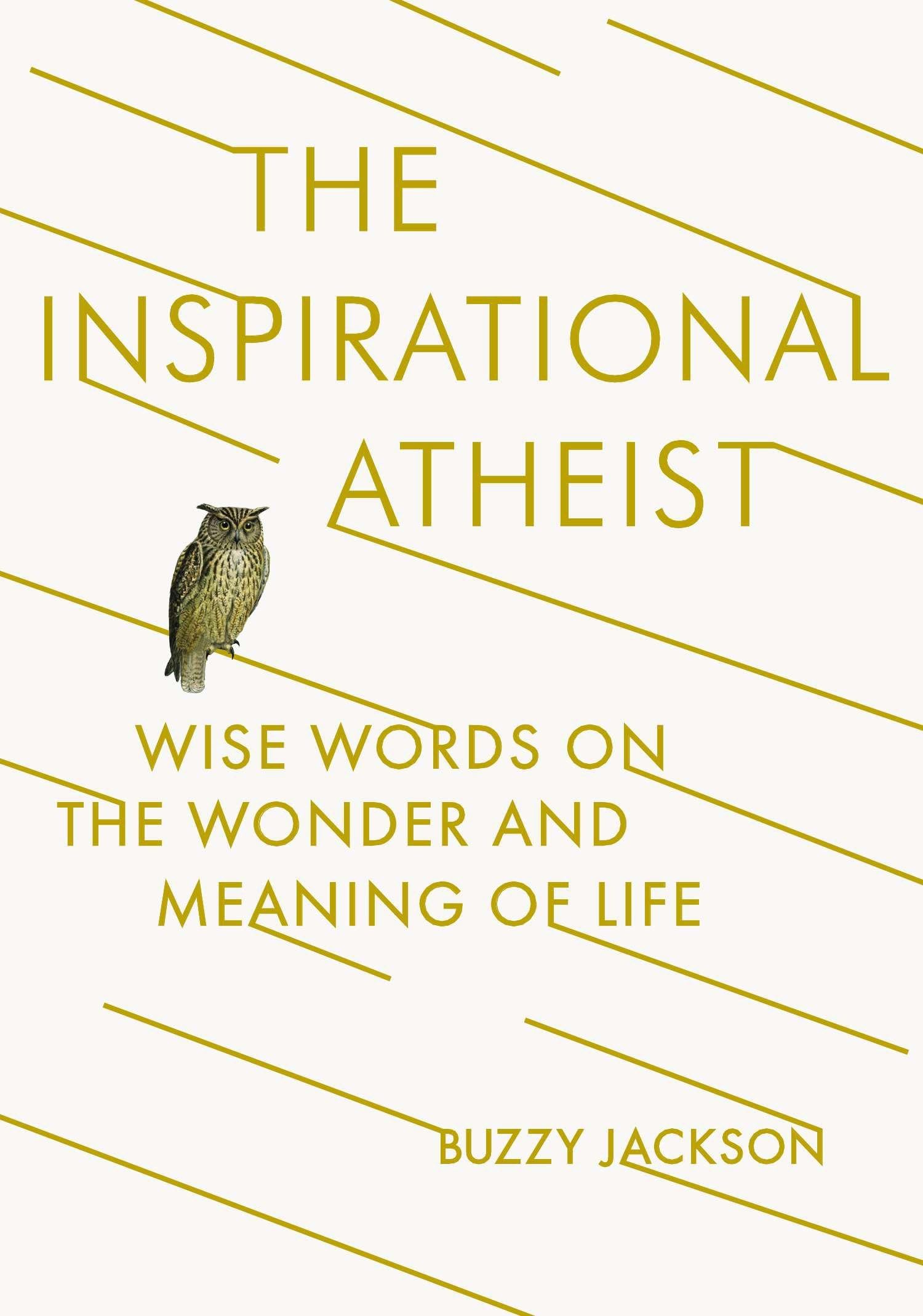
The Inspirational Atheist: Wise Words on the Wonder and Meaning of Life
$10.25
by Buzzy Jackson



Like all people, atheists contemplate issues of love, death, and morality, and in times of stress we long for solace and inspiration. A collection of uplifting quotations from some of mankind’s most important philosophers, scientists, writers, and even comedians, THE INSPIRATIONAL ATHEIST will be a treasured daily companion for the growing demographic of humanists who believe that life has meaning when we live it meaningfully, independent of the existence of a higher power. With words from Carl Sagan, D. H. Lawrence, Julia Child, Douglas Adams, Charlotte Bronte, Bertrand Russell, Ralph Waldo Emerson, George Carlin, Joan Didion, Alfred Lord Tennyson, Thomas Jefferson and dozens of others on topics ranging from Love and Nature to Wisdom and Beauty, this book is a celebration of the sublime without the divine. BUZZY JACKSON has a Ph.D. in History from UC Berkeley and is an award-winning author and a writer for the Boston Globe . For more info, please visit www.BuzzyJackson.com. INTRODUCTION CHICKEN SOUP FOR THE SOULLESS From the mystery of the vast night sky to the sweet return of birdsong in the spring, our universe is filled with wonders we have only just begun to explore and understand. I’ve always found inspiration in the beauty of nature, in relationships with people I love and admire, and in the art and culture of the world around me. And while I’ve discovered plenty of inspiration in libraries and bookstores, it’s never been in the “Inspirational” sections, because amidst all the shelves of “inspirational” books, I never encountered a single one that spoke directly to those of us with a secular outlook. Where, I wondered, was the book that collected and reinforced the feeling of awe we feel contemplating the cosmos and our place in it, our amazement at the puzzle of life itself, for those who are not religious? Where was the motivating quote of the day for nonbelievers? Where, I wondered, was the Chicken Soup for the Soulless ? Here, I hope. We all need a little inspiration now and then—and that includes the atheists, the skeptics, the agnostics, and the “spiritual-but-not-religious” among us. You know who you are: As of 2012, one-fifth of the American public claims no religious affiliation at all, and we’re growing in numbers each year across the Western world. As historian Jennifer Michael Hecht writes, “The earliest doubt on historical record was twenty-six hundred years ago, which makes doubt older than most faiths. Faith can be a wonderful thing, but it is not the only wonderful thing.” The Inspirational Atheist is for the growing population of humanists who believe that life has meaning when we live it meaningfully. Freethinking people are drawn to the secular humanist worldview because of the intellectual freedom and the ethical responsibility it demands. Nonbelievers do not practice kindness because some mythical figure tells us to; we do good because it is the right thing to do. The Inspirational Atheist is a book of wonderful things. And even more than that: a book of hundreds of revelations in which no one goes to Hell. Because there is no Hell. “Things are the way they are in our universe,” wrote astronomer Brian Greene, “because if they weren’t, we wouldn’t be here to notice.” And since we are here and we are able to notice, the effort we make to understand and appreciate our universe is surely one of humanity’s highest callings. We can trace that effort to understand back at least forty thousand years to the prehistoric art of cave paintings. In those handprints and hunting scenes our ancient ancestors first distinguished themselves by choosing to interpret the world around them and not merely survive in it. That spirit of inquiry and irrepressible human curiosity led us tens of thousands of years from the caves of El Castillo and Chauvet to the human-made mountains of the Egyptian pyramids, from the massive force and mysteries of Stonehenge and Easter Island through the doomed frescoes of Pompeii and on to Galileo’s delicate sketches of the moon viewed by telescope for the first time, and eventually to the breathtaking image of Neil Armstrong’s first footprint on the lunar soil in 1969. Those ochre-spattered handprints on dark cave walls point directly to the stark gray footprint on the moon’s Sea of Tranquility, an unbroken line of human creativity and exploration, forty thousand years of seeking to understand the universe and our place in it. And just as those handprints survived tens of thousands of years in the darkness, so our human footprints will remain on the surface of the moon for millions, perhaps billions of years, with no earthly breeze to erase them. The quotations collected here are reflections on this quest and a reminder of that journey. What has always set freethinkers apart is their willingness to see the world as it is, not as they wish it to be. And it is this courage and this tradition of truth seeking that are responsible for humanity’s singular stature on