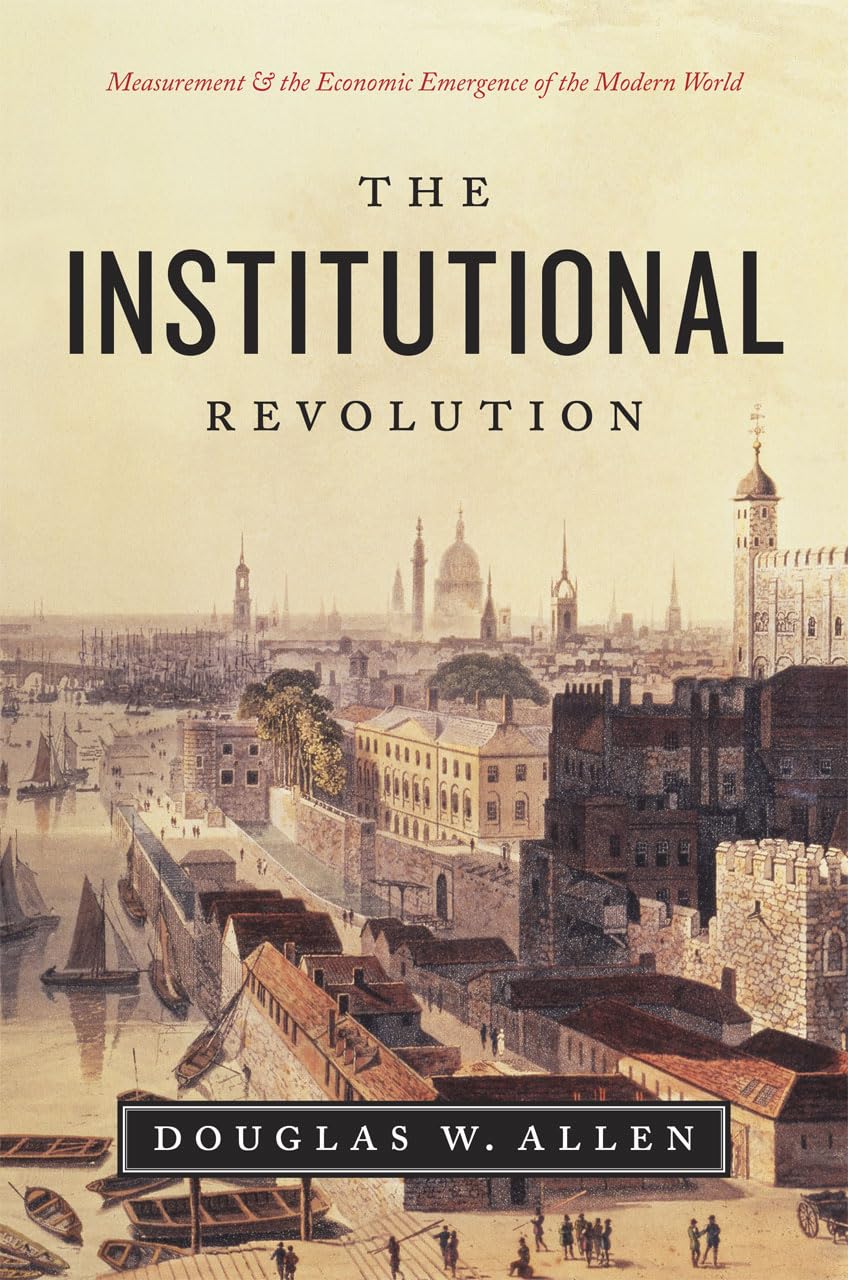
The Institutional Revolution: Measurement and the Economic Emergence of the Modern World (Markets and Governments in Economic History)
$33.00
by Douglas W. Allen



Few events in the history of humanity rival the Industrial Revolution. Following its onset in eighteenth-century Britain, sweeping changes in agriculture, manufacturing, transportation, and technology began to gain unstoppable momentum throughout Europe, North America, and eventually much of the world—with profound effects on socioeconomic and cultural conditions. In The Institutional Revolution, Douglas W. Allen offers a thought-provoking account of another, quieter revolution that took place at the end of the eighteenth century and allowed for the full exploitation of the many new technological innovations. Fundamental to this shift were dramatic changes in institutions, or the rules that govern society, which reflected significant improvements in the ability to measure performance—whether of government officials, laborers, or naval officers—thereby reducing the role of nature and the hazards of variance in daily affairs. Along the way, Allen provides readers with a fascinating explanation of the critical roles played by seemingly bizarre institutions, from dueling to the purchase of one’s rank in the British Army. Engagingly written, The Institutional Revolution traces the dramatic shift from premodern institutions based on patronage, purchase, and personal ties toward modern institutions based on standardization, merit, and wage labor—a shift which was crucial to the explosive economic growth of the Industrial Revolution. “I thoroughly enjoyed this excellent book.” -- Tyler Cowen ― Marginal Revolution Published On: 2011-08-15 "What are the connections among aristocrats, duels, private lighthouses and private police forces in the conduct of early modern economies? Douglas W. Allen in The Institutional Revolution brings together a whole series of customs and behaviors we now associate with irrational premodern practices and shows the part they played as informal institutions to ensure the provision of civil service goods before the nineteenth century." ― Times Literary Supplement Published On: 2012-10-26 “In 1910, J. H. Clapham memorably described the industrial revolution as a ‘thrice squeezed orange.’ Yet writing more than a century later, Douglas W. Allen has written a brilliant and enjoyable book that shows there is still plenty of juice left in this orange. With The Institutional Revolution , Allen provides a stimulating microeconomic reinterpretation of English economic development in the period between 1780 and 1850. The range of reading, the quality of the analysis, the elegance of the writing, and the lightness of touch displayed by Allen are all extremely impressive.” -- Graham Brownlow ― Economic History Review Published On: 2012-12-15 “Douglas W. Allen has written a brilliant and challenging book that puts the measurement problem in the foreground to convincingly explain the logic of premodern institutions—institutions that the typical modern person, until reading Allen, views as the embodiment of chaos, inefficiency, corruption, and ineptitude. The Institutional Revolution contains a wealth of historical information that anyone with an interest in history will find interesting and often delightful.” -- Thráinn Eggertsson, New York University “This is a very important book that increases understanding of how changes in measurement and institutions can increase trade and welfare. Allen uses economic logic to show that quaint premodern institutions—including the social rules of the old aristocracy, and the practice of dueling—aligned incentives at a time when variance in outcomes due to the enormous effects of nature could not easily be separated from those due to human behavior. Especially interesting is his insight into how the industrial and institutional revolutions in Britain developed interactively. This wonderful book sets the groundwork for further essential investigation into the micro foundations of specific institutional changes and economic growth, topics that are at the forefront of modern efforts to increase welfare.” -- Gary D. Libecap, University of California, Santa Barbara Published On: 2011-08-15 “In the early modern period, British aristocrats engaged in a panoply of seemingly inefficient activities. They owned grandiose, high-maintenance estates. . . . They refused to engage directly in any commercial activity and spent their hours cultivating demanding but seemingly useless skills like, music, dancing, repartee, and Latin conjugations. Yet, despite these apparently wealth-destroying behaviors, aristocrats grew wealthy, often astoundingly wealthy. As Allen asks in his marvelous book, ‘what economic puzzle were they solving in order to generate this wealth?’ . . . A milestone in the New Institutional Economics." -- Richard N. Langlois, Review of Austrian Economics Douglas W. Allen is the Burnaby Mountain Professor of Economics at Simon Fraser University in Canada. He is the author of numerous books, including The Nature of the Farm: Contract