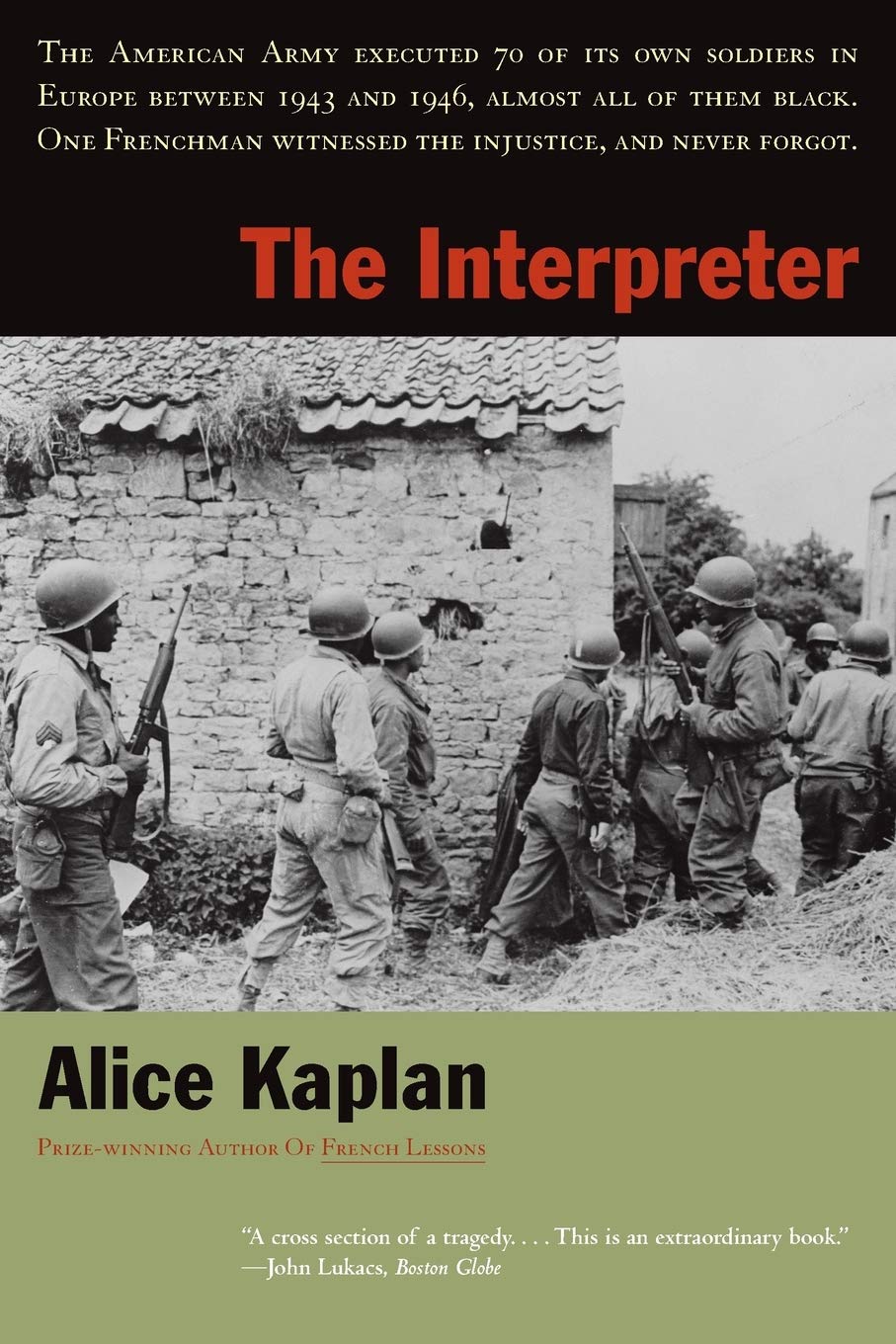



No story of World War II is more triumphant than the liberation of France, made famous in countless photos of Parisians waving American flags and kissing GIs as columns of troops paraded down the Champs Élysées. But one of the least-known stories from that era is also one of the ugliest chapters in the history of Jim Crow. In The Interpreter , celebrated author Alice Kaplan recovers this story both as eyewitnesses first saw it, and as it still haunts us today. The American Army executed 70 of its own soldiers between 1943 and 1946—almost all of them black, in an army that was overwhelmingly white. Through the French interpreter Louis Guilloux’s eyes, Kaplan narrates two different trials: one of a white officer, one of a black soldier, both accused of murder. Both were court-martialed in the same room, yet the outcomes could not have been more different. Kaplan’s insight into character and setting creates an indelible portrait of war, race relations, and the dangers of capital punishment. “A nuanced historical account that resonates with today’s controversies over race and capital punishment.” Publishers Weekly “American racism could become deadly for black soldiers on the front. The Interpreter reminds us of this sad component of a heroic chapter in American military history.” Los Angeles Times “With elegance and lucidity, Kaplan revisits these two trials and reveals an appallingly separate and unequal wartime U.S. military justice system.” Minneapolis Star Tribune “Kaplan has produced a compelling look at the racial disparities as they were played out…She explores both cases in considerable and vivid detail.” Sacramento Bee “Impressive…The very precision and extent of her research suggest an author whose dedication to her theme amounts to much more than an intent to document her acquaintance and proper use of archival sources. This is an extraordinary book.”—John Lukacs, Boston Globe -- John Lukacs ― Boston Globe “A brilliant account. . . . Inventive, moving, and beautifully written, this is a major contribution to investigative history. Highly recommended.” -- Anthony Edmunds ― Library Journal “A nuanced historical account that resonates with today’s controversies over race and capital punishment.” ― Publishers Weekly “American racism could become deadly for black soldiers on the front. . . . The Interpreter reminds us of this sad component of a heroic chapter in American military history.” -- Michael S. Roth ― Los Angeles Times “With elegance and lucidity, Kaplan revisits these two trials and reveals an appallingly separate and unequal wartime U.S. military justice system.” ― Minneapolis Star Tribune "A highly readable introduction to the underside of Allied/French relations at the Liberation." -- Hilary Footitt ― Modern & Contemporary France “Compelling. . . . [Kaplan] manages to weave a human story. . . . The two cases are so very different, however, that the conclusions Kaplan reaches appear somewhat tenuous.” -- Jon Latimer ― Times Literary Supplement Published On: 2008-04-18 "A fascinating analysis of soldiers, lawyers, commanders, and racial conditions in the Brittany area of France after the Normandy invasion. . . . Kaplan researches and writes well in creating a powerful book." -- Alan M. Osur ― Military History Alice Kaplan is the Sterling Professor of French at Yale University. She is coauthor of States of Plague , with Laura Marris, and author of French Lessons, The Collaborator, Looking for “The Stranger,” and Dreaming in French , all also published by the University of Chicago Press. She has been a finalist for both the National Book Critics Circle Award and the National Book Award. She lives in Guilford, Connecticut. The Interpreter By Alice Kaplan University of Chicago Press Copyright © 2007 Alice Kaplan All right reserved. ISBN: 9780226424255 Chapter One: Plumaudan At dawn on November 24, 1944, the day after Thanksgiving, a two-and-a-half-ton American Army truck made its way from the Disciplinary Center at Le Mans to Plumaudan, Brittany. Its destination: an abandoned château down the road from the village church. The Army had chosen one of Plumaudan's only imposing structures for the ceremony. Château la Vallée was a fourteenth-century manor house, deserted for years, with rickety stone walls and gaping holes where windows had been, a round tower, a lower square building facing the road into the village, and a courtyard the size of a baseball field. There in the courtyard, a group of Military Police unloaded their kit: large pieces of wood, slats, steps, a crossbar for the rope. The sky over Plumaudan was relentlessly gray that Friday morning and it looked like it might never stop raining. There was a wet chill in the air, the kind that goes straight to your bones -- a prelude to the coming winter, so bitter cold it would freeze the rivers. The villagers awoke to the sounds of hammering. The mayor h