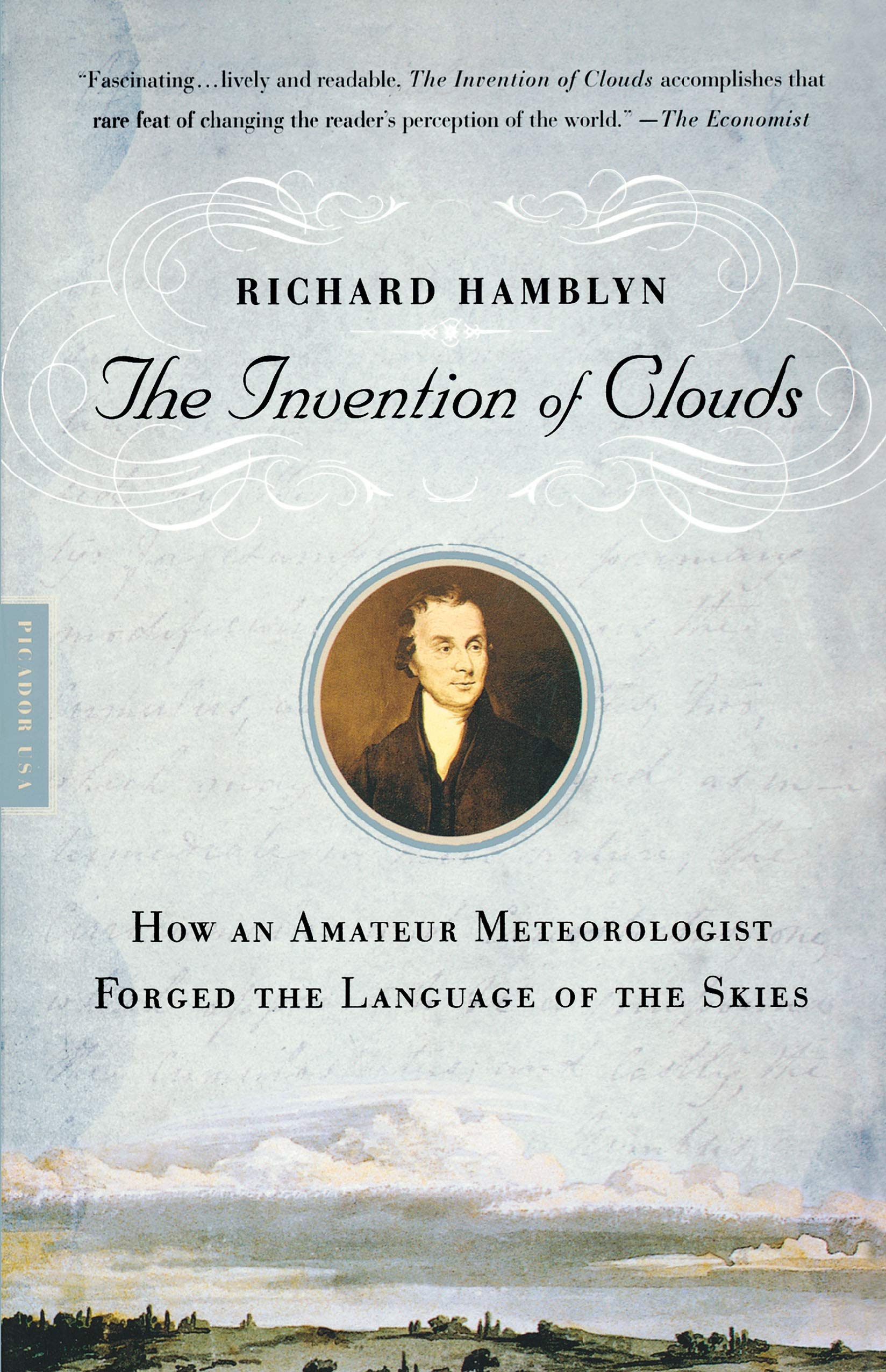
The Invention of Clouds: How an Amateur Meteorologist Forged the Language of the Skies
$11.94
by Richard Hamblyn



Winner of the Los Angeles Times Book Prize The early years of the nineteenth century saw an intriguing yet little-known scientific advance catapult a shy young Quaker to the dizzy heights of fame. The Invention of Clouds tells the extraordinary story of an amateur meteorologist, Luke Howard, and his groundbreaking work to define what had hitherto been random and unknowable structures―clouds. In December 1802, Luke Howard delivered a lecture that was to be a defining point in natural history and meteorology. He named the clouds, classifying them in terms that remain familiar to this day: cirrus, stratus, cumulus, and nimbus. This new and precise nomenclature sparked worldwide interest and captured the imaginations of some of the century's greatest figures in the fields of art, literature, and science. Goethe, Constable, and Coleridge were among those who came to revere Howard's vision of an aerial landscape. Legitimized by the elevation of this new classification and nomenclature, meteorology fast became a respectable science. Although his work is still the basis of modern meteorology, Luke Howard himself has long been overlooked. Part history of science, part cultural excavation, The Invention of Clouds is a detailed and informative examination of Howard's life and achievements and introduces a new audience to the language of the skies. “Fascinating . . . lively and readable, The Invention of Clouds accomplishes that rare feat of changing the reader's perception of the world.” ― The Economist “Beguiling . . . Hamblyn has drawn a vivid portrait of the rage for science that flourished in England early in the century.” ― The New York Times “This beguiling book is as eccentric as its subject, exploring not just Howard and his ensuing fame, but also the artistic, scientific, and intellectual atmosphere of the early nineteenth century . . . Endearing.” ― The Arizona Republic “A beautifully written book.” ― Forbes “An enthusiastic account . . . packed with fascinating trivia.” ― Entertainment Weekly “A grand story.” ― Scientific American “A fascinating peek into a time when people not only paid to hear scientific and philosophical lectures, but cheered loudly and enthusiastically at them.” ― The Atlanta Journal-Constitution “ The Invention of Clouds is the true story of a shy young Quaker, Luke Howard, and his pioneering work to define what had been random and unknowable: clouds . . . Although his work is still the basis of modern meteorology, Howard himself has been overlooked. Richard Hamblyn's concise work--party history of science, party cultural evocation--is a detailed and informative examination of Howard's life.” ― Physical Sciences Digest Richard Hamblyn was born in 1965 and is a graduate of the universities of Essex and Cambridge, where he wrote a doctoral dissertation on the early history of geology in Britain. He lives and works in London. The Invention of Clouds How an Amateur Meteorologist Forged the Language of the Skies By Richard Hamblyn Picador USA Copyright © 2002 Richard Hamblyn All right reserved. ISBN: 9780312420017 Chapter One The Theater of Science Science, illuminating ray! Fair mental beam, extend thy sway, And shine from pole to pole! From thy accumulated store, O'er every mind thy riches pour, Excite from low desires to soar, And dignify the soul. Sarah Hoare, 1831 It might seem difficult to imagine now, in this era of cool detachment, but in theopening years of the nineteenth century people cheered loudly at lectures. Whilefiling through the doors into a lamplit hall, upon the arrival of the speaker and hismercurial props, or at signal moments of disclosure and display, audiences foundopportunities to make themselves heard. It mattered little whether the speaker was amechanic, a meteor zealot, or simply an amateur showman on a mission to explain.Anyone with confidence and good vocal projection could arrange to appear at oneof the endless assemblies of paying spectators that were springing up fast throughoutthe expanding cities of Europe and North America. The full range of the philosophical shows and diversions available to audiencesat the turn of the nineteenth century was various and impressive, particularlyin the towns and cities of Britain, and especially in London, where there was nothingisolated or unusual about a lecture such as Howard's on the clouds. As eveningfell, the crowds assembled and the revelations began to unfold. And what a cast ofrevelations they were: every animal, vegetable, and mineral known to man, samplesof all four elements, and challenges to all six senses, not to mention machines, inventions,and novelties of every kind, were regularly paraded before the eyes of anastonished and insatiable public. There were demonstrations of fireworks, hydraulics,magnetics, and mathematics. There were machines to show the revolutionsof the planets, the eruptions of volcanoes, or the hidde