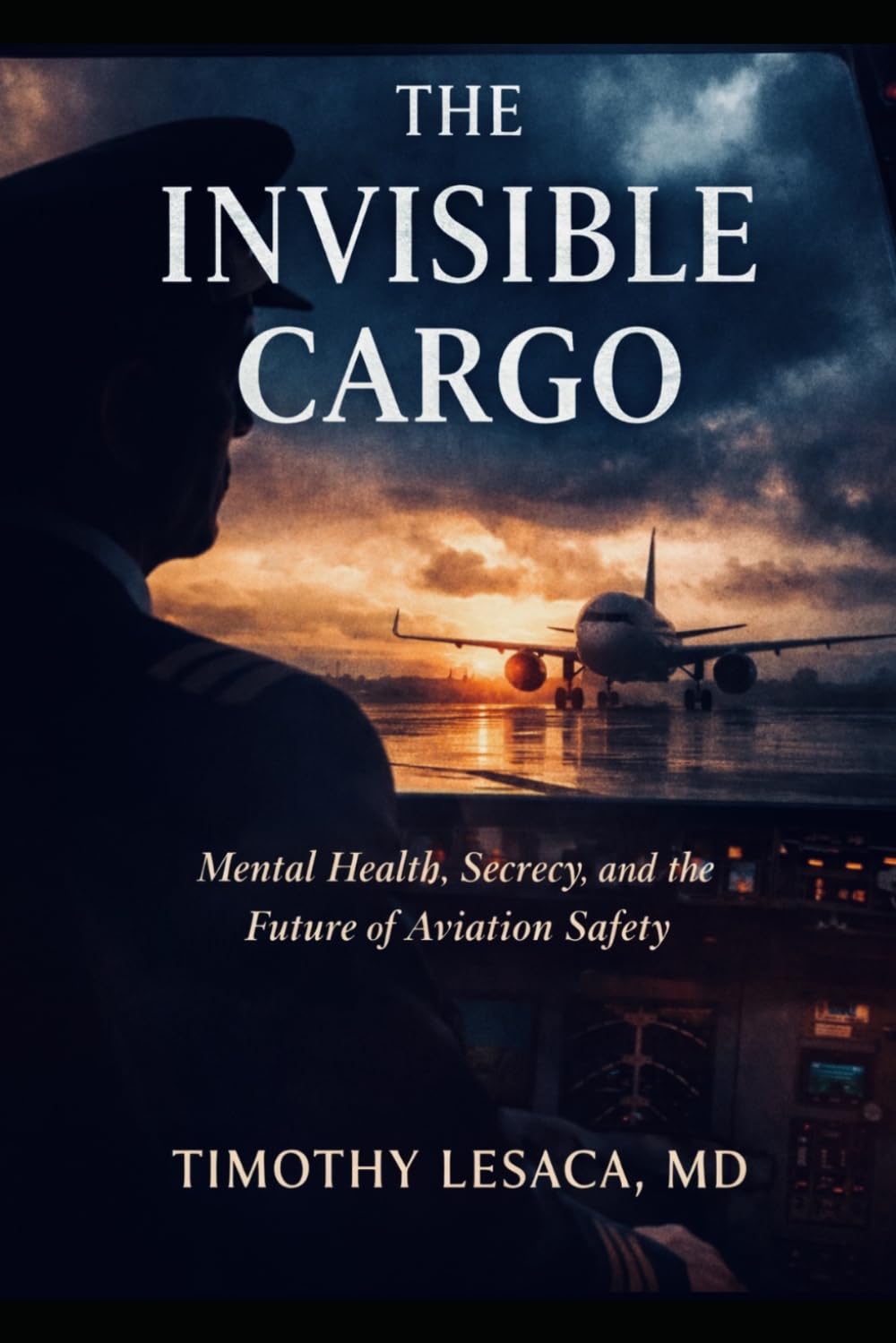
The Invisible Cargo: Mental Health, Secrecy, and the Future of Aviation Safety
$4.60
by Timothy Lesaca MD



The Invisible Cargo Mental Health, Secrecy, and the Future of Aviation Safety By Timothy Lesaca, MD Commercial aviation is one of the safest systems ever built—an achievement grounded in engineering precision, rigorous training, and a relentless commitment to learning from failure. Yet even the most advanced safety systems have blind spots. Some risks are visible, measurable, and correctable. Others remain hidden until it is too late. The Invisible Cargo examines one of aviation’s most difficult and consequential challenges: the role of mental health in safety-critical professions. Drawing on major accidents, emerging research, and decades of clinical insight, psychiatrist Timothy Lesaca, MD, explores how psychological distress—often private, often concealed—can become an operational risk within a system that depends on honest self-reporting. At the center of the book is a troubling contradiction. Aviation requires pilots and other professionals to disclose when they are unfit to perform, yet the personal and professional consequences of that disclosure can be uncertain, costly, and, at times, career-defining. In such an environment, silence is not simply stigma. It can become a rational response. Through careful analysis of cases including Germanwings Flight 9525 and other contested or confirmed events, Lesaca moves beyond individual pathology to examine the structure surrounding these tragedies: fragmented medical oversight, economic pressure, cultural expectations of composure, and the limits of post-accident investigation. He shows how even well-intentioned systems—designed to protect privacy, enforce standards, and maintain public confidence—can inadvertently discourage early help-seeking. But The Invisible Cargo is not a book about catastrophe alone. It is a book about prevention. Lesaca argues that aviation safety depends not only on technical reliability, but on the conditions under which people are willing to tell the truth about themselves. He examines fatigue, burnout, work design, and the psychological realities of modern aviation work, extending the discussion beyond pilots to include the broader aviation workforce. The result is a shift in perspective: mental health is not a peripheral wellness issue, but a core element of operational safety. The book also addresses the reforms now underway. Regulators, researchers, and industry leaders are beginning to recognize that improving safety requires more than stricter rules—it requires systems that make early disclosure realistic, treatment accessible, and return to duty both fair and efficient. Peer support programs, risk-based certification pathways, and evolving regulatory approaches represent meaningful progress, but significant cultural and structural barriers remain. Written with clarity, restraint, and respect for both the profession and the public it serves, The Invisible Cargo offers a sober and humane account of a problem aviation can no longer afford to ignore. It challenges the industry to move beyond silence and toward a model of safety in which honesty is not punished, but made possible. Because in a system that depends on trust, the most dangerous risk is not what is known—it is what remains hidden.