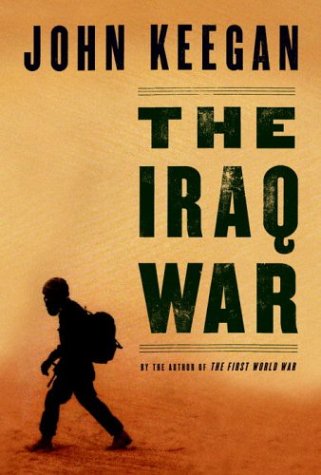



Author of the acclaimed The Face of Battle , and, most recently, Intelligence in War , John Keegan now brings his extraordinary expertise to bear on perhaps the most controversial war of our time. The Iraq War is an urgently needed, up-to-date and informed study of the ongoing conflict. In exclusive interviews with Secretary of Defense Donald Rumsfeld and General Tommy Franks, Keegan has gathered information about the war that adds immeasurably to our grasp of its causes, complications, costs and consequences. He probes the reasons for the invasion and delineates the strategy of the American and British forces in capturing Baghdad; he examines the quick victory over the Republican Guard and the more tenacious and deadly opposition that has taken its place. He then analyzes the intelligence information with which the Bush and Blair administrations convinced their respective governments of the need to go to war, and which has since been strongly challenged in both countries. And he makes clear that despite the uncertainty about weapons of mass destruction, regime change, and the use and misuse of intelligence, the war in Iraq is an undeniably formidable display of American power. The Iraq War is authoritative, timely and vitally important to our understanding of a conflict whose full ramifications are as yet unknown. John Keegan is recognized as one of the top military writers of his day, having authored comprehensive analyses of both World Wars and other significant historical events. In The Iraq War , he takes on a situation that was still murky and volatile at the time of publication. The result is a book rich with detailed information on the region and its key figures but somewhat hasty in its effort to provide a succinct history lesson. In the opening chapter, Keegan writes "The war was not only successful but peremptorily short, lasting only twenty-one days from 20 March to 9 April," and he later gives little mention to the protracted and amorphous violence in the region since Baghdad fell, characterizing as "aftermath" that which many see as the actual war itself. Between these sections, however, Keegan provides valuable insight into the geopolitical history of the region and provides an extensive biography of a ruler of whom most Westerners became aware only in the early 1990s: Saddam Hussein. Keegan presents Saddam as a brutal thug who is also possessed of a powerful and vicious political savvy, and charts his growth from Ba'ath Party muscleman to ruler of Iraq. Sections on the military efforts of the U.S. and British forces are extensively detailed and offer insight into not only what the plans of the coalition forces were but the strategic philosophies behind them as well. Keegan characterizes the war as "mysterious," seeking to understand why opposition forces seemed to disappear from active combat and why the citizens of Iraq paid the conflict little regard. And while such mysteries have not yet been solved, it is clear given the ongoing instability in Iraq that the final chapters of the Iraq War have yet to be written. --John Moe Keegan has long been revered as a brilliant military historian with a gift for recounting the individual experiences of battle while simultaneously explaining broader strategic objectives. However, this compact and superbly written work is not strictly a military history of "Operation Iraqi Freedom." Approximately half of the narrative focuses on the creation and evolution of the modern Iraqi state in the twentieth century. Keegan makes the compelling argument that Iraq, traditionally divided along religious, ethnic, and tribal lines, has never been a nation in the usually accepted sense of the term. The unity of Iraq has been maintained at gunpoint. The portrait here of Hussein is both fascinating and chilling, the author capturing the aura of paranoia and grandiose fantasy with which he surrounded himself. Keegan offers some tantalizing tidbits on the diplomatic maneuvers as Washington moved toward war, and the Bush administration strived to patch together a "coalition." He describes the war itself with his usual elan and skill, drawing striking differences between this campaign and the Gulf War. As Keegan shows, in some areas the Iraqi military virtually melted away. Unfortunately, as we now see on a daily basis, many of their small arms either went with them or fell into the hands of more committed fighters. Essential reading for understanding the ongoing conflict. Jay Freeman Copyright © American Library Association. All rights reserved “The best military historian of our generation.” —Tom Clancy “While it is difficult to examine any on-going conflict in a vacuum, there will come a day when the battles stand alone. When that day comes, Keegan’s book will be judged the first and best on the subject.” — Calgary Sun “A brief outline that is authoritative (at least until further details will be known) and is more on the state of affairs on the other s