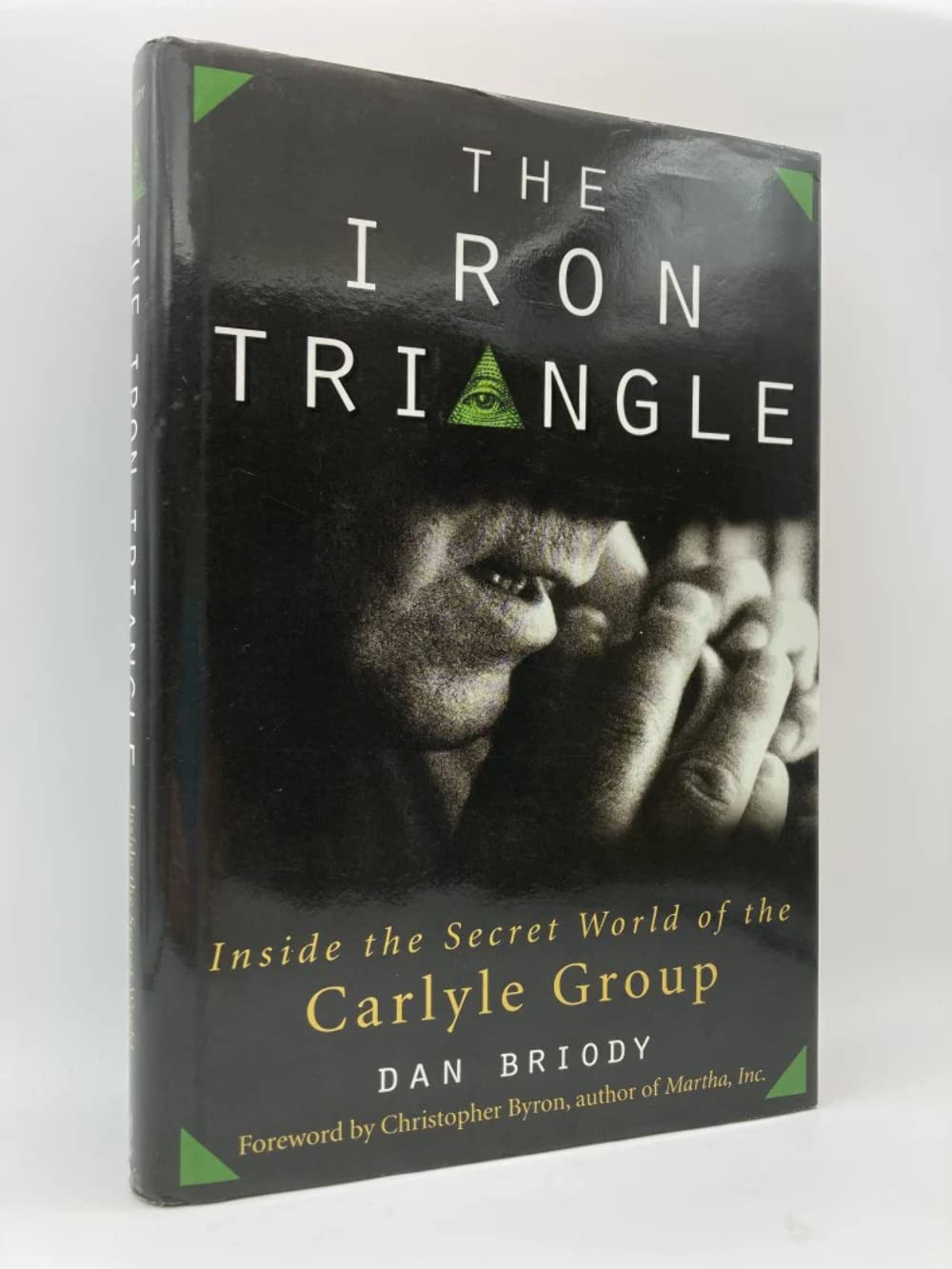



A penetrating look at the company at the nexus of big business, government, and defense The Carlyle Group is one of the largest private equity firms in the world with over $13 billion in funds. Carlyle's investments include everything from defense contractors to telecommunications and aerospace companies. But there is more to this company than meets the eye. Carlyle's executives include heavyweights from the worlds of business and politics, such as former secretary of defense and CIA deputy director Frank Carlucci, former secretary of state James Baker III, former President George Bush, former UK Prime Minister John Major, and former chairman of the SEC Arthur Levitt. Osama Bin Laden's estranged family was personally invested in the group until recently. In The Iron Triangle, journalist Dan Briody examines a company at the nexus of big business, government, and defense that, according to some sources, epitomizes corporate cronyism, conflicts of interest, and war profiteering. This fascinating examination leads readers into a w orld that few can imagine-full of clandestine meetings, quid pro quo deals, bitter ironies, and pettyjealousies. And the cast of characters includes some of the most powerful men in the world. Strap in, because this ride could get a little bumpy. Dan Briody (New York, NY) is an award-winning business journalist whose Red Herring article "Carlyle's Way" broke the story on the inner workings of the Carlyle Group. Briody has appeared on numerous radio and television programs covering the Carlyle Group and has become a primary source for other journalists covering this story. Briody's articles have appeared in Forbes, Red Herring, and the Industry Standard. “…strongly recommended to anyone who enjoys a good conspiracy theory.” ( The Spectator , 21 st January 2006) A TRUSTED adviser to the Pentagon stands to make $725,000 for advising a company seeking a deal that the government opposes on national security grounds. When the country is at war, no less. This very recent tale, of Richard N. Perle, who was chairman of the Defense Policy Board, a voluntary citizens advisory body, but thought nothing wrong of his arrangement, shows that few topics could be more timely than the web of government, business and military interests that lobbyists and bureaucrats call the iron triangle. Now a first-time author, Dan Briody, has come along with "The Iron Triangle: Inside the Secret World of the Carlyle Group" (Wiley, $24.95), which aspires to tell the ultimate tale of private interests trampling on public trust. Carlyle is the Washington buyout firm that has made the most of its unusual political connections to complete some rarified deals. As the author warns in his preface, "the scandal here is not what's illegal but what's legal." The firm and the world in which it operates have been the subjects of previous profiles, most memorably a 1993 article by Michael Lewis in The New Republic. He called Carlyle the "neat solut ion f or people who don't have a lot to sell besides their access, but who don't want to appear to be selling their access." Mr. Briody himself wrote about the firm in December 2001 in Red Herring magazine. And therein lies the problem. The book is one-stop shopping for anyone who wants a laundry list of accusations against Carlyle since its inception in 1987. But in the year or so that the author was researching and writing the book, he did not unearth enough hard proof of self-dealing to sustain 210 pages. It feels padded, even without the 50 pages of addenda. Clearly, with a Bush back in the White House, Mr. Briody and his publisher must have been expecting that Carlyle's connections to the Bush family would sell the book. But even if Carlyle's deals eventually enrich the current president and his father, the former president, that does not mean that their every action was for that reason. Readers might also ask if it is surprising that a firm like Carlyle, which has long made its living in the military industry, would be making big money now that the country is obsessed with security. A book of this ambition ought to be able to weed out apparent conflicts of interest from actual ones and coincidences from conspiracies. The chapters in which the author comes closest to finding conflicts involve instances in which public officials awarded contracts, gave favorable treatment or turned over public money to Carlyle before leaving office. Then, in a blink, they turn up working for the firm or companies associated with it. Certainly, permissive laws that rely on former politicians' own sense of shame about capitalizing on connections have helped buoy Carlyle's fortunes. As of June 2002, the firm had $13.5 billion "under management," as they say on Wall Street. What makes Carlyle so utterly different is its pedigree. It was started by Stephen L. Norris, a former tax whiz for Marriott, and David M. Rubenstein, a onetime aide to President Jimmy Carter. What brought them together