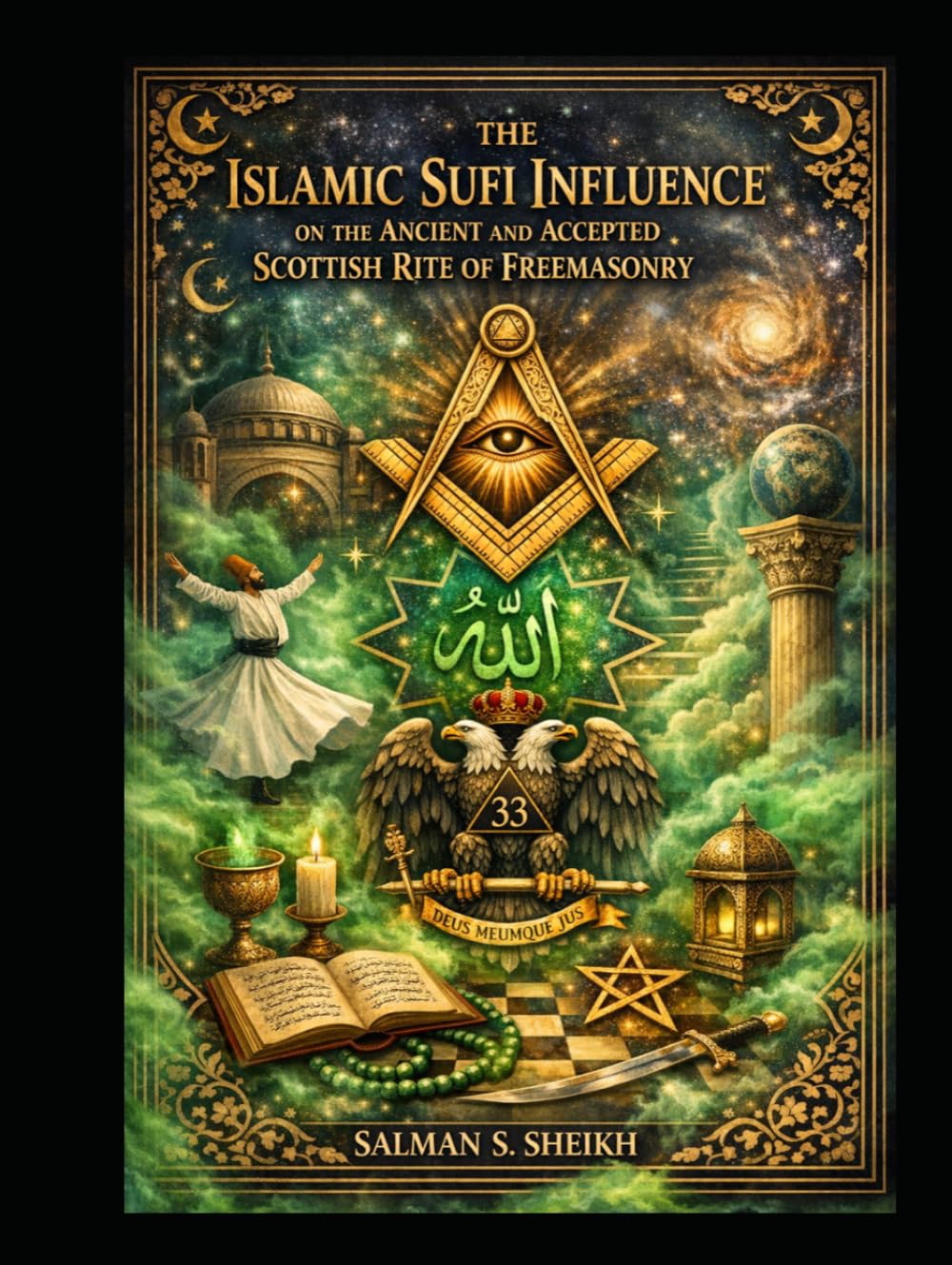
The Islamic Sufi Influence On The Ancient And Accepted Scottish Rite Of Freemasonry
$33.00
by Salman S Sheikh



The history of Freemasonry is often told as a purely European story. But the reality may be far more complex. Most traditional accounts trace the origins of modern Freemasonry to the guilds of medieval stonemasons and the philosophical societies of Enlightenment Europe. While those influences are real, they do not fully explain the deeper symbolic and philosophical foundations found within the fraternity—particularly within the Ancient Accepted Scottish Rite. In The Islamic Sufi Influence on the Ancient Accepted Scottish Rite of Freemasonry, Salman S. Sheikh examines the broader historical environment in which many of these ideas developed. Rather than treating Freemasonry as an isolated European creation, this book places it within the larger intellectual world of the medieval Mediterranean, where scholars, merchants, mystics, and craftsmen from Islamic, Jewish, and Christian societies exchanged knowledge for centuries. Drawing from history, philosophy, and comparative religious studies, the book explores how the intellectual traditions of the Islamic world—especially Sufi metaphysics—formed part of the cultural environment that influenced later Western symbolic traditions. Among the topics explored are the limitations of Eurocentric narratives in the study of Freemasonry, the Mediterranean as a long-standing network of philosophical and cultural exchange, the role of Islamic scholars in preserving and expanding ancient Greek knowledge, parallels between Sufi initiatic systems and the structure of Masonic degrees, the importance of sacred geometry in Islamic architecture and symbolic traditions, historical encounters between medieval Islamic brotherhoods and European chivalric orders, the deeper symbolism of the Double-Headed Eagle within the Scottish Rite, and the widespread assumption that Freemasonry began in 1717 and why that view may be incomplete. Rather than arguing that Freemasonry is an Islamic institution, this study suggests that the symbolic language of the fraternity developed within a shared intellectual environment shaped by many civilizations. During the Islamic Golden Age, scholars working in cities such as Baghdad, Cairo, Cordoba, and Damascus preserved and expanded philosophical traditions that would later influence Europe. Through translation movements, trade routes, and cultural interaction across the Mediterranean, these ideas gradually entered Western intellectual life. When the symbolic systems of Freemasonry later developed, they emerged within a world already shaped by centuries of intercultural exchange. This book invites readers to reconsider the historical narrative surrounding Freemasonry and to recognize the broader intellectual heritage that connects Islamic philosophy, medieval guild traditions, and Western esoteric thought. Ultimately, it is a study about the shared pursuit of wisdom across civilizations—a pursuit that has always transcended cultural and religious boundaries.