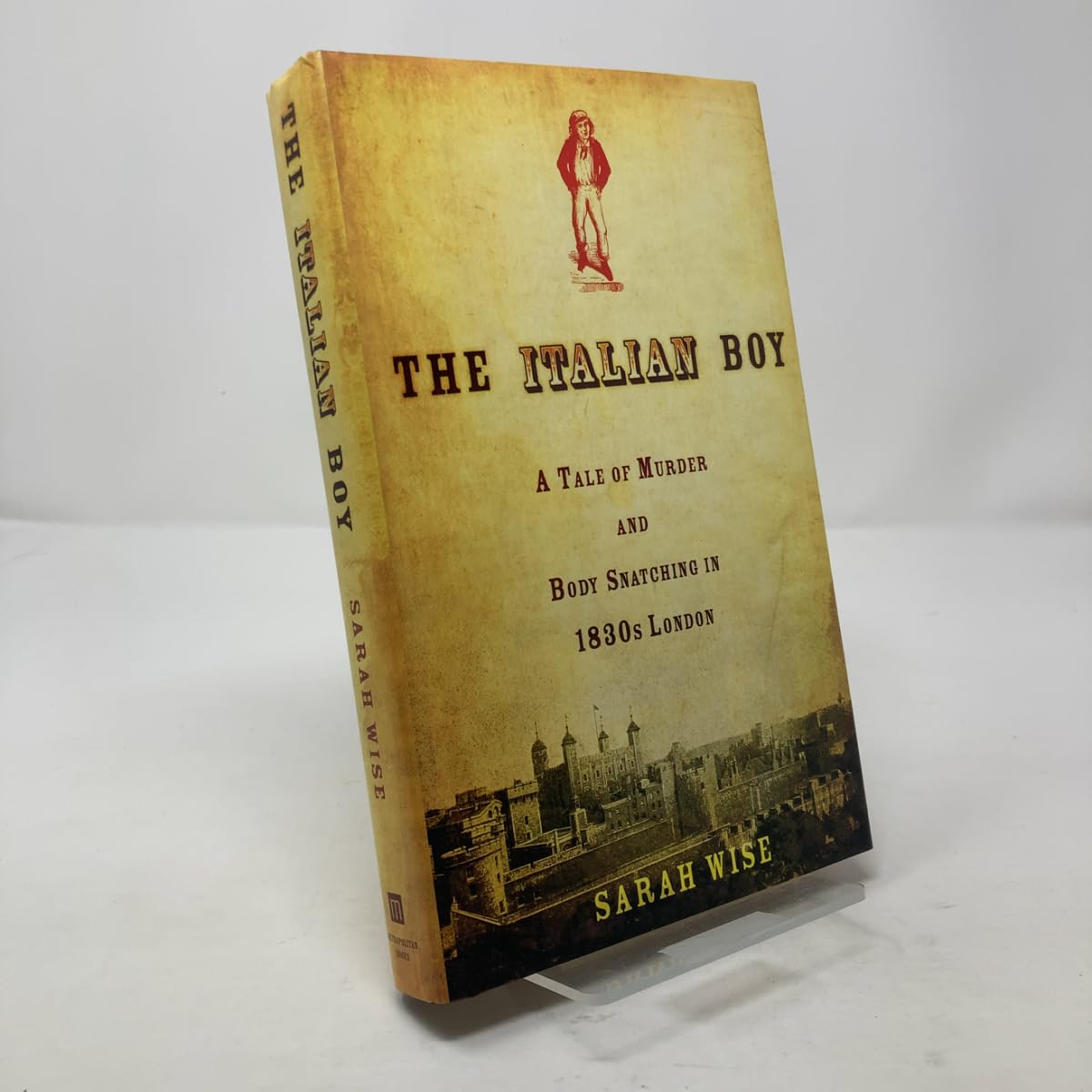



A thrilling history of England's great metropolis at a point of great change, told through the story of a young vagrant murdered by "resurrection men" Before his murder in 1831, the "Italian boy" was one of thousands of orphans on the streets of London, moving among the livestock, hawkers, and con men, begging for pennies. When his body was sold to a London medical college, the suppliers were arrested for murder. Their high-profile trial would unveil London's furtive trade in human corpses carried out by body-snatchers-or "resurrection men"-who killed to satisfy the first rule of the cadaver market: the fresher the body, the higher the price. Historian Sarah Wise reconstructs not only the boy's murder but the chaos and squalor of London that swallowed the fourteen-year-old vagrant long before his corpse appeared on the slab. In 1831, the city's poor were desperate and the wealthy were petrified, the population swelling so fast that old class borders could not possibly hold. All the while, early humanitarians were pushing legislation to protect the disenfranchised, the courts were establishing norms of punishment and execution, and doctors were pioneering the science of human anatomy. As vivid and intricate as a novel by Charles Dickens, The Italian Boy restores to history the lives of the very poorest Londoners and offers an unparalleled account of the sights, sounds, and smells of a city at the brink of a major transformation. Adult/High School–Making good use of scant information, Wise chronicles one of the most celebrated crimes of the 19th century, perpetrated by the dreaded "Resurrection Men." These were grave robbers engaged in the lucrative practice of providing London's medical schools with cadavers for dissection. As demand exceeded supply, some turned to homicide, especially since the freshest bodies brought the highest reward. By the end of the book, readers have gained knowledge of the controversial creation of Robert Peal's "bobbies," the primitive origins of crime-scene investigation, and the conduct of British jury trials of the period. The author describes the exponential growth of the city in the first third of the 19th century, the precarious economic situation of the lower population strata, and the poverty and filth that so appalled later Victorians and led them to take corrective action. She explains why Italian boys–and many other children–called the streets of London home and why the poor were perpetual crime victims. This engrossing and suspenseful blending of sociology, history, and true crime will appeal to both researchers and casual readers. –Dori DeSpain, Fairfax County Public Library, VA At the time of the 1831 murder of the "Italian Boy," body snatchers would grab orphans on the streets of London and dispatch them. The so-called resurrection men would sell the bodies to medical colleges for students to dissect; the fresher the body, the higher the price. Wise has based the narrative of this particular case on the London Times ' reports of the inquest, the committal proceedings, and the trial of three men charged in the boy's death. Other sources include newspapers and journals, books, reports of parliamentary select committees, police reports, and Old Bailey sessions. In chronicling the murder of the 14-year-old boy (who was thought to be Italian), Wise offers a picture of the squalor of London and its poor in the late 1820s and early 1830s. Some of the people were literate, many were not; all of them lived in what Wise calls "a giant cesspit in^B its sinuous streets and unlit warrens." The author, a brilliant historian and storyteller, has captured with unerring immediacy the history of London and its people in that era. George Cohen Copyright © American Library Association. All rights reserved A historian of Victorian England, Sarah Wise has written for The Guardian, The Observer, The Independent on Sunday , and several magazines. The Italian Boy is her first book. She lives in London. From The Italian Boy : Urban poverty, so often a disgusting and harrowing sight to the respectable, could also be a source of wonder and intrigue. A beggar with a certain look, or air, or "act," could feed on city dwellers' craving for novelty and display. To London's grimmest streets, to a population with little access to books or periodicals, and no access to parks, zoos, galleries, or museums—Italian boys brought music, intriguing objects, and strange animals, plus, in many cases, their own beauty. The economies of the Italian states had been devastated by the Napoleonic Wars and throughout the 1820s there was large-scale migration, with many Italian artisans moving to northern European cities to pursue their trades. While later in the century Italian street children would be known for playing musical instruments and dancing, until the mid-1830s their principal source of income was exhibiting small animals as well as wax and plaster figures. The objects and creatures were