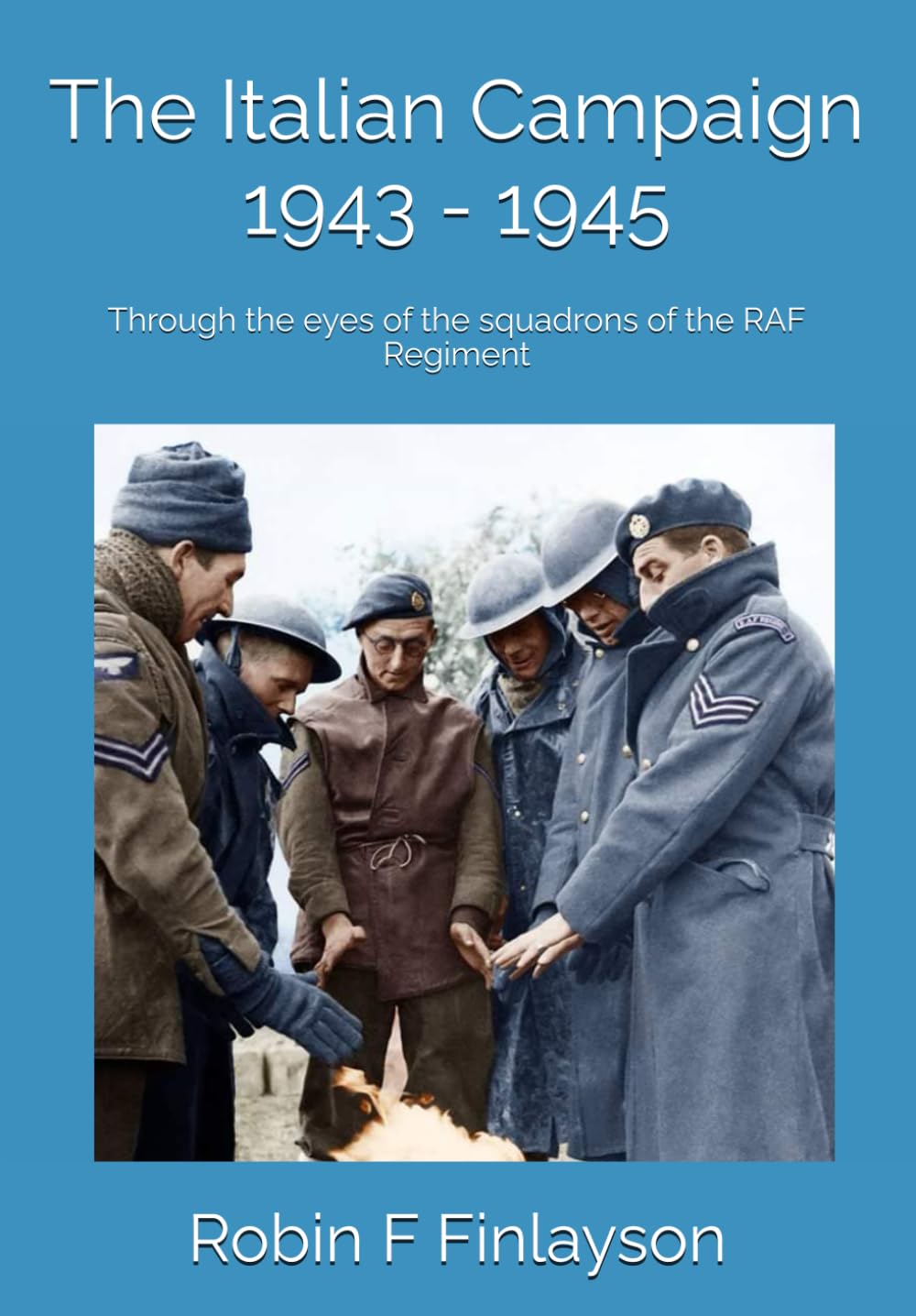
The Italian Campaign 1943 - 1945: Through the eyes of the squadrons of the RAF Regiment
$19.06
by Robin F Finlayson



The campaign for Italy started a few weeks after the successful re-taking of Sicily. The first pincer movement was undertaken by the British Eight Army, commanded by General Montgomery on the 3rd September 1943. With an amphibious landing at Reggio (Operation ‘Baytown’), in the ‘toe’ of the Italian mainland. Slightly later, on the 9th September the US Fifth Army, under General Clark, undertook an amphibious landing at Salerno (Operation ‘Avalanche’), coming under heavy German resistance. Whilst the British landed at Taranto (Operation ‘Slapstick’), lightly opposed. The campaign was a ‘hard slog’, and it wouldn’t be until the 2nd May 1945, following the surrender of the German Army’s C Group, that hostilities would end. The RAF Regiment would commit 13 squadrons by the end of October and twenty by the end of 1943. Initially deployed to protect RAF Assets, mainly airfields and radar stations, the impact of Allied Air superiority soon had a significant impact on the role of the Regiment, and it was positively varied. The Regiment’s LAA squadrons scope was limited, with the non-mobile units, most with their twin .303 Browning machine guns, protecting the radar sites. And the mobile units, with their 20mm Hispano cannons, primarily protecting the inner defensive zones of the landing grounds. While the Army with their 40mm Bofors guns and Heavy AA Guns, protected the outer zones. Later in the campaign, reinforcements from the Middle East squadrons, with their composite LAA capability, combining 40mm Bofors guns and 20mm Hispanos Cannons, increased their operational effectiveness. And soon there was a comprehensive Bofors gun training programme for all the LAA squadrons. Though with the continued Allied air superiority, the need to rationalise resources and maintain the commitment to Operation ‘Overlord’, the number of LAA squadrons was soon significantly cut. The variations to the standard Regiment role mainly landed on the Field squadrons and consisted of three main taskings, (1) protecting the main intelligence units and their targets, (2) operating the forward GALs, guiding in the bombers onto their targets and (3) acting as infantry in the front line. The Field squadrons guided the bombers onto Ortona and Monte Cassino, as well as being in the front line with the Army. They were also some of the first units into Rome and Florence, protecting the Intelligence units and their targets. Later they were employed in the front line on the east coast against the Gothic Line and key in the taking of the fortified Sugar Factory, just south of Ravenna. With the last major Allied offensive, the GALs were in operation, supporting the bombers onto Ravenna. Finally, two flights of one of the newly restructured Rifle Squadrons remained in Italy with the Intelligence units, whilst all of the other Regiment squadrons moved to commitments in Palestine and Austria. Per Ardua