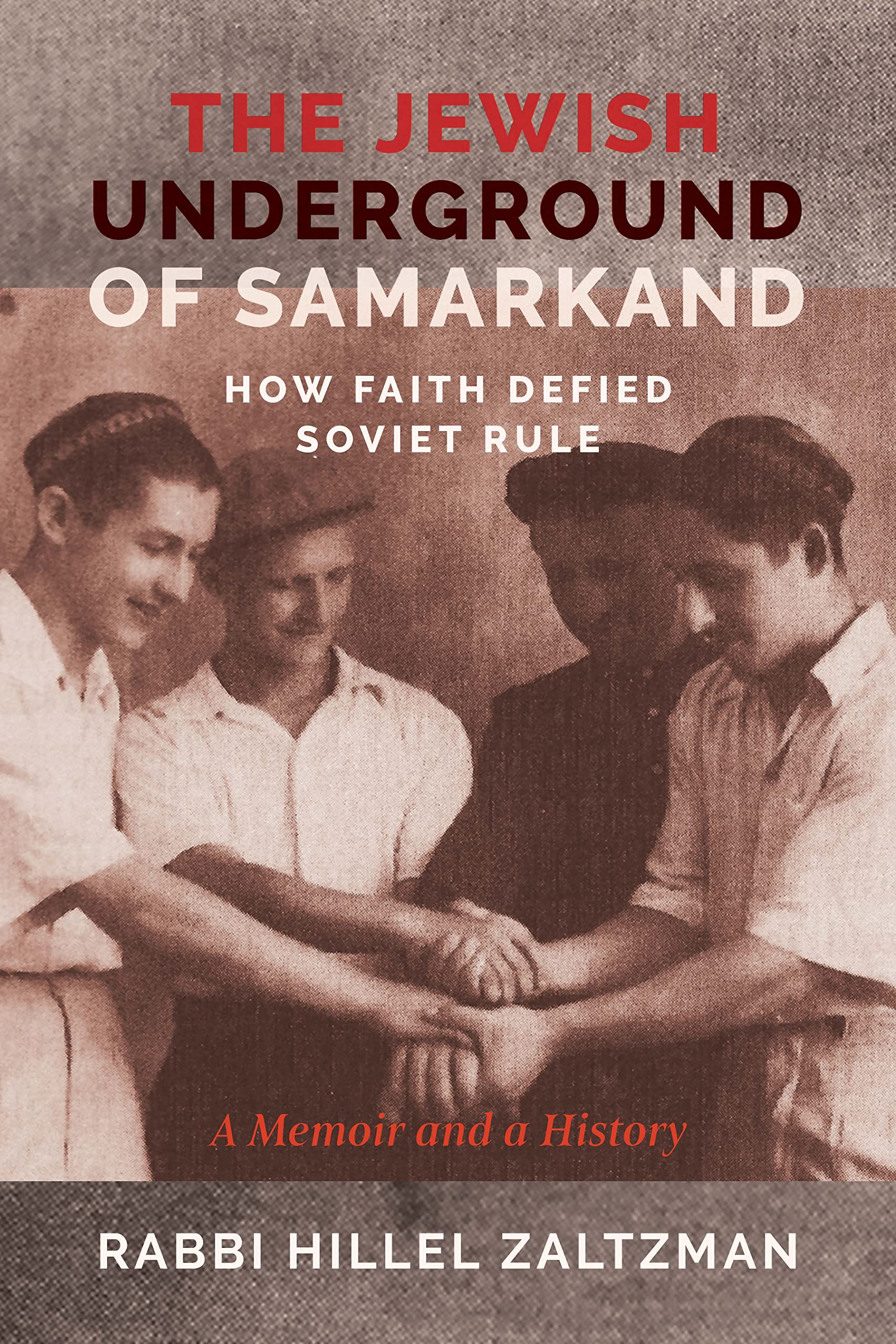
The Jewish Underground of Samarkand: How Faith Defied Soviet Rule
$19.91
by Rabbi Hillel Zaltzman



A portal into the perseverance of Jewish culture in the face of attempts to destroy it. To answer his son's question: what was it like growing up in Samarkand ? Rabbi Hillel Zaltzman wrote and researched this memoir and history about Chassidic Jews who found refuge in Samarkand during the World War II and continued to live there under Soviet rule. This is a personal story for Zaltzman, who was born in Kharkov, Ukraine. When the Nazis invaded Kharkov, Zaltzman’s parents fled with their three young children to Samarkand (Uzbekistan). There they reconnected to other refugee Chassidic families, as well as some famous Chassidic rebbes also in flight. In Uzbekistan they created a thriving Jewish community until its institutions were abruptly shut down by Stalin immediately after the war. Still this Jewish community in Samarkand, Uzbekistan is remembered as shpitz Chabad —the epitome of Chassidic ideals and devotion. Zaltzman’s father kept him out of the Soviet schools, where atheism was promoted and Sabbath observance was impossible, teaching him furtively at home, until a neighbor discovered his existence at the age of 9. Zaltzman had no choice but to attend a public school then, but he still observed the demands of his faith and stayed home from school when necessary. Hillel studied with esteemed Chabad Chassidic rebbes who taught at great personal risk. If discovered, they could be sentenced to harsh labor in Siberia. Zaltzman credits his father’s unswerving commitment to his chinuch —his Jewish education—was beyond any compromise, and it was an exemplary expression of their Chabad brand of Chassidic Judaism: “The Chabad community was infused with a rich inner world of Chassidic vitality,” Zaltzman writes. Meanwhile, the Soviet regime remained obsessed with eliminating a Jewish religious identity; a special division of the NKVD (Soviet secret police) was assigned the task of destroying Jewish schools and yeshivas, and surveilling individuals through synagogue informers. Zaltzman records his experiences and adventures and those of other memorable people he has known and the sacrifices they made to share their love of Torah and Jewish learning in the secret underground yeshivas. He describes their attempts to celebrate Jewish holidays, make matzah, and obtain prayer books, as well as their other colorful escapades. He also tells of their exasperating experiences trying to obtain exit visas to leave the Soviet Union. The largely untold story of Chabad activism and heroism comes through with great immediacy in this first-person account of spiritual resistance to a Communist regime at war with the Jewish devotion to God and Torah. From the age 16, along with several other idealistic young men, Hillel Zaltzman was involved in Chamah, an underground Jewish organization that helped sustain and preserve Jewish life in the Soviet Union through education. Chamah established a network of underground Jewish schools that clandestinely taught more than 1,500 children over the years and provided material and spiritual support to Jews trying to obtain exit visas in the 1960s and 70s. Hillel himself was allowed to immigrate to Israel only in 1971, after years of trying. Now living in New York, he is the director of I Chamah , an international organization which is devoted to serving Jews from the Former Soviet Union in Israel, Russia, and the US. Rabbi Zaltzman was honored for his humanitarian and Jewish outreach in the U.S. Senate in May 2016, as part of Jewish American Heritage Month. "Zaltzman's stirring memoir, which was originally published in 2015 as Samarkand and has been condensed for this new edition, recounts his attempts to preserve Jewish culture in Soviet Uzbekistan. . . . He writes of these achievements in steady, unshowy prose, succeeding in his stated goal to enlighten readers who are unaware of a thriving Jewish community in the former Soviet Union. It's a fascinating blend of personal and cultural history."— Publishers Weekly "While the Kremlin ruthlessly suppressed organized religion, Chassidic Jews in Samarkand managed to sustain their traditions with determined ingenuity. Brimming with vivid detail, this book will interest anyone curious to know how they survived in the face of Stalinist repression."— Joshua Rubenstein , Davis Center for Russian and Eurasian Studies at Harvard University and the author of nine books on Soviet history including The Last Days of Stalin "A debut history that details the plight of a family of Jews who fled from Ukraine to Uzbekistan while pursuing their faith . . . . the author does a remarkable job of vividly depicting the city of Samarkand, which became famous for its tenacious preservation of Jewish customs despite zealous political persecution. It serves as an effective historical study of Jewish life under Communist tyranny, and Zaltzman's mastery of details of the period is undeniable.— Kirkus Reviews "The inspiring story of Chabad's undergroun