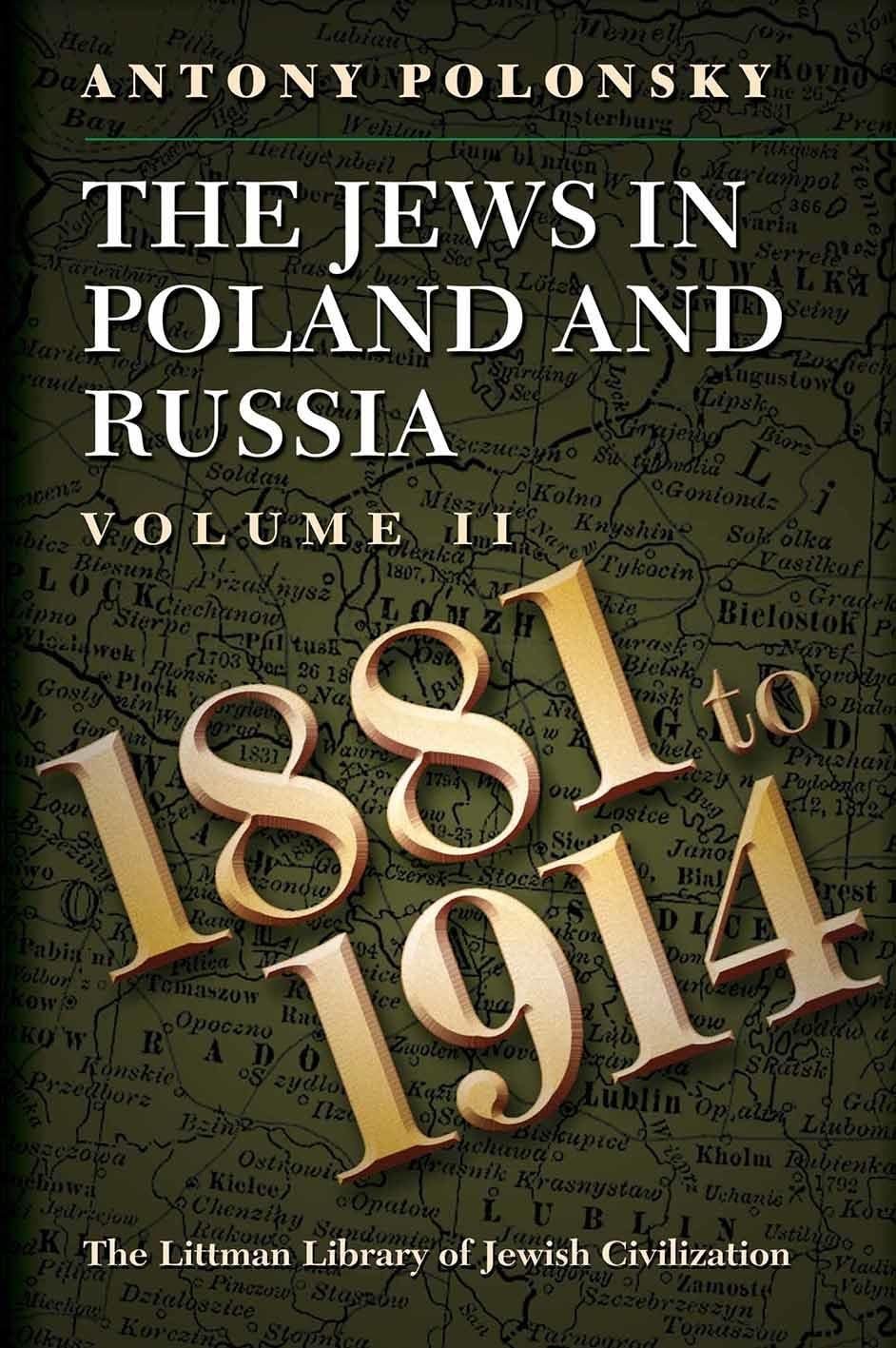
The Jews in Poland and Russia: Volume II: 1881 to 1914 (The Littman Library of Jewish Civilization)
$38.49
by Antony Polonsky



Each of the three volumes of this magisterial work provides a comprehensive picture of the realities of Jewish life in the Polish lands in the period it covers, while also considering the contemporary political, economic, and social context. Volume I: 1350 to 1881 provides a wide-ranging overview down to the mid-eighteenth century, including social, economic, and religious history. The period from 1764 to 1881 is covered in more detail, with attention focused on developments in each country in turn, especially with regard to the politics of emancipation, acculturation, assimilation, and forced integration. Volume II: 1881 to 1914 explores the factors that had a negative impact on Jewish life as well as the political and cultural movements that developed in consequence: Zionism, socialism, autonomism, the emergence of modern Hebrew and Yiddish literature, Jewish urbanization, and the rise of popular Jewish culture. Galicia, Prussian Poland, the Kingdom of Poland, and the tsarist empire are all treated individually, as are the main cities. Volume III: 1914 to 2008 covers the interwar period, the Second World War, and the Holocaust, including Polish–Jewish relations and the Soviet record on the Holocaust. A survey of developments since 1945 concludes with an epilogue on the situation of the Jews since the collapse of communism. 'Combines a masterful grasp of Jewish history with that of eastern Europe. While underlining the unique features and achievements of the Jewish communal experience he authoritatively integrates them into the history of the countries in which Jews lived . . . Incorporating current, ground-breaking scholarship from North America, Israel, and Europe these beautifully narrated volumes should not only be seen as a staple of university courses, but also as a must-read for anyone attempting to understand any aspect of modern Jewish history and religious tradition, wherever it may be playing out . . . With this extremely important book, Antony Polonsky not only writes history but, following the example of his illustrious predecessors, makes it.' - K atarzyna Person, European Judaism 'The first two volumes of Antony Polonsky's magisterial The Jews in Poland and Russia trilogy provide a much-needed addition to the landscape of Jewish historical studies . . . [a] significant achievement in presenting the most modern findings in a clear, readable, comprehensive survey . . . his narrative is grand and his analysis tight . . . an excellent synthesis of this community's history, incorporating much of the groundbreaking scholarship of the last few decades. Repeatedly, the volumes remind us of the many lost opportunities for real reform in the region. They help correct the nostalgic and romanticized portraits of what is sometimes considered a lost civilization, while simultaneously demonstrating the vibrancy and diversity of Jewish life in the region . . . essential reading for those seeking a thorough and balanced understanding of Jewish life in pre-twentieth century Eastern Europe.' - Jeffrey Veidlinger, H-Judaic 'For several decades now, Antony Polonsky has been at the forefront of Polish–Jewish studies . . . It is thus fitting that Polosnky, who has nurtured young scholars, especially in Poland itself and North America, should bring together old and new work in this remarkable multi-volume synthesis of Jewish history and culture . . . These volumes will provide the first port of call for any student of east European Jewry.' - Tony Kushner, Jewish Chronicle 'We can only commend Antony Polonsky for his massive effort to explain seven centuries of Jewish history in a mere 2,000 pages . . . Polonsky's strength lies in his ability to illuminate intellectual and cultural developments . . . Because of the excellent bibliographies, extensive annotation, and wonderful maps included in each volume, any reader wishing to read in greater detail about Polish and Russian Jewry will have plenty of resources to enable the search.' - Alexandra S. Korros, Jewish Quarterly 'An excellent synthesis of recent research on east European Jewish culture and history. As such it fills a definite need for an accessible introduction to the current scholarship and thinking about the Jews of Poland and Russia . . . should be on the reading list of anyone interested in the history and folk cultures of eastern Europe, whether they work specifically with Jewish history and folk culture, or with other regional cultures.' - David Elton Gay, Journal of Folklore Research 'Any reader who invests the time and money to read the book . . . will find it very rewarding―and not just because of the wealth of information it contains. What Polonsky's book brings home, in a way that a narrower study could not, is the sheer complexity and vitality of Jewish life in that time and place . . . this broader picture is needed to make sense of the social changes that were accelerating by the late nineteenth century―above