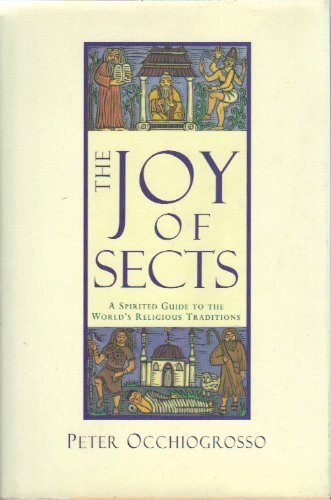
The Joy of Sects: A Spirited Guide to the World's Religious Traditions
$20.59
by Peter Occhiogrosso



A lighthearted guide to the religions of the world offers a basic understanding of international traditions, presenting the fundamental themes of Hinduism, Taoism, Buddhism, Judaism, Christianity, and Islam, as well as the philosophies of the New Age movement. The author states that this book is a reference work for the television and computer age, designed for easy access to names, terms, and other information about world religions. If this is the book's only purpose, it succeeds. It is a miniature encyclopedia with bite-sized definitions and explanations to aid anyone needing immediate help when confronted with a new or strange religious term or seeking more information on a religious topic that is unfamiliar. The book successfully covers Hinduism, Buddhism, Taoism, Judaism, Christianity, and Islam. Of special interest is a chapter on New Age religions, presently a burgeoning field. An objection to the book is its frivolous title, which may condemn this good, quick reference source to be dismissed as just another popular book on religion. Recommended for public libraries. Glenn Masuchika, Chaminade Univ. Lib., Honolulu Copyright 1994 Reed Business Information, Inc. Comparative religion can be dry, but not the way Occhiogrosso writes it. Not only is this fat book comprehensive, it's lively and, perhaps best of all, easy to understand. Occhiogrosso, the author of Once a Catholic (1988), explains the world's religions so clearly and with such easy wit that even those befuddled by religious terminology--from kosher to karma --will find themselves seeing the light for the first time. The book is divided into seven chapters, one each on Hinduism, Buddhism, Taoism, Judaism, Christianity, Islam, and New Age. Each chapter is then divided by such topics as history, contemporary practices, and terms, with clever subject headings like "The Mark of Zoroaster" or "Confucius Say What?" Libraries may want one copy for circulation and another for reference. An excellent resource. Ilene Cooper