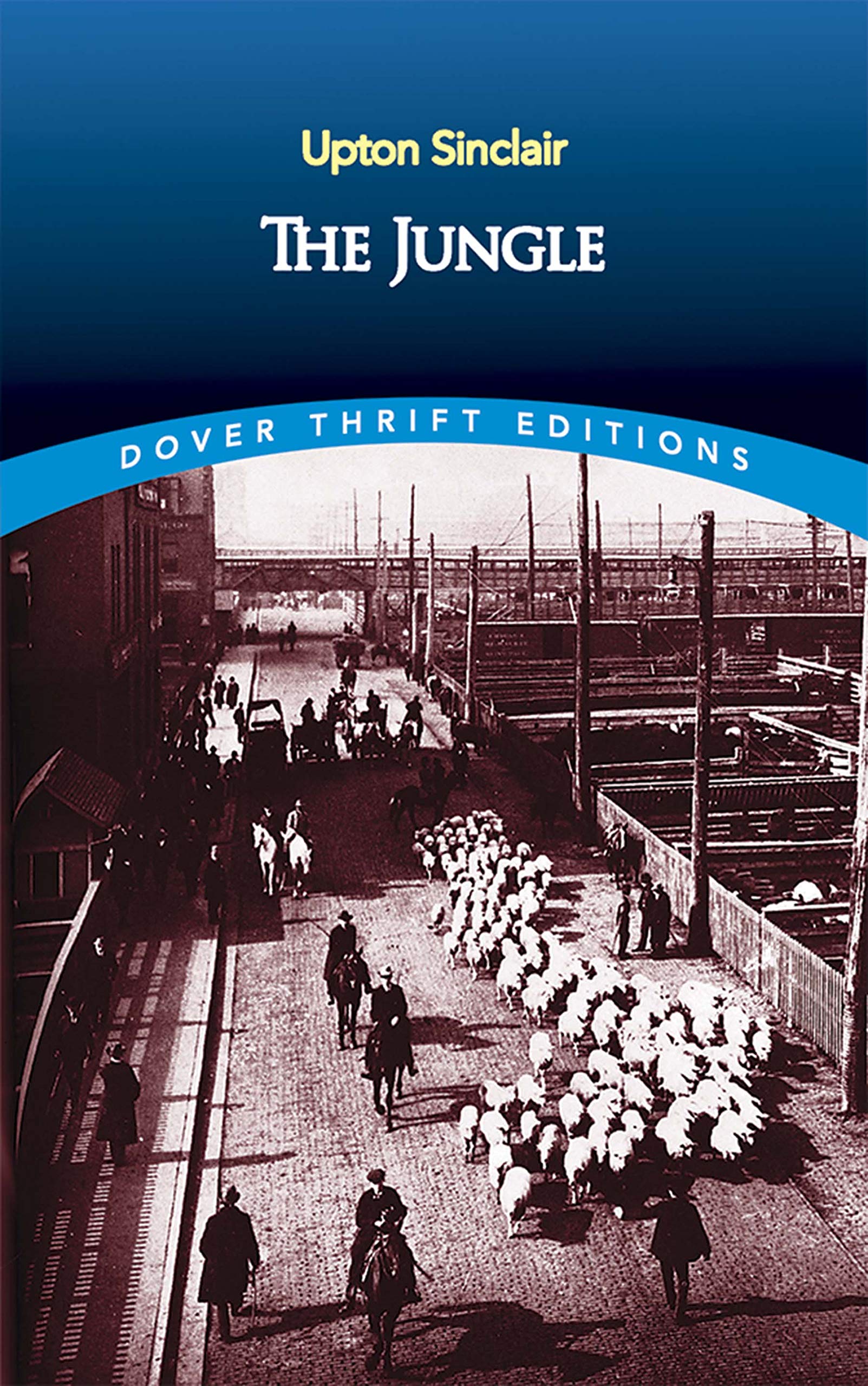
The Jungle: The Powerful Exposé of Labor Abuse in America's Meatpacking Industry (Dover Thrift Editions: Classic Novels)
$5.80
by Upton Sinclair



An ardent activist, champion of political reform, novelist, and progressive journalist, Upton Sinclair is perhaps best known today for The Jungle — his devastating exposé of the meat-packing industry. A protest novel he privately published in 1906, the book was a shocking revelation of intolerable labor practices and unsanitary working conditions in the Chicago stockyards. It quickly became a bestseller, arousing public sentiment and resulting in such federal legislation as the Pure Food and Drug Act.
The brutally grim story of a Slavic family who emigrates to America, The Jungle tells of their rapid and inexorable descent into numbing poverty, moral degradation, and social and economic despair. Vulnerable and isolated, the family of Jurgis Rudkus struggles — unsuccessfully — to survive in an urban jungle. A powerful view of turn-of-the-century poverty, graft, and corruption, this fiercely realistic American classic is still required reading in many history and literature classes. It will continue to haunt readers long after they've finished the last page. An ardent activist, champion of political reform, novelist, and progressive journalist, Upton Sinclair is perhaps best known today for The Jungle —his devastating exposé of the meat-packing industry. A protest novel he privately published in 1906, the book was a shocking revelation of intolerable labor practices and unsanitary working conditions in the Chicago stockyards. It quickly became a bestseller, arousing public sentiment and resulting in such federal legislation as the Pure Food and Drug Act.
The brutally grim story of a Slavic family who emigrates to America, The Jungle tells of their rapid and inexorable descent into numbing poverty, moral degradation, and social and economic despair. Vulnerable and isolated, the family of Jurgis Rudkus struggles—unsuccessfully—to survive in an urban jungle. A powerful view of turn-of-the-century poverty, graft, and corruption, this fiercely realistic American classic is still required reading in many history and literature classes. It will continue to haunt readers long after they've finished the last page. Upton Sinclair was a prolific author, committed socialist, and political activist who gained enormous popularity when his 1906 novel The Jungle exposed conditions in the U.S. meat-packing industry. In 1943, he earned a Pulitzer Prize for his series tale, Dragon's Teeth. The Jungle By Upton Sinclair Dover Publications Copyright © 2001 Upton Sinclair All right reserved. ISBN: 9780486419237 Chapter One Chapter I It was four o’clock when the ceremony was over and the carriages began to arrive. There had been a crowd following all the way, owing to the exuberance of Marija Berczynskas. The occasion rested heavily upon Marija’s broad shoulders—it was her task to see that all things went in due form, and after the best home traditions; and, flying wildly hither and thither, bowling every one out of the way, and scolding and exhorting all day with her tremendous voice, Marija was too eager to see that others conformed to the proprieties to consider them herself. She had left the church last of all, and, desiring to arrive first at the hall, had issued orders to the coachman to drive faster. When that personage had developed a will of his own in the matter, Marija had flung up the window of the carriage, and, leaning out, proceeded to tell him her opinion of him, first in Lithuanian, which he did not understand, and then in Polish, which he did. Having the advantage of her in altitude, the driver had stood his ground and even ventured to attempt to speak; and the result had been a furious altercation, which, continuing all the way down Ashland Avenue, had added a new swarm of urchins to the cortège at each side street for half a mile. This was unfortunate, for already there was a throng before the door. The music had started up, and half a block away you could hear the dull “broom, broom” of a ’cello, with the squeaking of two fiddles which vied with each other in intricate and altitudinous gymnastics. Seeing the throng, Marija abandoned precipitately the debate concerning the ancestors of her coachman, and, springing from the moving carriage, plunged in and proceeded to clear a way to the hall. Once within, she turned and began to push the other way, roaring, meantime, “Eik! Eik! Uzdaryk-duris!” in tones which made the orchestral uproar sound like fairy music. “Z. Graiczunas, Pasilinksminimams darzas. Vynas. Sznapsas. Wines and Liquors. Union Headquarters”—that was the way the signs ran. The reader, who perhaps has never held much converse in the language of far-off Lithuania, will be glad of the explanation that the place was the rear-room of a saloon in that part of Chicago known as “back of the yards.” This information is definite and suited to the matter of fact; but how pitifully inadequate it would have seemed to one who understood that it was also the supreme hour of ecsta
The brutally grim story of a Slavic family who emigrates to America, The Jungle tells of their rapid and inexorable descent into numbing poverty, moral degradation, and social and economic despair. Vulnerable and isolated, the family of Jurgis Rudkus struggles — unsuccessfully — to survive in an urban jungle. A powerful view of turn-of-the-century poverty, graft, and corruption, this fiercely realistic American classic is still required reading in many history and literature classes. It will continue to haunt readers long after they've finished the last page. An ardent activist, champion of political reform, novelist, and progressive journalist, Upton Sinclair is perhaps best known today for The Jungle —his devastating exposé of the meat-packing industry. A protest novel he privately published in 1906, the book was a shocking revelation of intolerable labor practices and unsanitary working conditions in the Chicago stockyards. It quickly became a bestseller, arousing public sentiment and resulting in such federal legislation as the Pure Food and Drug Act.
The brutally grim story of a Slavic family who emigrates to America, The Jungle tells of their rapid and inexorable descent into numbing poverty, moral degradation, and social and economic despair. Vulnerable and isolated, the family of Jurgis Rudkus struggles—unsuccessfully—to survive in an urban jungle. A powerful view of turn-of-the-century poverty, graft, and corruption, this fiercely realistic American classic is still required reading in many history and literature classes. It will continue to haunt readers long after they've finished the last page. Upton Sinclair was a prolific author, committed socialist, and political activist who gained enormous popularity when his 1906 novel The Jungle exposed conditions in the U.S. meat-packing industry. In 1943, he earned a Pulitzer Prize for his series tale, Dragon's Teeth. The Jungle By Upton Sinclair Dover Publications Copyright © 2001 Upton Sinclair All right reserved. ISBN: 9780486419237 Chapter One Chapter I It was four o’clock when the ceremony was over and the carriages began to arrive. There had been a crowd following all the way, owing to the exuberance of Marija Berczynskas. The occasion rested heavily upon Marija’s broad shoulders—it was her task to see that all things went in due form, and after the best home traditions; and, flying wildly hither and thither, bowling every one out of the way, and scolding and exhorting all day with her tremendous voice, Marija was too eager to see that others conformed to the proprieties to consider them herself. She had left the church last of all, and, desiring to arrive first at the hall, had issued orders to the coachman to drive faster. When that personage had developed a will of his own in the matter, Marija had flung up the window of the carriage, and, leaning out, proceeded to tell him her opinion of him, first in Lithuanian, which he did not understand, and then in Polish, which he did. Having the advantage of her in altitude, the driver had stood his ground and even ventured to attempt to speak; and the result had been a furious altercation, which, continuing all the way down Ashland Avenue, had added a new swarm of urchins to the cortège at each side street for half a mile. This was unfortunate, for already there was a throng before the door. The music had started up, and half a block away you could hear the dull “broom, broom” of a ’cello, with the squeaking of two fiddles which vied with each other in intricate and altitudinous gymnastics. Seeing the throng, Marija abandoned precipitately the debate concerning the ancestors of her coachman, and, springing from the moving carriage, plunged in and proceeded to clear a way to the hall. Once within, she turned and began to push the other way, roaring, meantime, “Eik! Eik! Uzdaryk-duris!” in tones which made the orchestral uproar sound like fairy music. “Z. Graiczunas, Pasilinksminimams darzas. Vynas. Sznapsas. Wines and Liquors. Union Headquarters”—that was the way the signs ran. The reader, who perhaps has never held much converse in the language of far-off Lithuania, will be glad of the explanation that the place was the rear-room of a saloon in that part of Chicago known as “back of the yards.” This information is definite and suited to the matter of fact; but how pitifully inadequate it would have seemed to one who understood that it was also the supreme hour of ecsta