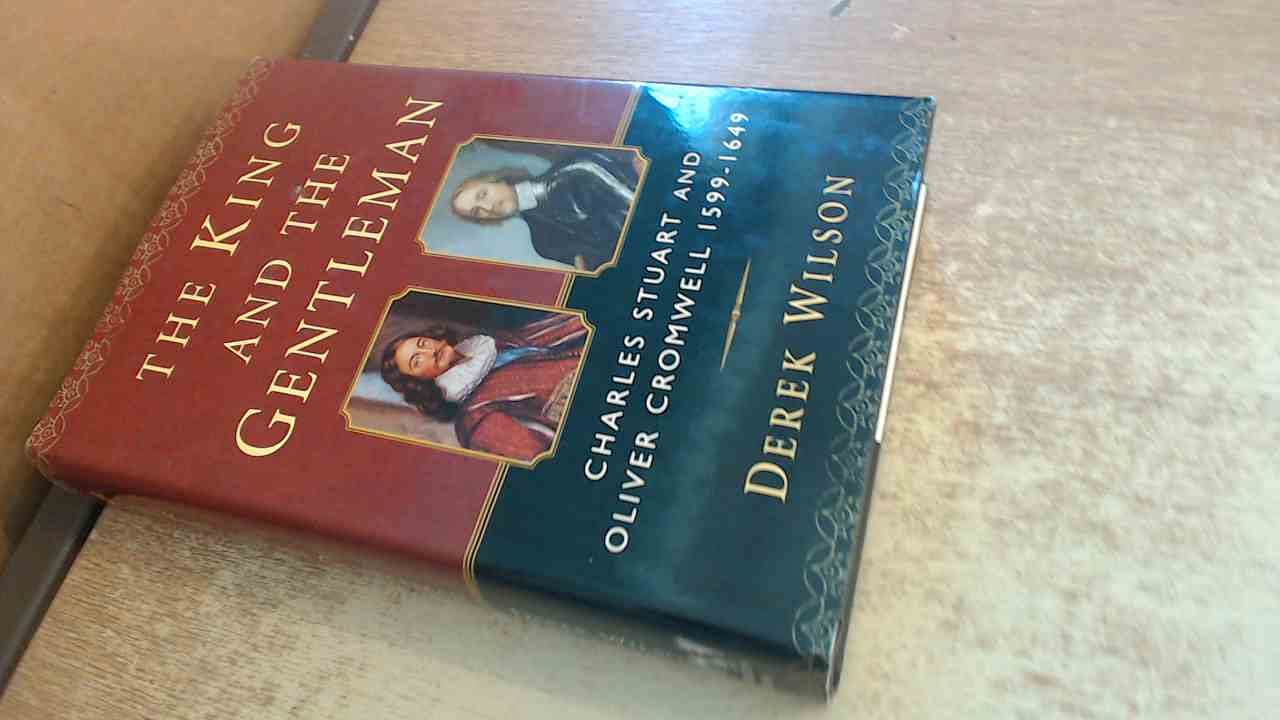
The King and the Gentleman: Charles Stuart and Oliver Cromwell, 1599-1649
$16.49
by Derek A. Wilson



A look at the lives of two powerful men, Oliver Cromwell and Charles Stuart, traces their lives and the effects they had on England during the Civil War, up until 1649, when one man died, and the other rose to power. English historians, it seems, never tire of examining the relationship of Charles I to his archrival, Oliver Cromwell. An unpopular ruler, Charles reigned as King of England, Scotland, and Ireland from 1625 to 1649. His religious intolerance, exacerbation of class divisions, and financial recklessness provided ample fodder for Royalist opposition, led by Cromwell. A far more skilled military leader and politician than the King, Cromwell led the radical Independents to victory in the civil wars of the 1640s. His popularity and challenge to the monarchy ultimately led to its abolition as well as the execution of the King. Cromwell governed as Lord Protector until his death in 1658. With The King and the Gentleman , Derek Wilson fills a scholarly void by examining the rulers' formative years as well as their religious convictions. According to the author, only a thorough understanding of both in context provides an accurate understanding of them as adults and their opposing visions for England. One of England's leading biographers and novelists, Wilson has not written for the initiate to English history; he expects a solid historical foundation from his readers. Those who find the conflict of Charles and Cromwell as absorbing and deserving of fresh insight will consider The King and the Gentleman a must-read. --Bertina Loeffler Sedlack This dual biography of two men whose face-to-face meetings were few and unremarked but whose lives intersected in inevitable and tragic ways is popular history at its best. Wilson, the author of previous biographies of the Rothschilds, Astors, and Hans Holbein, devotes a great deal of space to his subjects' forebears and childhoods, trying to discern how they became the adults they did. He also traces the development of their religious views (interestingly, Cromwell did not come from purely Puritan stock and was quite tolerant of other shades of belief), which were eventually the main point of contention between them. The writing is felicitous, emphasizing the personal rather than the political, and some knowledge of the period is helpful but not essential. Because it considers Charles I and Cromwell together, and because of its emphasis on their religious evolutions, this book is recommended for most public and academic libraries.AJean E.S. Storrs, formerly with Enoch Pratt Free Lib., Catonsville, MD Copyright 1999 Reed Business Information, Inc. Veteran historical biographer Wilson (The Astors: Landscape with Millionaires , 1993, etc.) takes a long look at Englands Charles I and the man who ultimately caused his downfall. Oliver Cromwell and Charles Stuart had little personal contact, and there is no detailed record of any meeting between them. Nonetheless, Wilson pens interesting portraits of the Scottish-born king whose religious and economic policies tore apart Great Britain and the zealous Protestant who rose from Member of Parliament to leader of the victorious ``Ironsides'' force and of the New Model Army, as well as signatory of Charless death warrant. In separate biographical sections, Wilson does an admirable job of covering the complex religious and political schism that rocked England and Scotland, and summarizes for general readers the wealth of extant material on both mens lives. But his attempts to contrast the two mens personalities, upbringing, education, and beliefs programmatically are unexceptional. Placing his subjects in specious proximity to each others spheres of action, Wilson takes leaps that his sources cannot support, often guessing at their motives and perceptions, as when he asserts that prior to their first meeting Cromwell saw his monarch only in the context of his royal mystique'' and that the King had no real knowledge of his Puritan opponent. Better as two good biographies than one mediocre one. (16 pages b&w illus.) -- Copyright ©1999, Kirkus Associates, LP. All rights reserved. Derek Wilson, one of England's leading biographers and novelists, graduated from Cambridge in 1961. He spent several years traveling and teaching in Africa before becoming a full-time writer and broadcaster in 1971. His highly acclaimed books include Rothschild: A Story of Wealth and Power, Sweet Robin: Robert Dudley Earl of Leicester, Hans Holbein: Portrait of an Unknown Man , and Tudor Tapestry: Men, Women and Society in Reformation England . He has scripted and presented numerous radio and TV programs. He is married and lives in Devon.