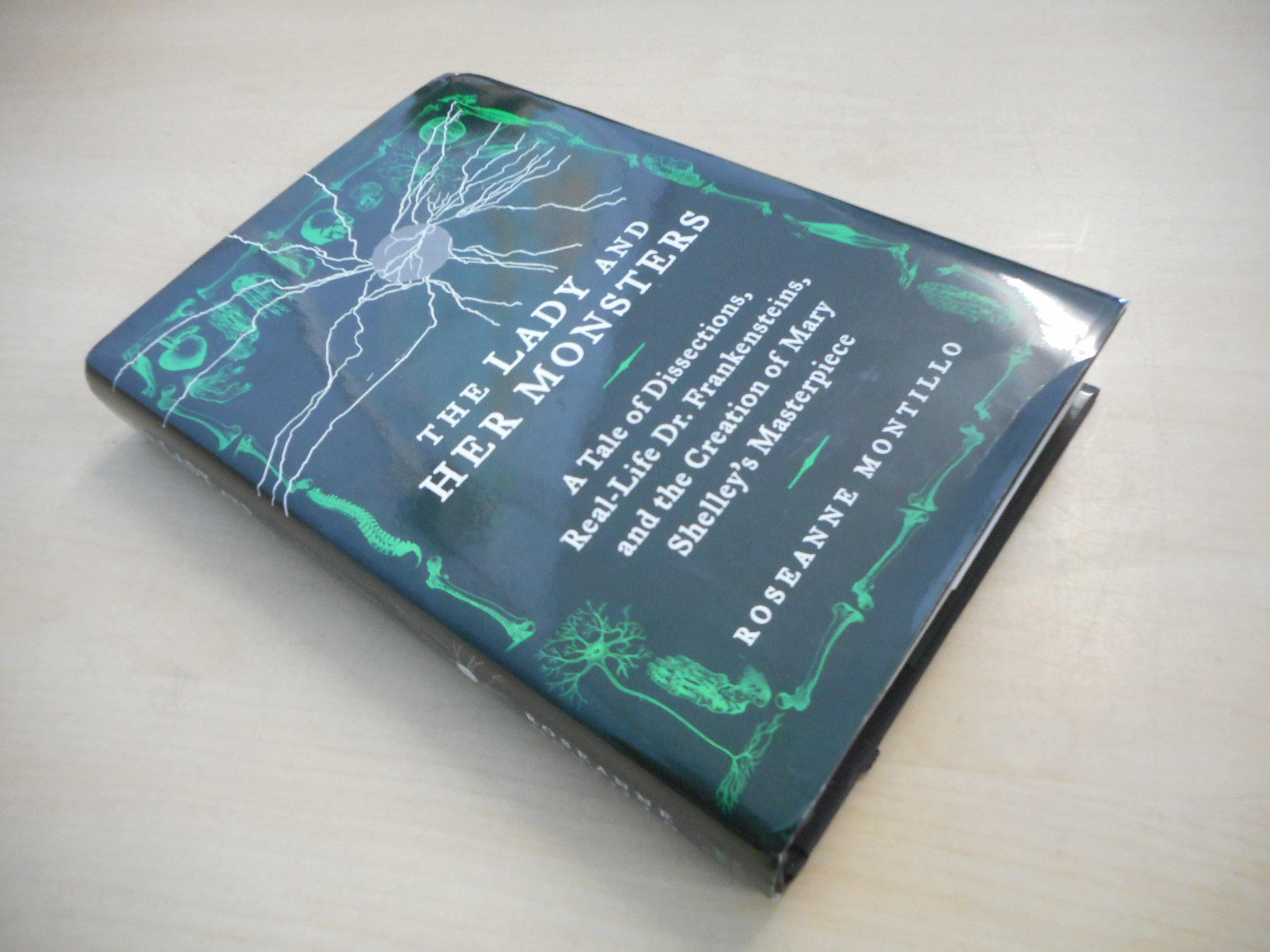
The Lady and Her Monsters: A Tale of Dissections, Real-Life Dr. Frankensteins, and the Creation of Mary Shelley's Masterpiece
$35.00
by Roseanne Montillo



The Lady and Her Monsters by Roseanne Motillo brings to life the fascinating times, startling science, and real-life horrors behind Mary Shelley’s gothic masterpiece, Frankenstein . Montillo recounts how—at the intersection of the Romantic Age and the Industrial Revolution—Shelley’s Victor Frankenstein was inspired by actual scientists of the period: curious and daring iconoclasts who were obsessed with the inner workings of the human body and how it might be reanimated after death. With true-life tales of grave robbers, ghoulish experiments, and the ultimate in macabre research—human reanimation— The Lady and Her Monsters is a brilliant exploration of the creation of Frankenstein, Mary Shelley’s horror classic. A Look Inside The Lady and Her Monsters From Giovanni Aldini's text, Essai theoretique experimental sur le galvanism, depicting two decapitated cadavers and his efforts to restore movements to them. Mrs. Docherty was suffocated and her body sold to Dr. Knox for dissection. The killers used the method known as 'burking' - plying their victim with drink then suffocating her. Mrs. Docherty was their last victim. In the 18th century, the river provided a great divide between social classes in London. It was also from one of its bridges that Mary Wollstonecraft jumped trying to commit suicide. Frankenstein Observing the first stirring of his creature -- This is a print from the 1831 edition. *Starred Review* Scores of books and movies have retold the infamous tale of the ghost-story contest that gave rise to Mary Shelley’s Frankenstein, but Montillo digs deeper (so to speak) in this dual history of literature and science. Half the book is simply one of the most readable biographical portraits you’ll find of Mary Shelley—the standoffish, spiteful, but brilliant daughter of a famous feminist mother and philosopher father, and whose torrid love affair with the wild poet Percy Shelley (aka “Mad Shelley”) kicked off with premarital midnight sex in a cemetery and only got weirder from there. Alternating with Mary’s narrative is the hellacious history of the rock-star anatomists of the 1700s, who enthralled Percy, and, by extension, Mary, with their grotesque forays into “galvanism,” the manipulation of dead muscle via electrical current. Both plots come lumbering at each other like, well, monsters until that fateful summer in Geneva when Mary stitched her various influences together into a single literary beast. Montillo is an academic but unafraid of salaciousness, injecting into her tale an invigorating solution of sex, gore, and gossip as we reach both the end of Mary’s woeful life and the end of the anatomists’ grave-robbing free-for-all as it ceded to the Anatomy Act. Sick, smart, shocking, and spellbinding. --Daniel Kraus “Enthusiatic prose... A Spirited investigation of the bizarre times that inspired Mary Shelley’s Frankenstein. ” - Shelf Awareness (Starred Review) “With a flair for both drama and detail, Montillo breathes her own kind of life into the story of the men determined to discover its very elements.” - Discover Magazine “Spills the dirt on the making of the 19th-century novel--affairs, family drama, a lake house with Lord Byron!--and paints a grimly fascinating picture of the dissections and experiments in “animal electricity” that inspired the gothic tale.” - Mental Floss “Montillo’s book is a welcome tribute to the literary, and especially the scientific, roots of the story.” - The Commercial Dispatch “A welcome tribute to the literary, and especially the scientific, roots of the story.” - The Lady and Her Monsters “A haunting picture of an era in which science and the arts overlapped, a perfect storm in which inspiration for “Frankenstein” could strike. Like a bolt of lightning.” - Washington Post “Her narrative… rattles enjoyably through a lurid and restless landscape. … Equally a literary and a scientific endeavor.” - Wall Street Journal “A delicious and enticing journey into the origins of a masterpiece.” - Publishers Weekly (starred review) “Montillo achieves a freshness through her lively narrative approach and a fascination with long-ago science and its ethics that sparks across the pages.” - New York Times Book Review “Montillo never loses sight of the fact that it was Mary Shelley’s imagination that sewed the pieces together - and provided the vital spark that keeps the tale alive nearly two centuries on.” - New Scientist The truly electric story of Mary Shelley’s Frankenstein , this book—printed with special ink—literally glows in the dark! Told with the verve and ghoulish fun of a Tim Burton film, The Lady and Her Monsters is a highly entertaining blend of literary history, lore, and early scientific exploration that traces the origins of the greatest horror story of all time–Mary Shelley's Frankenstein Exploring the frightful milieu in which Frankenstein was written, Roseanne Montillo, an exciting new literary talent, recounts how Shel