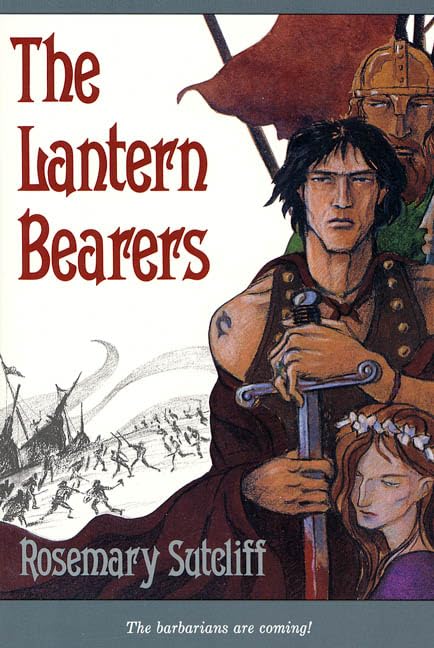



Threatened by a tide of invaders, the last of the Roman Auxiliaries are to leave Britain forever. But Aquila, a young legionnaire, chooses to stay behind, in order to join the fight to save his native land. "A spellbinding historical adventure." -- Bulletin of the Center for Children's Books Chapter 1 Aquila halted on the edge of the hanging woods, looking down. Below him he could see the farmstead under the great, bare swell of the downs; the russet-roofed huddle of buildings, the orchard behind, making a darker pattern on the paleness of the open turf, the barley just beginning to show its first tinge of harvest gold, the stream that rose under the orchard wall and wandered down the valley to turn the creaking wheel of the water-mill that ground their corn. Almost a year had gone by since the last time that he had stood here and looked down, for it was only last night that he had come home on leave from Rutupiae, where he commanded a troop of Rhenus Horse—Auxiliary Cavalry; there had been no regular Legions in Britain for forty years now—and every detail of the scene gave him a sharp-edged pleasure. It was good to be home. And really, the place didn’t look so bad. It was not what it had been in the good old days, of course. Kuno, who was the oldest man on the farm, could remember when there had been vine terraces on the south slope; you could see the traces of them still, just below the woods here, like the traces of the old fields and the old sheep-runs that had had to be let go back to the wild. It was the Pict War that had done the mischief, so long ago that even Kuno couldn’t remember, though he swore that he could, and, when he had drunk enough heather beer, used to tell everybody how he had seen the great Theodosius himself, when he came to drive out the Saxons and the Painted People. But though Theodosius had swept Britain clear, the damage had been done and the countryside had never been the same again. The great houses had been burned, the slaves had revolted against their masters, and the big estates had been ruined. It hadn’t been so bad for the small estates and farms, especially those that were not worked with slave labour. Kuno was very fond of telling—and the hearing of it always made Aquila feel humble, though he was sure that it should make him proud—how in the bad time, the Killing Time, when the slaves revolted, the free men of his own farm had kept faith with his great-grandfather. Because he was seeing his home again for the first time in almost a year, he was piercingly aware of it, and the things it stood for, and aware also how easily it might be lost. Old Tiberius’s farm, not many miles further seaward, had been burned by the Saxon raiders last year. When you thought about it, you realized that you were living in a world that might fall to pieces at any moment; but Aquila seldom thought about it much. He had lived in that world all his life, and so had at least three generations of his kind before him, and it hadn’t fallen to pieces yet, and it didn’t seem likely that it would do so on this rich, ripening day with the powdery whiteness of July lying over the countryside. There was the sound of flying feet behind him, and a brushing through the undergrowth and Flavia his sister was beside him, demanding breathlessly, “Why didn’t you wait for me?” Aquila turned his head to look at her. “I got tired of propping up the wall of Sabra’s cot, being stared out of countenance by that yellow-eyed cat of hers, while you chittered inside.” “You could have stayed inside and chittered too.” “I didn’t want to, thank you. Besides, I wanted to get back here and make sure the farm hadn’t run away since breakfast.” It was an odd thing to say, born of his sudden, unusual awareness, and they looked at each other quickly. “It is queer how one feels like that sometimes,” the girl said, grave for the moment. And then the shadow passed, and she was sparkling again. “But it hasn’t run away—and oh! it is so lovely that you are home again, Aquila! And look, here’s honeysuckle with crimson tips; and here’s clover, and blue scabious, as blue as a butterfly. I shall make a wreath for myself for dinner as though it were a banquet; just for myself, and not for you or Father at all, because men look silly in banquet wreaths, especially if they have galley-prow noses like yours!” And while she spoke, she was down on her knees, searching among the leaves for the tough, slender scabious stems. Aquila leaned against a tree and watched her, making a discovery. “You have grown up while I have been away.” She looked up, the flowers in her hands. “I was grown up before you went away. More than fifteen. And now I’m more than sixteen—quite old.” Aquila wagged his head sadly. “That’s what I say. I don’t suppose you can even run now.” She sprang up, her face alight with laughter. “What will you wager me that I do not reach the terrace steps ahead of you?” “A new pair of crimson slippers against a silver buckle for my swor