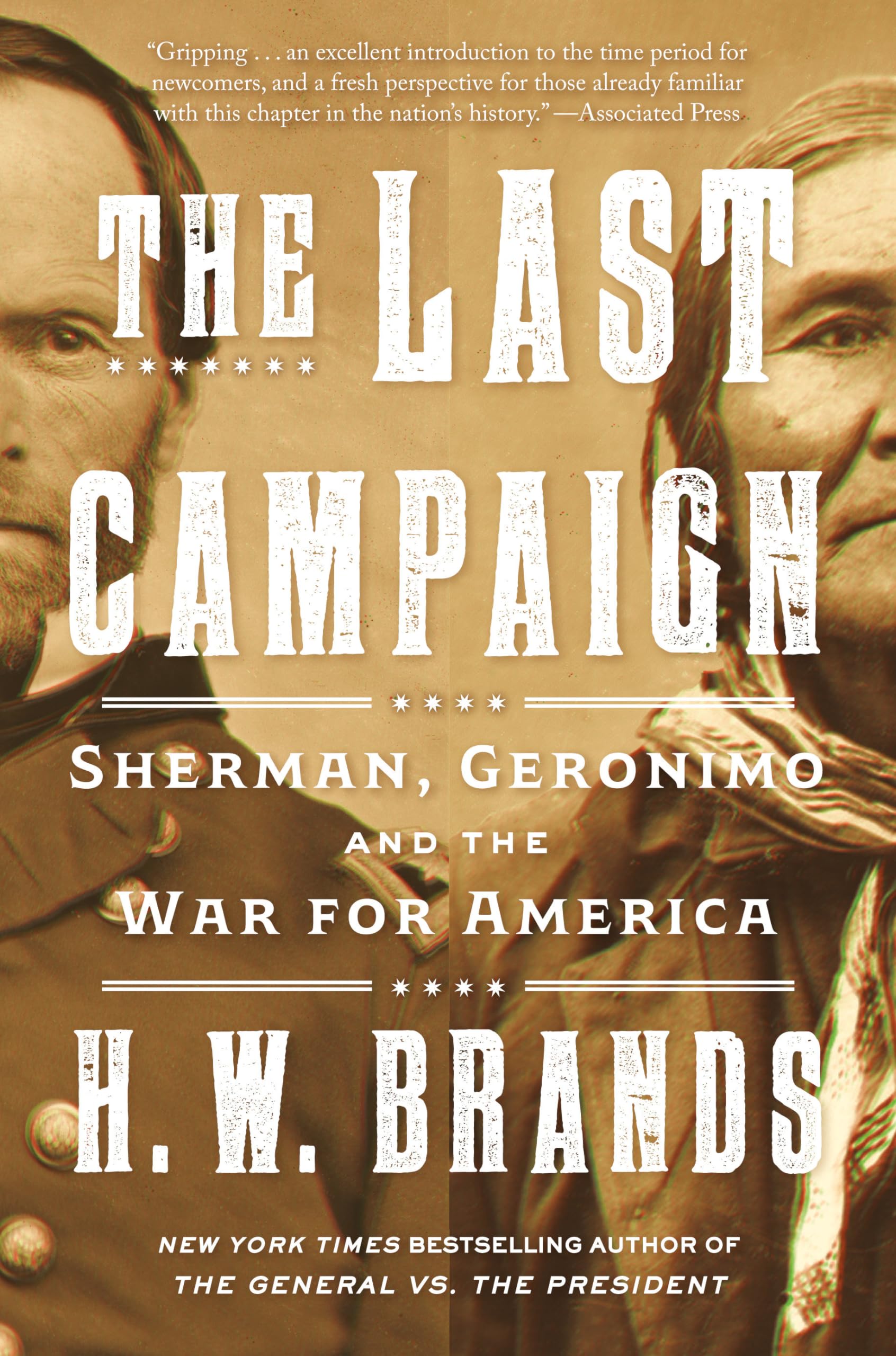
The Last Campaign: Sherman, Geronimo and the War for America (Vintage Books)
$12.80
by H. W. Brands



Bestselling historian and Pulitzer Prize finalist H. W. Brands follows the lives of General William Tecumseh Sherman and Apache war leader Geronimo to tell the story of the Indian Wars and the final fight for control of the American continent. "Gripping...Brands’ writing style and his mastery of history make the book an excellent introduction to the time period for newcomers, and a fresh perspective for those already familiar with this chapter in the nation’s history.” —AP William Tecumseh Sherman and Geronimo were keen strategists and bold soldiers, ruthless with their enemies. Over the course of the 1870s and 1880s these two war chiefs would confront each other in the final battle for what the American West would be: a sparsely settled, wild home where Indian tribes could thrive, or a more densely populated extension of the America to the east of the Mississippi. Sherman was a well-connected son of Ohio who attended West Point and rose to prominence through his scorched-earth campaigns in the Civil War. Geronimo grew up among the Apache people, hunting wild game for sustenance and roaming freely on the land. After the brutal killing of his wife, children and mother by Mexican soldiers, he became a relentless avenger, raiding Mexican settlements across the American border. When Sherman rose to commanding general of the Army, he was tasked with bringing Geronimo and his followers onto a reservation where they would live as farmers and ranchers and roam no more. But Geronimo preferred to fight. The Last Campaign is a powerful retelling of a turning point in the making of our nation and a searing elegy for a way of life that is gone. "Brands is a talented storyteller, with a novelist’s feel for pacing and detail.” — The Wall Street Journal “Sweeping. . . An excellent, well-written study—like most of the author’s books, a welcome addition to the literature of westward expansion.” — Kirkus Reviews *Starred Review* H. W. BRANDS holds the Jack S. Blanton Sr. Chair in History at the University of Texas at Austin. He has written more than a dozen biographies and histories, including The General vs. the President , a New York Times bestseller, and Our First Civil War , his most recent book. Two of his biographies, The First American and Traitor to His Class , were finalists for the Pulitzer Prize. Chapter 1 I was born in No-doyohn Canyon, Arizona, June, 1829,” Geronimo recalled from the distance of old age. “In that country, which lies around the headwaters of the Gila River, I was reared. This range was our fatherland; among these mountains our wigwams were hidden; the scattered valleys contained our fields; the boundless prairies, stretching away on every side, were our pastures; the rocky caverns were our burying places.” Geronimo’s people, the Apaches, had not always lived near the Gila River. Their language was of the Athabaskan family, revealing roots far to the north, among the tribes of the Northwest Coast. The Apaches had migrated to the desert and mountains of the Southwest, probably under compulsion, for life was harder there. They reached the Gila River a few centuries before Geronimo’s birth, perhaps around the time Columbus reached the West Indies. Geronimo was the fourth in a family of eight children. They were four boys and four girls. “As a babe I rolled on the dirt floor of my father’s tepee, hung in my tsoch”—cradle—“at my mother’s back, or suspended from the bough of a tree,” he said. “I was warmed by the sun, rocked by the winds, and sheltered by the trees as other Indian babes.” As he grew, he learned. “My mother taught me the legends of our people; taught me of the sun and sky, the moon and stars, the clouds and storms. She also taught me to kneel and pray to Usen”—God—“for strength, health, wisdom, and protection. We never prayed against any person, but if we had aught against any individual we ourselves took vengeance. We were taught that Usen does not care for the petty quarrels of men.” Other lessons came from his father. “My father had often told me of the brave deeds of our warriors, of the pleasures of the chase, and the glories of the warpath,” Geronimo said. He and his brothers emulated what they heard. “We played that we were warriors. We would practice stealing upon some object that represented an enemy, and in our childish imitation often perform the feats of war. Sometimes we would hide away from our mother to see if she could find us, and often when thus concealed go to sleep and perhaps remain hidden for many hours.” With age came responsibility. “When we were old enough to be of real service, we went to the field with our parents not to play, but to toil. When the crops were to be planted we broke the ground with wooden hoes. We planted the corn in straight rows, the beans among the corn, and the melons and pumpkins in irregular order over the field. We cultivated these crops as there was need.” Plots were modest in size. “Our field usually contained ab