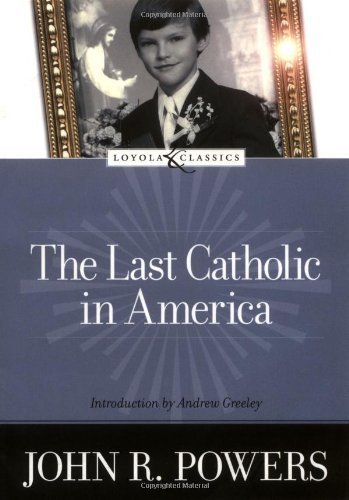



“It is fast-moving and often downright funny.”— New York Times “He has recaptured childish innocence and presented it with adult enlightenment—plus a touch of cynicism—yet never with irreverence.” — Book-of-the-Month Club News First confession and its terrors. Eighty-four first graders in a classroom ruled by just one nun. The agony and the ecstasy of Lent. The dubious honor of being declared the worst altar server ever. Dinah Shore and the Blessed Virgin haunting your dreams. This is Eddie Ryan’s world as he grows up in the intensely Catholic world of South-Side Chicago’s St. Bastion’s parish in the 1950s. In this classic coming-of-age novel, John Powers draws readers into Eddie Ryan’s world with deep affection and bittersweet humor. First Confession and its terrors. First grade with eighty-four other students and one nun to rule them all. The agony and the ecstasy of Lent. The Worst Altar Server Ever. Dinah Shore and the Blessed Virgin, haunting your dreams. This is Eddie Ryan’s world—the intensely Catholic world of Chicago’s Seven Holy Tombs neighborhood and St. Bastion’s parish in the 1950s. In this classic coming-of-age novel, John Powers draws readers into Eddie Ryan’s world with bittersweet humor and deep affection. “It is fast-moving and often downright funny.”— New York Times “He has recaptured childish innocence and presented it with adult enlightenment—plus a touch of cynicism—yet never with irreverence.” —Book-of-the-Month Club News First confession and its terrors. Eighty-four first graders in a classroom ruled by just one nun. The agony and the ecstasy of Lent. The dubious honor of being declared the worst altar server ever. Dinah Shore and the Blessed Virgin haunting your dreams. This is Eddie Ryan’s world as he grows up in the intensely Catholic world of South-Side Chicago’s St. Bastion’s parish in the 1950s. In this classic coming-of-age novel, John Powers draws readers into Eddie Ryan’s world with deep affection and bittersweet humor. John R. Powers was born in 1945 on the South Side of Chicago. He earned a BA in sociology from Loyola University Chicago and an MA and a PhD in communications from Northwestern University. He wrote his doctoral dissertation on Studs Terkel, a Chicago radio personality and writer known for his oral histories ( Hard Times , The Good War ). Powers was a professor of speech and performing arts at Northeastern Illinois University for six years. He also created and hosted a number of specials for Chicago public television during this time. Powers’s stories first appeared in the form of articles written for Chicago magazine. The novels followed in quick succession: The Last Catholic in America , Do Black Patent Leather Shoes Really Reflect Up?, and The Unoriginal Sinner and the Ice-Cream God . He has written one other novel, The Junk-Drawer Corner-Store Front-Porch Blues , as well as Odditude: Finding the Passion for Who You Are and What You Do . He and his wife, JaNelle, have two daughters, Jacey and Joy. He lives in Lake Geneva, Wisconsin, and is a motivational speaker. Introduction Andrew Greeley The invitation to write an introduction for a new edition of John R. Powers’s The Last Catholic in America, to be included in a series of “classics” astonished me. How long did it take for a Catholic novel to become a classic? Dr. Powers had written the book only a couple of years ago, had he not? My astonishment turned to dismay when I saw the 1973 copyright date—more than enough time to become a classic! I devoured the book again just as I had more than thirty years ago, enjoying it just as much as I had then, perhaps even more. Back in 1973, it was one of the first of the now extensive literature of Catholic nostalgia, which includes memoirs, fiction, and drama. The Last Catholic in America paved the way for the rest and is, far and away, the most humane of the lot. Powers’s novels are indeed nostalgic. They are also wise, hilarious, biting, and observant. They are fine examples of the coming-of-age tale, written with a pitch-perfect balance between the innocence of the child and the bittersweet knowledge of the adult. For beyond our relief at getting beyond all of what we laugh at, sometimes incredulously, haunts a suspicion that something meaningful has been lost. That’s where the nostalgia enters—for the pains and joys of Catholic life before the Second Vatican Council. What’s amazing is that The Last Catholic in America was published less than ten years after the close of the Second Vatican Council (1962–1965), the massive gathering of all Roman Catholic bishops convened by Pope John XXIII, and that ten years made all the difference—to the world of Eddie Ryan, that is. For no doubt, if St. Bastion’s were a real parish, and you’d gone there in 1973, you’d find a far different place than Eddie Ryan knew in the 1950s or even in 1965. There’d be no Latin Masses; the nuns who were left would have changed their long habits for something more pract