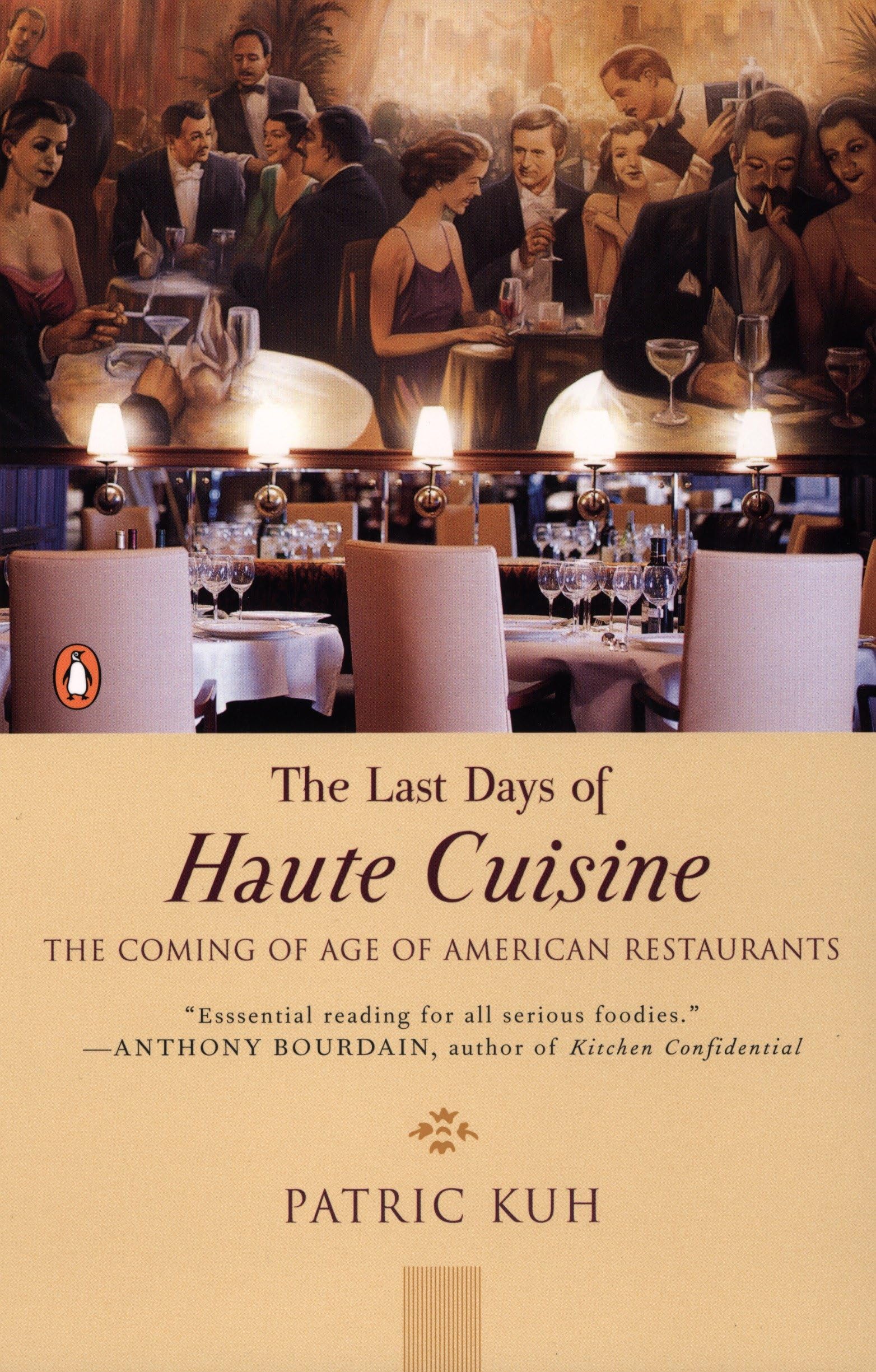
The Last Days of Haute Cuisine: The Coming of Age of American Restaurants
$15.96
by Patric Kuh



“Essential reading for all serious foodies.”—Anthony Bourdain, author of Kitchen Confidential Combining an insider’s passion with down-to-earth humor, chef and food writer Patric Huk traces the evolution of American high-style restaurants from the 1941 opening of Le Pavillon to the recent rise of less traditional restaurants, such as Le Cirque, Spago, and Danny Meyer’s Union Square group. Huk takes readers inside this high-stakes business, sharing little-known anecdotes, describing legendary cooks and bright new star chefs, and relating his own reminiscences. Populated by a host of food personalities, including Julia Child, M. F. K. Fisher, and James Beard, Kuh’s social and cultural history of America’s great restaurants reveals major changes in US cuisine. “A fascinating and compulsively readable story of the American restaurant and the larger-than-life people who made this the world’s most exciting restaurant scene.”—Michael Ruhlman, author of The Soul of a Chef Patric Kuh is a Paris-trained chef who has worked in preeminent restaurants in France, New York, and California. He has written for Gourmet, Esquire , and Salon.com and is the author of a novel, An Available Man . He lives in Los Angeles, California. The Last Days of Haute Cuisine The Coming of Age of American Restaurants By Patric Kuh Penguin Books Copyright © 2002 Patric Kuh All right reserved. ISBN: 0142000310 Chapter One FIRST BITE Just off the Avenue de l'Opéra in Paris, not far from the neighborhoodknown as Les Grands Boulevards, in the tiny Place Gaillon, is theRestaurant Drouant. It is painted appropriately enough the same dove-grayas a boulevardier's spats, and in the same spirit the entire buildingis rakishly well maintained. The first-floor windows have pottedcarnations, the corner molding reads "Drouant 1880," and the oysterdisplays are backed up against the outside walls, shielded from thepassing traffic by a bank of sculpted shrubs. It is a few minutes' walkfrom here to the Palais Garnier opera house and only a slightly longerstroll to the Comédie Française and the colonnaded gallery of thePalais Royal. It is, however, a long way from here to a reclaimedlandfill in the borough of Queens, New York, though that is where thisquintessential Belle Époque restaurant may have left its most lastingmark. It was from Drouant and its sister restaurant, the nearby Café deParis, that a group of restaurant workers would embark to open therestaurant at the French Pavilion at the 1939 World's Fair. The fair washeld within sight of the Manhattan skyline, on a piece of land that Life magazine, even as it tried to promote the fair, could only describe as"a desolate, swampy, stinking expanse called Flushing Meadow." TheFrench Pavilion was meant to communicate something finer, a certainidea of France?and in a very Parisian way, it did. The second-floorbalcony of the restaurant looked across the Lagoon of Nations with allthe elegant entitlement of the terrace of Fouquet's on the Champs-Élysées,as if its every fluttering parasol were announcing to thecountry that the French had arrived. The president of the fair, Grover A. Whalen, wrote that it"was built and dedicated to the people." Brotherly spirit was in the airand the theme that the entire fair was centered around was nothingless than "The World of Tomorrow." In the real world of tomorrow,Hitler would be invading Poland on September 1 of that year; but inthe world of tomorrow the way the organizers meant it, everyonewould have a GE toaster, a Chevy in the driveway, and AT&T long distance.Subtlest of all the promotional devices was the concept of audienceinteraction. The hard sell would have introduced a jarring notewithin the communal spirit of the fair and so, instead of simply showinga product as one did in a showroom, corporations showed Americanshow the products worked. Thus, a market segment became "anaudience," a sales floor became "a diorama," and a pitch "a demonstration." At General Motors's "Futurama" exhibit, fairgoers could gazeat Norman Bel Geddes's design for a city surrounded by fourteen-lanehighways that somehow managed to be both car-filled and fast-moving.Meanwhile, AT&T provided a balcony where three hundredpeople at a time could listen in on one lucky person's free long-distanceconversation. GE brought its audience in by having engineersput five million volts of electricity through a hot dog to see if it wouldcook. (It wouldn't; it simply tasted burned.) Among international participants,the English may have failed to understand the subtlety of theinteractive method when they brought the Magna Carta, an objectthat could not be bought. The French did not make that same mistake.They did not bring Gobelin tapestries or the Mona Lisa ; they brought arestaurant that could seat four hundred, Le Pavilion de France. The team of men who would work at this restaurant had beenput together in France like specialists for a heist. The