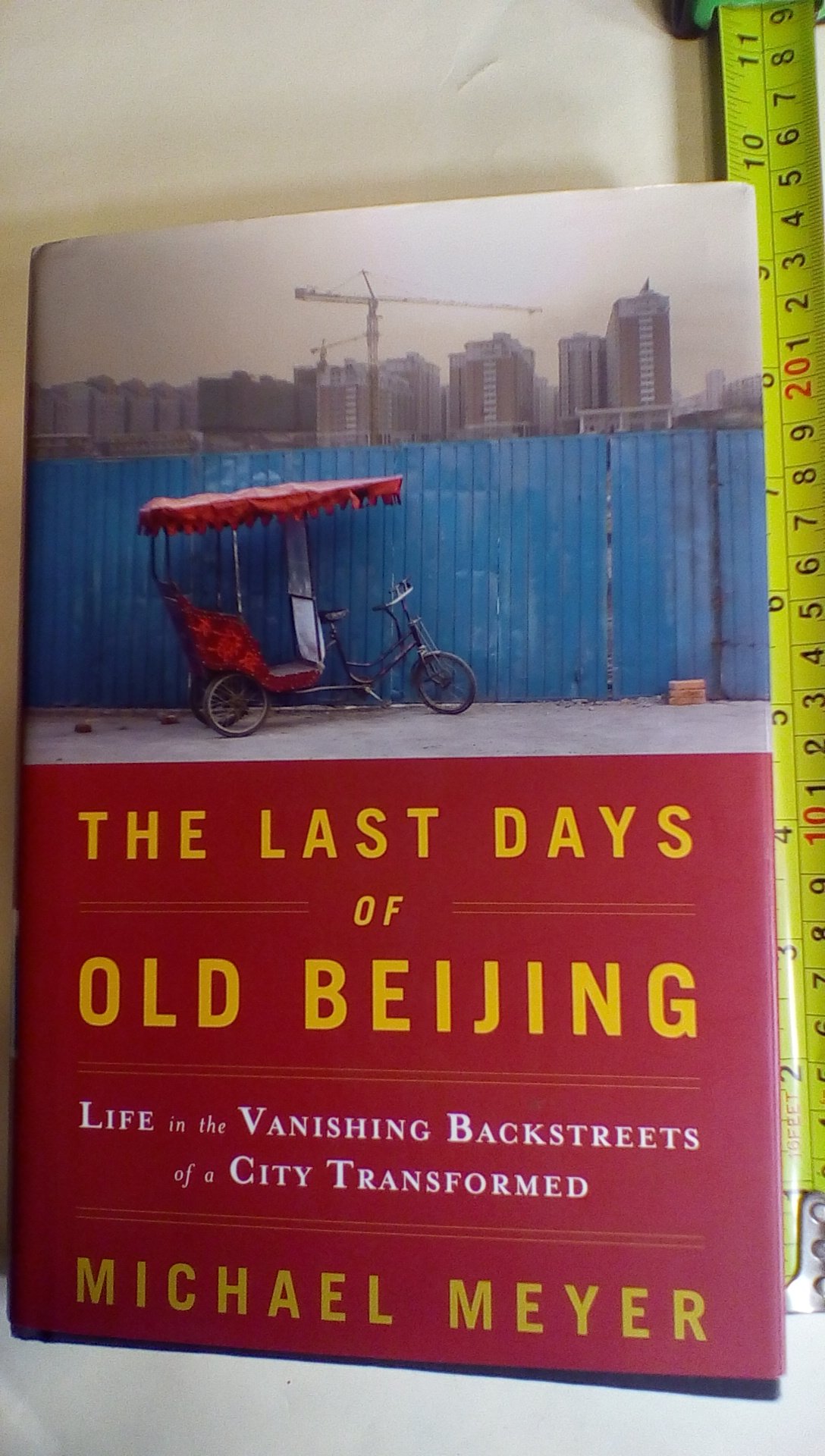
The Last Days of Old Beijing: Life in the Vanishing Backstreets of a City Transformed
$14.59
by Michael Meyer



A fascinating, intimate portrait of Beijing through the lens of its oldest neighborhood, facing destruction as the city, and China, relentlessly modernizes. Soon we will be able to say about old Beijing that what emperors, warlords, Japanese invaders, and Communist planners couldn’t eradicate, the market economy has. Nobody has been more aware of this than Michael Meyer. A long-time resident, Meyer has, for the past two years, lived as no other Westerner—in a shared courtyard home in Beijing’s oldest neighborhood, Dazhalan, on one of its famed hutong (lanes). There he volunteers to teach English at the local grade school and immerses himself in the community, recording with affection the life stories of the Widow, who shares his courtyard; coteacher Miss Zhu and student Little Liu; and the migrants Recycler Wang and Soldier Liu; among the many others who, despite great differences in age and profession, make up the fabric of this unique neighborhood. Their bond is rapidly being torn, however, by forced evictions as century-old houses and ways of life are increasingly destroyed to make way for shopping malls, the capital’s first Wal-Mart, high-rise buildings, and widened streets for cars replacing bicycles. Beijing has gone through this cycle many times, as Meyer reveals, but never with the kind of dislocation and overturning of its storied culture now occurring as the city prepares to host the 2008 Summer Olympics. Weaving historical vignettes of Beijing and China over a thousand years through his narrative, Meyer captures the city’s deep past as he illuminates its present. With the kind of insight only someone on the inside can provide, The Last Days of Old Beijing brings this moment and the ebb and flow of daily lives on the other side of the planet into shining focus. One of the wonders and terrors of freewheeling capitalism is its dynamism. Old ideas, technologies, and physical structures are swept aside without sentimentality or regard for the human costs. This is especially evident in the rapidly emerging economies of India and China, where the old struggles to coexist with the new. Meyer first went to China as a Peace Corps volunteer in 1995, and he continues to reside in one of the few remaining old neighborhoods in Beijing, one that is clearly doomed, as high-rises, shopping malls, and widened avenues move ever closer. Meyer describes his adopted home ground with a mixture of affection and hard realism. Living conditions are harsh, homes are crowded, the wood in many structures is rotting, and outhouses rather than indoor plumbing are the norm. Yet residents, including Meyer, have a strong and stubborn attachment to their community; he provides touching examples of how many strive to stay put. A wistful, charming paean to a community and way of life that is soon to be swept away in the name of progress. --Jay Freeman "Meyer's powerful book is to Beijing what Jane Jacobs's The Death and Life of Great American Cities was to New York City." — Publishers Weekly , Starred Review "An emissary from a nation that routinely junks its own past and starts anew, Meyer finds himself a champion of an unpopular cause."—Holly Brubach, T: The New York Times Style Magazine "His book reads like a love letter to the hutongs and to Old Beijing itself, a snapshot snatched before the scene disappears forever." —Rob Gifford, Slate Magazine "A charming memoir and a compelling work of narrative nonfiction about the city itself." —Ian Johnson, Wall Street Journal "The book...is a delightfully observed view of a vast part of Chinese society that barely was glimpsed during the recent Olympics, yet is fading away."—Kim Ode, Minneapolis Star Tribune "Heartfelt, understated, readable prose." — Utah Daily Herald "But his history of land development in Beijing, from the time of the Italian Jesuit Matteo Ricci to Mao to the present, and of attempts in Hanoi, Havana and other Communist cities to preserve their own sense of place, are just as compelling (and sad) to read." —Richard B. Woodward, New York Times Travel Section. "[A] substantive, smart book...Meyer knows the ins and outs of hutong history because he's one of the few Westerners to have ever lived in one." —Maureen Corrigan, Fresh Air "In "The Last Days of Old Beijing: Life in the Vanishing Backstreets of a City Transformed," longtime resident Michael Meyer eloquently portrays the madness of the city during this period." —Karl Taro Greenfeld, Los Angeles Times "Michael Meyer tells the story of Beijing’s destruction from the perspective of one tiny hutong (narrow lane) neighbourhood to the south of Tiananmen Square where he taught in a school. A spiritedness shines through among his earthy neighbours, even in the face of what Mr. Meyer calls "the Hand", which, visiting always at night, paints the Chinese character for "destroy" on houses that are to be razed." — The Economist "All in all, his record of the dying ways of a city is an impressive feat." —Kate Sek