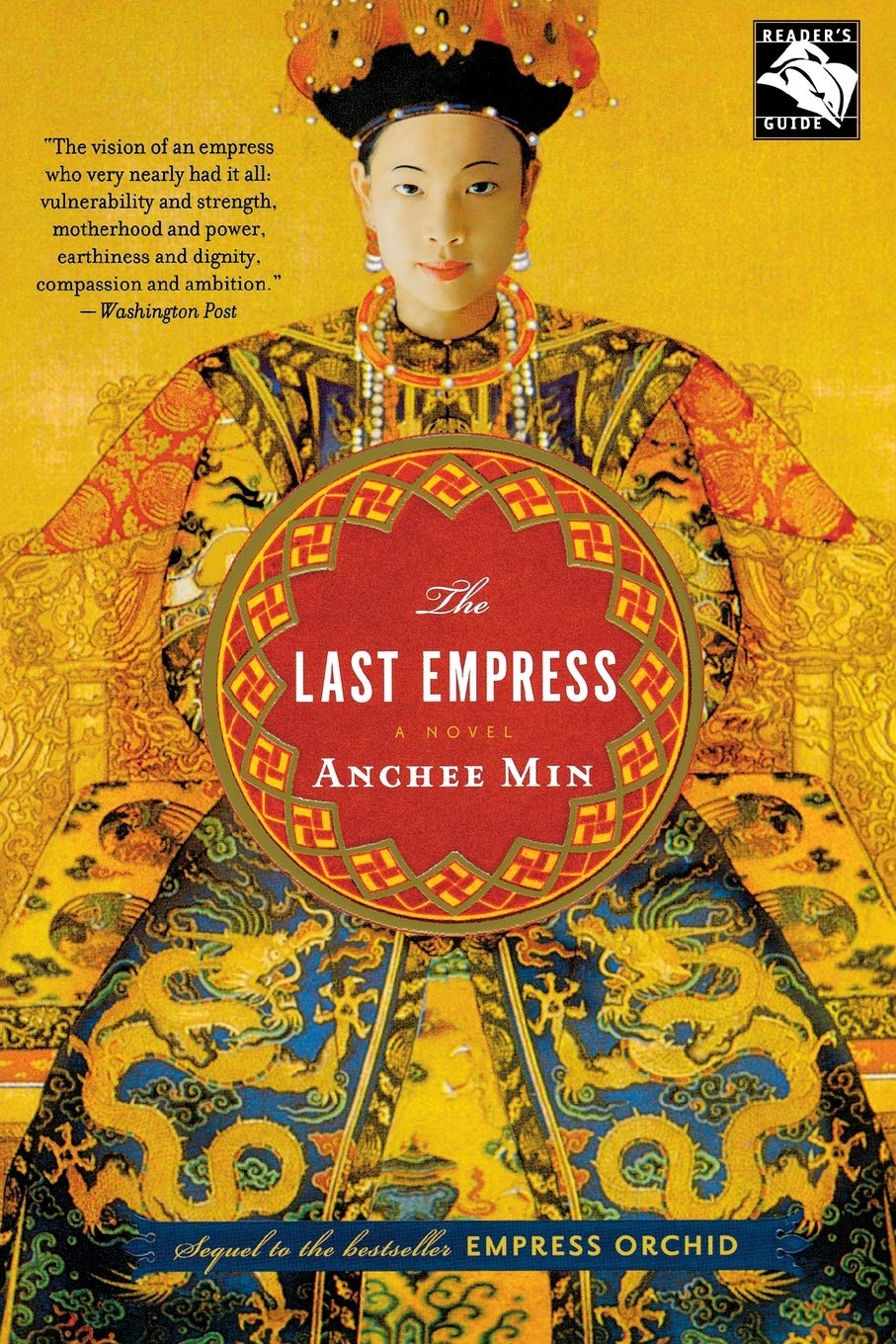



The last decades of the nineteenth century were a violent period in China’s history marked by humiliating foreign incursions and domestic rebellion, ultimately ending in the demise of the Ch’ing dynasty. The only constant during this tumultuous time was the power wielded by one person, the resilient, ever-resourceful Tzu Hsi, Lady Yehonala -- or Empress Orchid, as readers came to know her in Anchee Min’s critically acclaimed novel covering the first part of her life. The Last Empress is the story of Orchid’s dramatic transition from a strong-willed, instinctive young woman to a wise and politically savvy leader who ruled China for more than four decades. Moving from the intimacy of the concubine quarters into the spotlight of the world stage, Orchid must face not only the perilous condition of her empire but also a series of devastating personal losses, as first her son and then her adopted son succumb to early death. Yearning only to step aside, and yet growing constantly into her role, only she—allied with the progressives, but loyal to the conservative Manchu clan of her dynasty—can hold the nation’s rival factions together. Anchee Min offers a powerful revisionist portrait based on extensive research of one of the most important figures in Chinese history. Viciously maligned by the western press of the time as the “Dragon Lady,” a manipulative, blood-thirsty woman who held onto power at all costs, the woman Min gives us is a compelling, very human leader who assumed power reluctantly, and who sacrificed all she had to protect those she loved and an empire that was doomed to die. Anchee Min was born in Shanghai in 1957. At seventeen she was sent to a labor collective, where a talent scout for Madame Mao’s Shanghai Film Studio recruited her to work as a movie actress. She came to the United States in 1984 with the help of actress Joan Chen. Her memoir, Red Azalea, was named one of the New York Times Notable Books of 1994 and was an international bestseller, with rights sold in twenty countries. Her novels Becoming Madame Mao and Empress Orchid were published to critical acclaim and were national bestsellers. Her two other novels, Katherine and Wild Ginger, were published to wonderful reviews and impressive foreign sales. The Beginning In 1852, a beautiful seventeen-year-old girl from an important but impoverished family of the Yehonala clan arrived in Peking as a minor concubine to the young Emperor, Hsien Feng. Tzu Hsi, known as Orchid as a girl, was one among hundreds of concubines whose sole purpose was to bear the Emperor a son. It was not a good time to enter the Forbidden City, a vast complex of palaces and gardens run by thousands of eunuchs and encircled by a wall in the center of Peking. The Ch'ing Dynasty was losing its vitality and the court had become an insular, xenophobic place. A few decades earlier, China had lost the first Opium War, and it had done little since to strengthen its defenses or improve its diplomatic ties to other nations. Within the walls of the Forbidden City the consequences of a misstep were often deadly. As one of hundreds of women vying for the attention of the Emperor, Orchid discovered that she must take matters into her own hands. After training herself in the art of pleasing a man, she risked everything by bribing her way into the royal bedchamber and seducing the monarch. Hsien Feng was a troubled man, but for a time their love was passionate and genuine, and soon she had the great fortune to bear him his only son and heir. Elevated to the rank of Empress, Orchid still had to struggle to maintain her position as the Emperor took new lovers. The right to raise her own child, who was under the control of Empress Nuharoo, the Emperor's senior wife, was constantly at issue. The invasion by Britain, France, and Russia in 1860, and the subsequent occupation of Peking, forced the Chinese court into exile in the distant hunting reserve of Jehol, beyond the Great Wall. There the humiliating news of the harsh terms for peace contributed to the decline of the Emperor's health. With the death of Hsien Feng came a palace coup, which Orchid helped to foil with the help of her brother-in-law Prince Kung and General Yung Lu. The handsome Yung Lu reignited romantic feelings in the still young Orchid, but in her new position of power there was little opportunity for a personal life. As coregent with Empress Nuharoo until her son's maturity, Empress Orchid was at the beginning of a long and tumultuous reign that would last into the next century. 1 Mother's eyes were closed when she died. But a moment later they cracked open and remained open. 'Your Majesty, please hold the eyelids and try your best to close them," Doctor Sun Pao-tien instructed. My hands trembled as I tried. Rong, my sister, said that Mother meant to close her eyes. She had waited for me for too long. Mother did not want to interrupt my audience. 'try not to trouble people' was Mother's philosophy. She