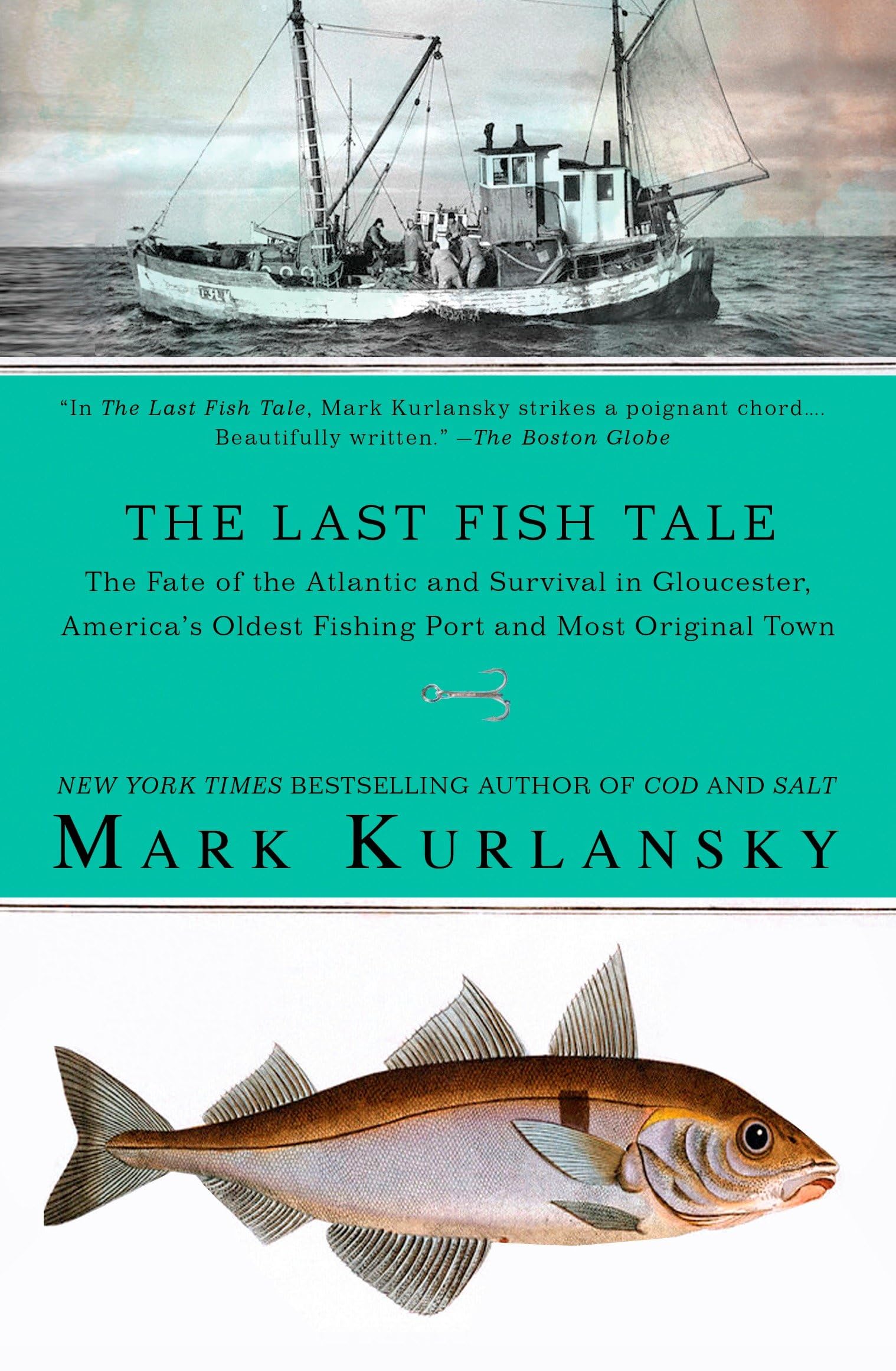
The Last Fish Tale: The Fate of the Atlantic and Survival in Gloucester, America's Oldest Fishing Port and Most Original Town
$14.93
by Mark Kurlansky



"A marvelous, compelling tale"( Rocky Mountain News ) from the New York Times bestselling author of Salt and Cod . Gloucester, Massachusetts, America's oldest fishing port, is defined by the culture of commercial fishing. But the threat of over-fishing, combined with climate change and pollution, is endangering a way of life, not only in Gloucester but in coastal cities all over the world. And yet, according to Kurlansky, it doesn't have to be this way. Engagingly written and filled with rich history, delicious anecdotes, colorful characters, and local recipes, The Last Fish Tale is Kurlansky's most urgent story, "an engrossing multi-layered portrait of a fishing community that can be read for pure pleasure as well as being a campaigning plea for the environment" ( Financial Times ). "A heartfelt tribute...as beautifully-written as the fondest and best-crafted eulogy." - Boston Globe "A colorful history of Gloucester...rich, varied, and satisfying, just like a good chowder." - Entertainment Weekly Mark Kurlansky is the New York Times bestselling author of many books, including Cheesecake , The Food of a Younger Land , Cod: A Biography of the Fish That Changed the World ; Salt: A World History ; 1968: The Year That Rocked the World ; and The Big Oyster: History on the Half Shell . He has received the Dayton Literary Peace Prize, Bon Appetit’s Food Writer of the Year Award, the James Beard Award, and the Glenfiddich Award. He lives in New York City. Chapter One The First Gloucester Story From hence doth stretch into the sea the fair headland Tragabigzanda fronted with three isles called the Three Turks’ Heads. —John Smith, Description of New England, 1616 There are two kinds of stories told in gloucester: fish tales and Gloucester stories. A fish tale exaggerates to make things look bigger. It is triumphal. When in the early seventeenth century George Waymouth reported that the cod caught off New England were five feet long with a three-foot circumference, this may have been a fish tale. We don’t know. Surely the Reverend Francis Higginson’s reports from Salem in 1630 that lions had been seen running wild in Cape Ann, or that the squirrels could fly from tree to tree, were fish tales. A Gloucester story is just the opposite. It is a story of miserable irony in which things are shown in their worst light, a story with a sad ending. Often the history of a place begins with the person who named it. But in the case of Gloucester, the story begins with the men who didn’t— the ones who tried to name it and failed. The naming of Gloucester is an entire cycle of Gloucester stories. The earliest Europeans to arrive at what is today Cape Ann are thought to have been the Vikings, who, according to the written Icelandic legends known as the Sagas, sailed in 1004 down the North American coast from Labrador to Newfoundland to a place they called Vineland. For a long time it was debated whether to believe this story. But in 1961 the remains of eight Viking turf houses dating to the year 1000 were found in a place in Newfoundland known as L’Anse aux Meadows. Where, then, was Vineland? Today many historians believe that it was the coastline of New England, named after the wild grapes that grew there. According to another story, in 1004, Leif Ericson’s brother Thorwald landed on Cape Ann and named it Cape of the Cross. But neither the name nor Thorwald went far. Thorwald died on the expedition and those historians who believe the story at all think that he is buried somewhere on Cape Ann. And that is the first Gloucester story. In 1606, Samuel de Champlain, a French explorer of the coast of Maine, sailed down to Cape Ann, and seeing three islands off its tip— now called Thachers, Milk, and Straitsmouth Islands—he named the peninsula with the great gray granite boulders marking its headlands, the Cape of Three Islands, which even if said in French, Cap aux Trois Îles, is not much of a name. He noted that there were actually two rocky headlands and a passage between them, which he sailed through taking depth soundings as he went, thus charting the course that fishermen home from the sea have been using ever since—from Thachers around East Gloucester to Eastern Point, into the harbor between West and East Gloucester. Champlain thought this was an extraordinary harbor, deep and sheltered with ample mooring space, and he spent three months charting it. He named it Le Beau Port, which was a little more poetic than the Cape of Three Islands, but was destined to be no more durable. Being a skilled seaman, he found anchorage in the safest, most leeward cove in the harbor, but that was not to bear his name either. Instead, the sheltered nook is known today as Smith Cove, named after the young English adventurer, thirty- four-year-old Captain John Smith, who arrived eight years later, in 1614. This Englishman was very different from Champlain. Though they both were prodigious writers, Champlain’s writing