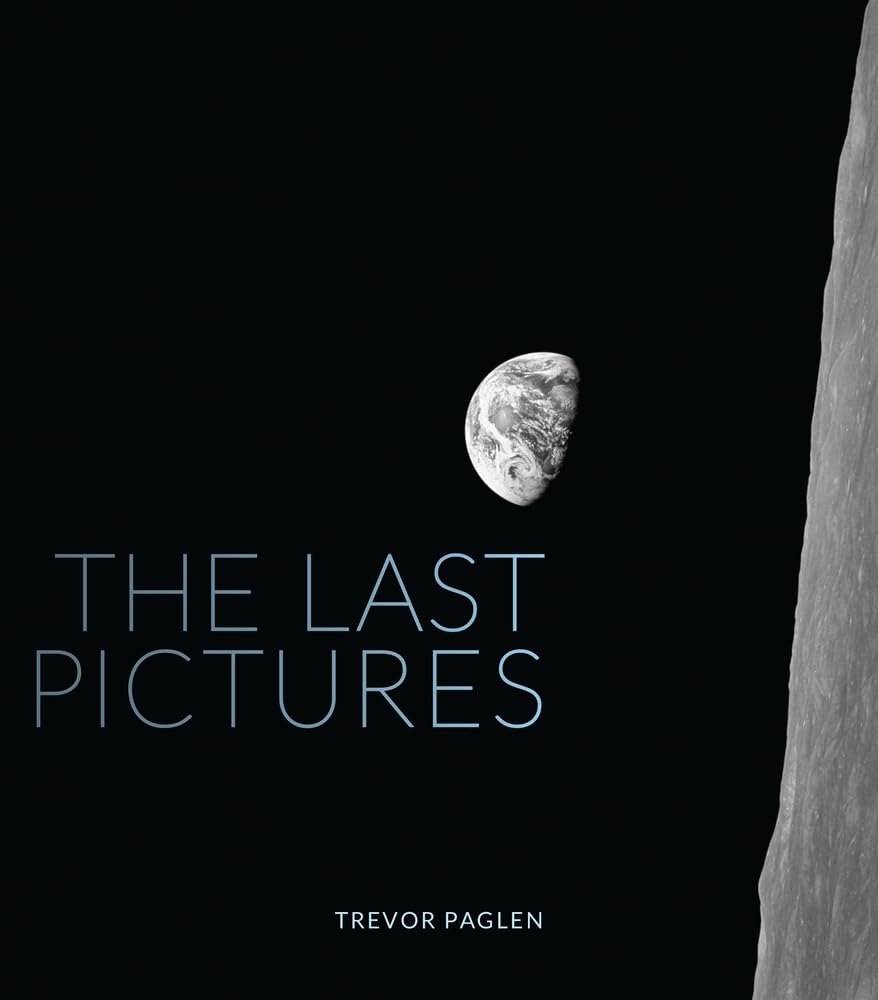



Human civilizations' longest lasting artifacts are not the great Pyramids of Giza, nor the cave paintings at Lascaux, but the communications satellites that circle our planet. In a stationary orbit above the equator, the satellites that broadcast our TV signals, route our phone calls, and process our credit card transactions experience no atmospheric drag. Their inert hulls will continue to drift around Earth until the Sun expands into a red giant and engulfs them about 4.5 billion years from now. The Last Pictures , co-published by Creative Time Books, is rooted in the premise that these communications satellites will ultimately become the cultural and material ruins of the late 20th and early 21st centuries, far outlasting anything else humans have created. Inspired in part by ancient cave paintings, nuclear waste warning signs, and Carl Sagan's Golden Records of the 1970s, artist/geographer and MacArthur "Genius" Fellow Trevor Paglen has developed a collection of one hundred images that will be etched onto an ultra-archival, golden silicon disc. The disc, commissioned by Creative Time, will then be sent into orbit onboard the Echostar XVI satellite in September 2012, as both a time capsule and a message to the future. The selection of 100 images, which are the centerpiece of the book, was influenced by four years of interviews with leading scientists, philosophers, anthropologists, and artists about the contradictions that characterize contemporary civilizations. Consequently, The Last Pictures engages some of the most profound questions of the human experience, provoking discourse about communication, deep time, and the economic, environmental, and social uncertainties that define our historical moment. Copub: Creative Time Books The book showcases a diversity of photographic technologies, from surveillance shots taken by a drone to close-ups of the Ebola virus captured by an electron micrograph; this shuffling together of radically disparate scales makes for a thought-provoking browsing experience. The Last Pictures tells a dark but urgent story about present conditions of representational frustration. In the here and now, we have this book, a partial but chilling document of what we were, what we are, and what we might become. —Julia Bryan-Wilson “This is not just a publicist-driven fancy. . . . [Paglen’s images are] aesthetic and allegorical. . . . A unique tale of human history.” ― Wallpaper Published On: 2013-02-01 "The images are wondrous, paradoxical, and awe-inspiring." -- Dara Solomon ― Prefix Published On: 2013-12-01 “This is not just a publicist-driven fancy. . . . [Paglen’s images are] aesthetic and allegorical. . . . A unique tale of human history.” ― Wallpaper Published On: 2013-02-01 "The images are wondrous, paradoxical, and awe-inspiring." -- Dara Solomon ― Prefix Published On: 2013-12-01 Trevor Paglen is an internationally recognized artist, writer, scholar, and MacArthur "Genius" Fellow working across multiple disciplines in a variety of media. Among his books are Blank Spots on the Map , Torture Taxi , and I Could Tell You But Then You Would Have to Be Destroyed by Me . His art is in the permanent collections of numerous museums including the Metropolitan Museum of Art, the San Francisco Museum of Modern Art, and the Smithsonian Museum of American Art. The Last Pictures By Trevor Paglen UNIVERSITY OF CALIFORNIA PRESS Copyright © 2012 Trevor Paglen All rights reserved. ISBN: 978-0-520-27500-3 Contents Foreword by Anne Pasternak and Nato Thompson, viii, Introduction: Geographies of Time, x, 1 Ancient Aliens, 2, 2 One Hundred Pictures, Frozen in Time, 8, 3 One Hundred Pictures, 24, 4 Field Notes, 176, Epilogue, 186, Acknowledgments, 189, Credits, 194, CHAPTER 1 ANCIENT ALIENS On an upper floor of a nondescript high-rise in Toronto, I sat behind Ted Molczan's desk, peering over his shoulder at an Excel spreadsheet on his large LCD monitor. A scatter chart plotted the distribution of flash timings made by a satellite that he had spent years observing. Molczan, one of the world's leading amateur observers—whose particular specialty involves tracking secret spacecraft—strongly suspected that this particular object wasn't actually much of a satellite. Instead, he believed, it was a Mylar balloon deployed by the American military, a decoy to draw attention away from a highly classified "stealth" satellite code-named MISTY. The long flash timings indicated that the object was slowly rotating as it hurtled through space, nearly 3,000 kilometers (just over 1,800 miles) above Earth. I'd travelled to Toronto to watch the night sky with Molczan, and he'd been a generous host. We watched the suspected decoy slowly amble across the sky, and we observed brighter and faster satellites designed for reconnaissance missions. Molczan showed me a castaway rocket body hurtling through the heavens and the faint flicker of an unknown object in