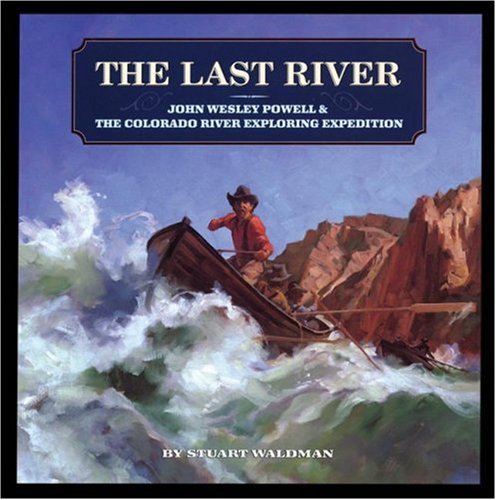
The Last River: John Wesley Powell and the Colorado River Exploring Expedition (Great Explorers)
$58.42
by Stuart Waldman



The one-armed professor who conquered the mighty Colorado. No European had ever taken boats down the Colorado river and come out alive. In May 1869, ten men boarded four rowboats in Green River City, Wyoming. Three months and 1,000 miles later, just two battered boats carrying six exhausted and starving men emerged from the depths of the Grand Canyon. The Last River tells their remarkable story. The man who challenged the Colorado was different from other explorers. Major John Wesley Powell was a small, bookish, one-armed geology professor from a midwestern farm. Despite his size and the constant pain from the Civil War wound that had cost him his arm, Powell's twin passions -- adventure and scientific exploration -- drew him to the Colorado River. For three months he and nine crew members made their home on the river. They thrilled to riding the rapids and endured the back-breaking labor of transporting boats and cargo past rapids too dangerous to run. They discovered canyons of unsurpassed beauty and gave them names like Music Temple and Canyon of Lodore. They saved each other from drowning, and suffered together as their food supply dwindled to nearly nothing. Excerpts from journals of crew members personalize the gripping text. Original paintings and a fold-out map allows the reader to simultaneously follow the expedition's route and its adventures. The Last River is an inspiring and riveting true adventure written with drama and compassion that brings history to life. Grade 3-6–In 1869, a one-armed Civil War veteran who was mad about geology gathered a small crew to explore the last blank space left on the U.S. map: the Colorado River. A description of the areas natural history segues right into the adventure. Powell and his men were the first on record to run the rivers rapids from a tributary in Wyoming down through the Grand Canyon. It was a wild ride–rowboats smashing, Powell dangling from a canyon wall by a rescuers long underwear, brutal conditions, resentment of the leader, disappearing men–and this book does it justice. Well-chosen thrills, spills, and conflicts are spliced into a narrative that highlights the danger underlying this scientific mission. Readers learn about Powell and what drove him, but its the journey that takes center stage. The handsomely designed text pages are accompanied by boxed journal entries from some of the men, lending immediacy to the tale, or by black-and-white period photos. Large, full-color impressionistic paintings convey the action, events, and geographic drama. A foldout map that can remain open while reading is helpful; several careless editing errors (including a URL typo) are not. An afterword briefly recounts the further lives of the expeditions survivors. With its brevity and sharp focus, this would be a good introduction to the excursion and might spark interest in more detailed accounts, such as Mary Ann Frasers In Search of the Grand Canyon (Holt, 1995). –Nancy Palmer, The Little School, Bellevue, WA Copyright © Reed Business Information, a division of Reed Elsevier Inc. All rights reserved. Gr. 4-7. In 1869 the Colorado River Exploring Expedition set forth from Green River City led by John Wesley Powell, a one-armed explorer who was determined to reach the Colorado's canyons to study their geology. Venturing down the Green River into unmapped stretches of the Colorado, 10 men challenged the rapids and endured other rigors of the trip. Seven lived to tell the tale. Waldman relates their story clearly in the main text, while occasional sidebars carry short excerpts from the men's journals and letters. Illustrations include clear nineteenth-century photos as well as handsome full- and double-page paintings, ranging from stately landscapes of canyons to scenes of danger and rescue. Rich in color, strong in composition, and beautifully executed, these often-dramatic paintings bring the story to life. An excellent design feature is the foldout map of the region that allows readers to follow the explorers' route without flipping back and forth through the book. The presentation concludes with a source bibliography and an epilogue telling what happened to the men after the expedition. Carolyn Phelan Copyright © American Library Association. All rights reserved Dramatic illustrations and many sidebars with excerpts from the journals of Powell's men.... appealing illustrations will lure readers. ― Kirkus Reviews Published On: 2005-10-15 Handsome full- and double-page paintings... Rich in colors, strong in composition, and beautifully executed, these often-dramatic paintings bring the story to life. -- Carolyn Phelan ― Booklist Published On: 2005-12-15 Stuart Waldman is a writer and editor. His previous Great Explorer's Book, We Asked For Nothing: The Remarkable Journey of Cabeza de Vaca , won an International Reading Association Children's Book Award, Notable Book for 2004. Gregory Manchess 's paintings have appeared in such public