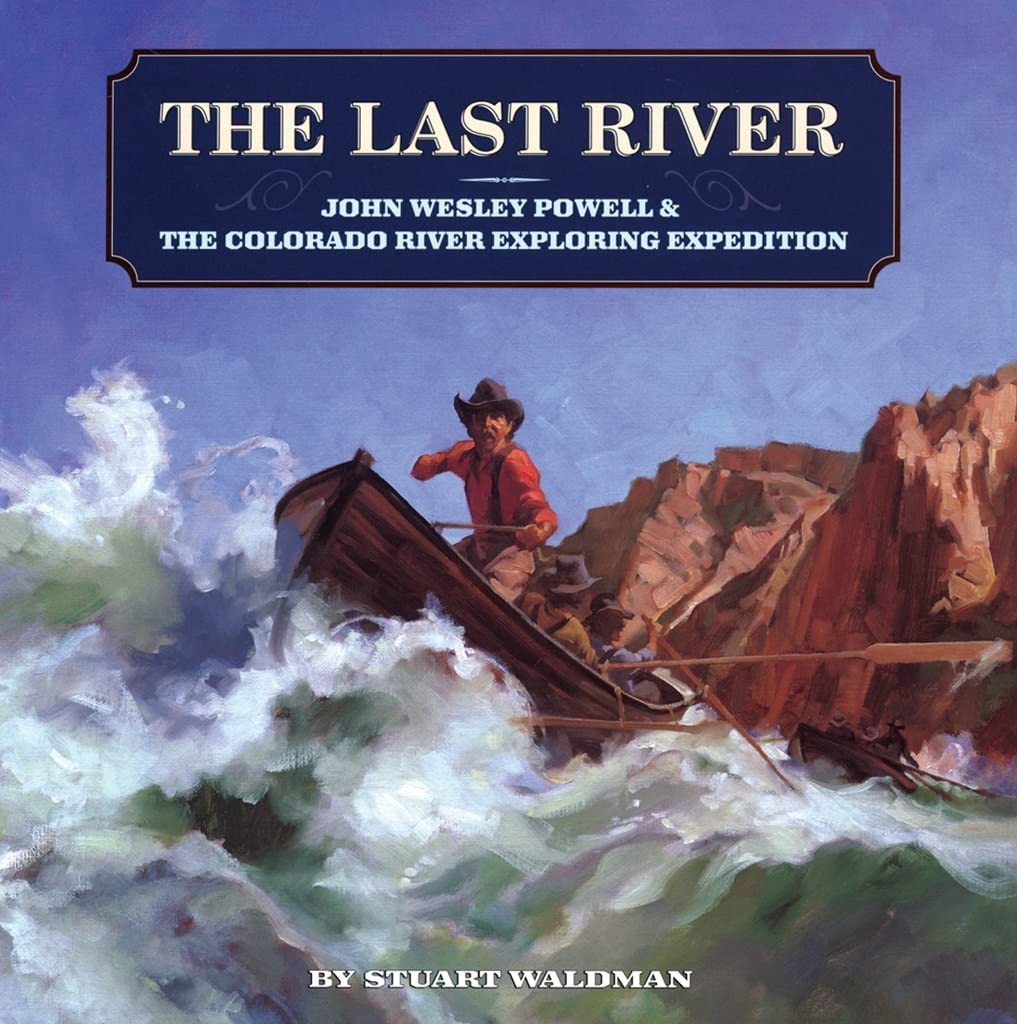
The Last River: John Wesley Powell and the Colorado River Exploring Expedition
$12.95
by Stuart Waldman



"It was a wild ride... and this book does it justice. Well-chosen thrills, spills, and conflicts are spliced into a narrative that highlights the danger underlying this scientific mission... Handsomely designed text... large, full-color impressionistic paintings convey the action." --School Library Journal No European had ever taken boats down the Colorado river and come out alive. In May 1869, ten men boarded four rowboats in Green River City, Wyoming. Three months and 1,000 miles later, two battered boats carrying six exhausted and starving men emerged from the depths of the Grand Canyon. The Last River tells their remarkable story. The man who challenged the Colorado, Major John Wesley Powell, was a small, bookish geology professor from a Midwestern farm. Despite his size and the constant pain from the Civil War wound that had cost him his arm, Powell's twin passions--adventure and scientific exploration--drew him to the Colorado River. For three months, he and nine crewmembers thrilled to riding the rapids and endured the backbreaking labor of transporting boats and cargo past rapids too dangerous to run. They discovered canyons of unsurpassed beauty and gave them names like Music Temple and Canyon of Lodore. They saved each other from drowning, and suffered together as their food supply dwindled to nearly nothing. Excerpts from journals of crewmembers personalize the gripping text. Original paintings and a foldout map allow the reader to follow the expedition's route and its adventures. The Last River is an inspiring and riveting true adventure written with drama and compassion that brings history to life. [Review of hardcover edition:] Handsome full- and double-page paintings... Rich in colors, strong in composition, and beautifully executed, these often-dramatic paintings bring the story to life. -- Carolyn Phelan ― Booklist Published On: 2005-12-15 [Review of hardcover edition:] Dramatic illustrations and many sidebars with excerpts from the journals of Powell's men.... appealing illustrations will lure readers. ― Kirkus Reviews Published On: 2005-10-15 Stuart Waldman is a writer and editor. His previous Great Explorer's Book, We Asked For Nothing: The Remarkable Journey of Cabeza de Vaca , won an International Reading Association Children's Book Award, Notable Book for 2004. Gregory Manchess's paintings have appeared in such publications as Time , Newsweek , Atlantic Monthly , Smithsonian and National Geographic . He has also illustrated many movie posters, billboards and children's books. His work has received a gold medal and three silver medals from the Society of Illustrators in New York. On the morning of May 24, 1869, the entire population of Green River City gathered at the riverbank to watch the Colorado River Exploring Expedition begin its journey. It was not a large crowd. Green River City had been founded just months before, and contained only a few small buildings, a train station and a store that also served as a saloon. The expedition's crew had spent the previous night in that saloon celebrating with the townspeople. An American flag was raised in the lead boat. The people waved and cheered. The expedition's leader, John Wesley Powell, tipped his hat to the crowd and they cheered again. Powell gave a signal and the four boats pushed off. Minutes later they disappeared around a bend in the river. The rest of the country was not as enthusiastic as the people of Green River City. Few had heard of the Colorado River Exploring Expedition, and of those that had, few believed it would succeed. John Wesley Powell wasn't an explorer; he was a college professor. He had never piloted a boat through a canyon rapid, much less a rapid of the Colorado. He was small, a little over 5'6" tall, and he weighed only 120 pounds. Most improbable of all, the man who was leading an expedition down the most dangerous river in America had only one arm. John Wesley Powell was born in 1834 and raised in the Midwest, the son a farmer. When he was 12, his father told him he had to quit school and help run the farm. Wes, as his family called him, loved book5 and learning. He read in the morning in the fields. He read in the wagon while hauling goods to market. He read late at night in the quiet of the barn. By the time he was 21, Powell had learned enough to pass an entrance exam and enroll in college. He was fascinated by geology, the study of the earth and its origins. It was a new science and few colleges taught it. Once again Powell became his own instructor. He read every geology text he could get his hands on and then went beyond books. During vacations, he trekked through wilderness areas, studying the landscape and collecting rocks, minerals and fossils. One summer, Powell rowed a small wooden boat down the length of the Mississippi River, over 2,000 miles, by himself! Powell looked forward to these solitary expeditions, and not only for the science. He loved the cha