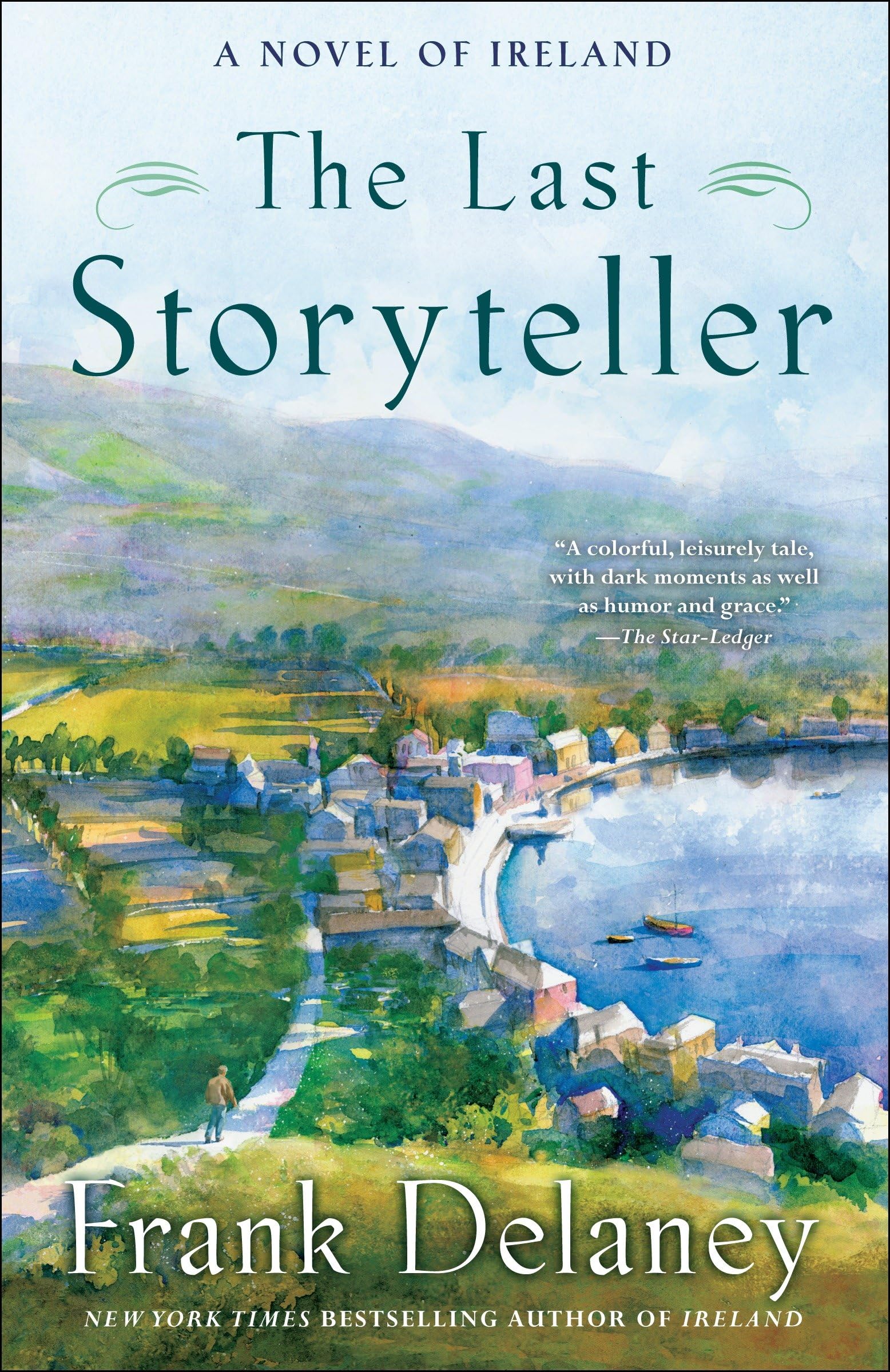



“Riveting . . . Readers will quickly warm to [Frank] Delaney’s vividly described Ireland of the 1950s, its fully realized inhabitants, and the dynamic political and personal relationships that make for a remarkable story.” —Publishers Weekly (starred review) “If we’re to live good lives, we have to tell ourselves our own story. In a good way.” So says Ben MacCarthy’s beloved mentor, and it is this fateful advice that will guide Ben through the tumultuous events of Ireland in 1956. The national mood is downtrodden; poverty, corruption, and an armed rebellion rattle the countryside; and although Ben wants no part of the insurrection, he unknowingly falls in with an IRA sympathizer. Yet despite his perilous circumstances, all he can think about is finding his former wife and true love, Venetia Kelly, who after many years has returned to Ireland with her brutish new husband, a popular stage performer. Determined not to lose Venetia again, Ben calls upon every bit of his passion and courage to win her back, while finally reconciling his violent past with his hopes for a bright future. Brimming with fascinating Irish history, daring intrigue, and the drama of legendary love, The Last Storyteller is an unforgettable novel as richly textured and inspiring as Ireland itself. “A colorful, leisurely tale, with dark moments as well as humor and grace.”— The Star-Ledger “A magical tale [that] weaves in a jackpot of Irish myths.”—Bookreporter “Character-rich and dramatic.”— Library Journal “Riveting . . . Readers will quickly warm to [Frank] Delaney’s vividly described Ireland of the 1950s, its fully realized inhabitants, and the dynamic political and personal relationships that make for a remarkable story.” —Publishers Weekly (starred review) “A colorful, leisurely tale, with dark moments as well as humor and grace.”— The Star-Ledger “A magical tale [that] weaves in a jackpot of Irish myths.”—Bookreporter “Character-rich and dramatic.”— Library Journal Frank Delaney is the author of the New York Times bestselling novel Ireland , as well as The Last Storyteller, The Matchmaker of Kenmare, Venetia Kelly’s Traveling Show, Tipperary, Shannon, and Simple Courage: A True Story of Peril on the Sea. A former judge for the Man Booker Prize, Delaney enjoyed a prominent career in BBC broadcasting before becoming a full-time writer. Delaney died in 2017. 1 He comes back to my mind when I smell wood smoke. We had a clear and crisp October that year, and a simple white plume of smoke rose through the trees from his fairy-tale chimney. The long, quiet lane ended at his gate. My nose wrinkled as I climbed out of the car. Applewood? Not sweet enough. Beech? Possibly, from the old mansion demesne across the road. Could it be elm? Twenty years later it would be, as the elms died everywhere. A white fence protected his small yard and its long rectangles of grass. He had a yellow garden bench and rosebushes, pruned to austerity. Around the side of the house I counted one, two, three fruit trees. If, on a calendar, a tourist brochure, or a postcard, you saw such a scene, with the golden roof of thatched and smocked straw, a pleased smile would cross your mind. Not a sound to be heard, not a dog nor a bird. My breathing went short and shallow, and I swallowed, trying to manage my anticipation. Somebody had polished the door knocker so brilliantly that my fingers smudged the gleaming brass. They said that he was eighty. Maybe he was, but when he opened the door our eyes came exactly level, and I was six feet three and a half inches. He shook hands as though closing a deal, and I was so thrilled to meet him at long last that my mouth turned dry as paper. “Do you know anything about houses like this?” he asked as he led me into the wide old kitchen. I knew everything about the house, I knew everything about him—but I wanted to hear it in his words, his voice. “It feels nicely old,” I ventured. He laughed. “Hah! ‘Nicely old’—I’ll borrow that.” Then, with some care, he turned to survey me, inclined his head a little, and smiled at me as though I were his beloved son. “I’m very pleased to meet you at last.” I said, “I’m more than pleased to meet you, sir.” He waved a hand, taking in the wide fireplace, the rafters, the room. “This was what they called a ‘strong farmer’s’ house. Now with ‘all the modern conveniences,’ as they say. I suppose you know what a strong farmer was?” “Wasn’t it somebody who supported his family from what he produced on his farm?” “The very man,” he said. He showed me the walls—two feet thick: “They keep in the heat for the winter, and they keep out the heat of the summer—those boys knew how to build. And look, I can put wide things on the windowsills.” He lifted a great bowl of jade, glinting with dragons. “Feel the weight of that. I carried it all the way back from Ceylon in 1936.” Looking up, he stretched an arm and patted a beam. “Did