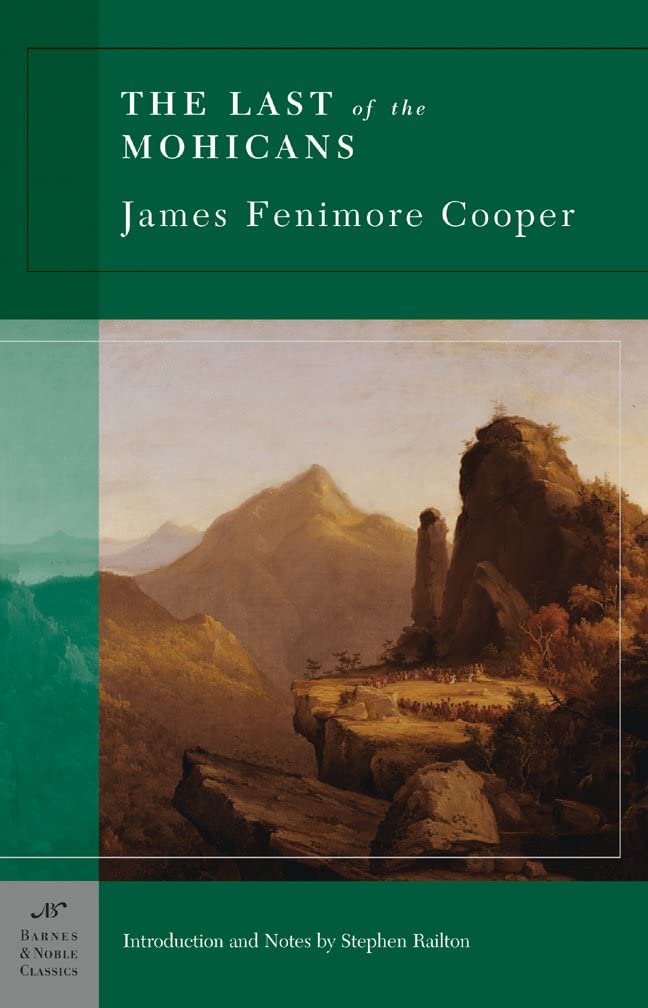



The Last of the Mohicans , by James Fenimore Cooper , is part of the Barnes & Noble Classics series, which offers quality editions at affordable prices to the student and the general reader, including new scholarship, thoughtful design, and pages of carefully crafted extras. Here are some of the remarkable features of Barnes & Noble Classics : New introductions commissioned from today's top writers and scholars - Biographies of the authors - Chronologies of contemporary historical, biographical, and cultural events - Footnotes and endnotes - Selective discussions of imitations, parodies, poems, books, plays, paintings, operas, statuary, and films inspired by the work - Comments by other famous authors - Study questions to challenge the reader's viewpoints and expectations - Bibliographies for further reading - Indices & Glossaries, when appropriate All editions are beautifully designed and are printed to superior specifications; some include illustrations of historical interest. Barnes & Noble Classics pulls together a constellation of influencesbiographical, historical, and literaryto enrich each reader's understanding of these enduring works. During the fierce French and Indian wars, an adroit scout named Hawkeye and his companion Chingachgook weave through the spectacular and dangerous wilderness of upstate New York, fighting to save the beautiful Munro sisters from the Huron renegade Magua. The Last of the Mohicans is the most popular of James Fenimore Cooper ’s five Leatherstocking Tales . With its death-defying chases and teeth-clenching suspense, this American classic established many archetypes of American frontier fiction. An engrossing Western” by America’s first great novelist, The Last of the Mohicans is a story of survival and treachery, love and deliverance. Stephen Railton , Professor of English at the University of Virginia, has written books on Cooper, Mark Twain, and the American Renaissance, and has created major websites on Twain, Uncle Tom’s Cabin , and American culture. Stephen Railton , Professor of English at the University of Virginia, has written books on Cooper, Mark Twain, and the American Renaissance, and has created major websites on Twain, Uncle Tom’s Cabin , and American culture. From Stephen Railton's Introduction to The Last of the Mohicans We must not fall for the fiction Cooper uses to organize the story he tells in The Last of the Mohicans . There has never been a last” Mohican. The tribe Cooper refers to by that name survives to this day, on a small reservation in Wisconsin. According to Cooper’s version of the Mohicans’ story, the death of Uncas in the middle of the eighteenth century is the last act in the tragedy of a once-mighty nation. There are a number of tragic elements in the real history of the people who, when they learned to write English, referred to themselves as the Muhheakunnuk or Moheakunnuk, but the story they have written with their actions is that of a people who, while remaining true to key elements of their heritage, made great efforts to adapt to and earn a place in the new world that descended on them with the arrival of the traders and settlers from Europe. As Patrick Frazier recounts that story in The Mohicans of Stockbridge , the tribe accepted Christianity about two decades before the events Cooper dramatizes in the novel; two decades after the supposed death of the last Mohican, they fought on the American side during the Revolutionary War. When the tribe relocated from Massachusetts to the vicinity of New York’s Oneida Lake in the mid-1780s, just a few years before the infant James Cooper was carried to Cooperstown on the banks of nearby Lake Otsego, they took with them a letter from George Washington attesting that the Muhheakunnuks have fought and bled by our side . . . as our friends and brothers . . . [and] as friends and subjects to the United States of America.” No efforts could stop the tide of white pioneers from diminishing their population and driving them farther west, but like nearly all the original Native American tribes, they survived despite the centuries of cultural loss, economic dispossession, white aggression, discrimination, and neglect. That true story, however, is one the United States is still reluctant to tell, and repressed almost completely throughout the nineteenth century as the pioneers moved westward across the continent. On the other hand, Americans loved the story Cooper tells in Mohicans. Published in 1826, it was Cooper’s sixth novel; he was already America’s most successful novelist, a position he held through most of his career, and among the thirty-two novels he wound up writing before his death in 1851 were a number of best-sellers. The Last of the Mohicans was first among them all: his most popular book, and one of the most widely read American novels ever. Like most of Cooper’s novels, especially those he wrote in the first half of his career, it derives from the model