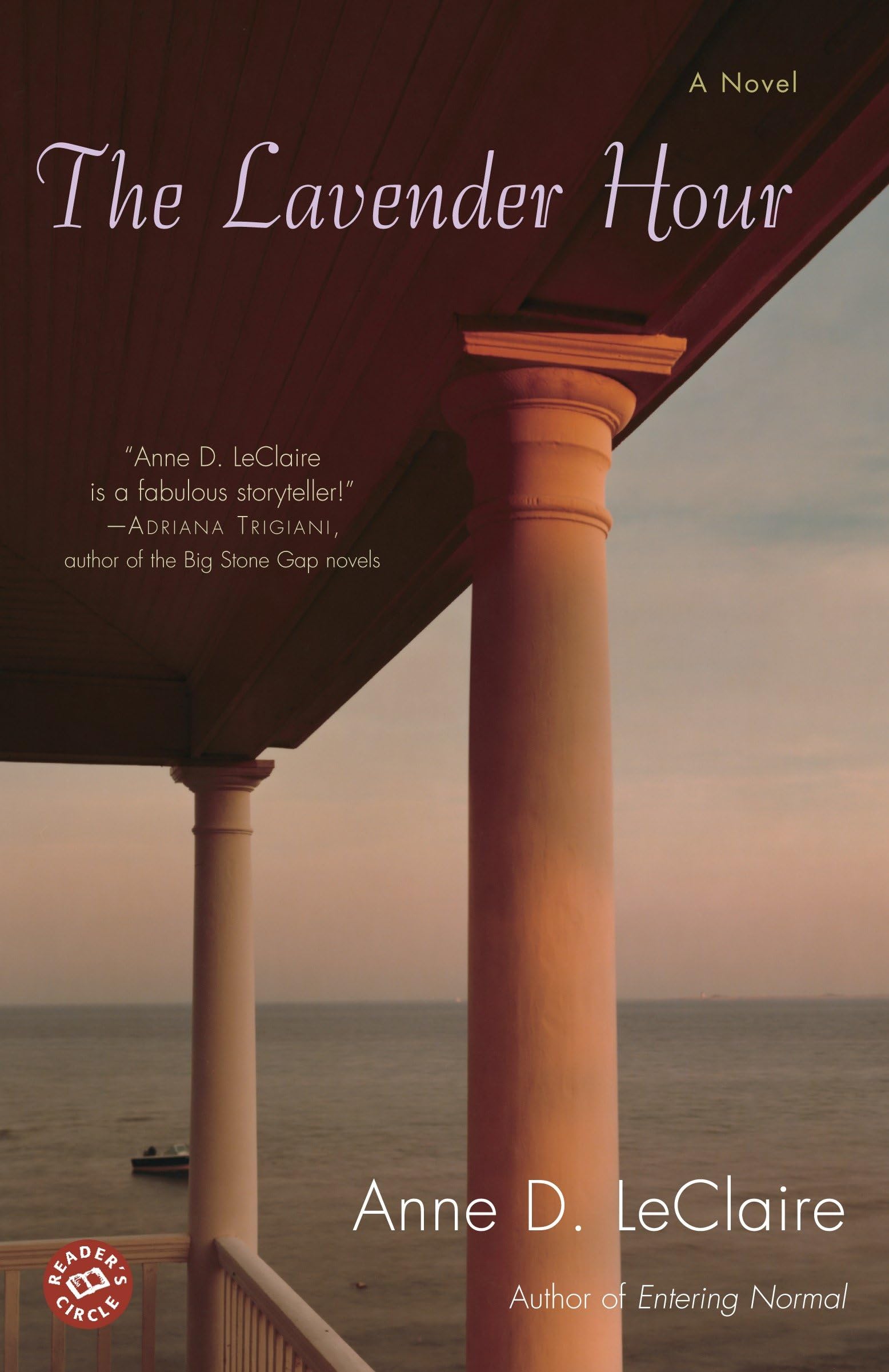



Downsized from her teaching job, Jessie longs for a sense of renewal and decides to spend a year on Cape Cod, seeking to be cleansed by rushing ocean waters and comforted by the lavender hues of the setting sun. While there she volunteers with a local hospice program, where she meets Luke, a once proud fisherman whose life and body have been ravaged by cancer. Jessie’s presence is a great help to Luke’s mother, who has moved in to take care of her son. After initial misgivings Jessie and Luke forge a deep friendship, and the former teacher is surprised to find herself opening up about her life, the loss of her father when she was a girl, her often difficult relationship with her mother, and her own battle with illness. When Luke makes a critical request of his new friend, Jessie must look deep within herself for an answer, knowing that her actions will have far-reaching effects on Luke’s family and forever change the bonds within her own. In her eighth novel, LeClaire pulls out all the emotional stops in an operatic tale of 32-year-old cancer survivor Jessie Long. Five years after undergoing brain surgery, Jessie is declared cancer free and relocates to the family cottage in Cape Cod, Massachusetts, far from her mother and sister in Richmond, Virginia. The former art teacher lies about her medical history and becomes a volunteer at a hospice center. She freely admits that her romantic history has been disastrous and then promptly falls in love with her first hospice patient, 45-year-old commercial fisherman Luke Ryder, who is dying of pancreatic cancer. Jessie's emotional involvement clouds her judgment, and she ends up breaking nearly all of the guidelines laid out for volunteers. When Luke commits suicide by overdosing on pain medication, Jessie is charged with his murder. LeClaire's uninhibited portrayal of Jessie's more unfortunate tendencies--her unappealing hobby of making jewelry out of human hair, her constant carping about her mother's newfound happiness--makes this tale far more entertaining than its heavy subject matter would indicate. Joanne Wilkinson Copyright © American Library Association. All rights reserved “A few writers, and Anne LeClaire is one, can illuminate honestly every nuance of life reclaimed from loss, as the setting sun outlines every limb of a tree in winter.” –Jacquelyn Mitchard, author of The Deep End of the Ocean “Brilliant, dark, and deep . . . LeClaire writes with great compassion and insight, and understands the ways that lives intersect, the way one decision can change everything forever.” –Luanne Rice, author of Sandcastles “Heart-wrenching, illuminating . . . The Lavender Hour paints in vivid detail the many shades of grief and the healing magic of place.” –Claire Cook author of Must Love Dogs “LeClaire packs this winning novel with resounding life lessons and a resonating set of romantic relationships.” –Kirkus Reviews Anne LeClaire is the author of the critically acclaimed novels Leaving Eden and Entering Normal . She is also a short story writer who teaches and lectures on writing and the creative process, and has worked as a radio broadcaster, a journalist, and a correspondent for The Boston Globe . Her work has appeared in The New York Times , Redbook , and Yankee magazine, among other publications. She is the mother of two adult children and lives on Cape Cod. Chapter 1 A station older than oldies was playing Johnny Lee’s “Lookin’ for Love in All the Wrong Places,” and didn’t that make me laugh right out loud in spite of my high-wired nerves. My sister, Ashley, used to say this could be the title song of my life. Hard to argue with that. My romantic history was a string of jagged beads, each broken in a different way. I snapped off the radio—time to change that tune—but, of course, now that it had taken up residence in my head, it would be cycling through for the rest of the day. I checked the dash clock. Late. Late. Late. I could make better time on a banana-seat bike. The gray sedan in front of me, one in a long line of cars, inched along three degrees short of a dead stop. Back when I was a child vacationing on Cape Cod, traffic like this was a hassle reserved for summertime, but a shitload of change had occurred in two decades. Now roads were clogged nearly year-round, and each month, one more seasonal cottage held in a family for generations was replaced by a place so large, I swear it could exist in two time zones. I tailgated the sedan, as if that would speed things up. I was beyond late. No excuses. “Jessie Lynn, I swear you’ll be tardy for your own wake,” my mama used to tell me. Of course, that was back when she could say something like that without looking like she wanted to slit her tongue and serve it for dinner, back before we all became painfully aware that such a possibility could actually loom on the visible horizon of my life. At one time, Lily used to treat promptness as something of consequence, along with mat