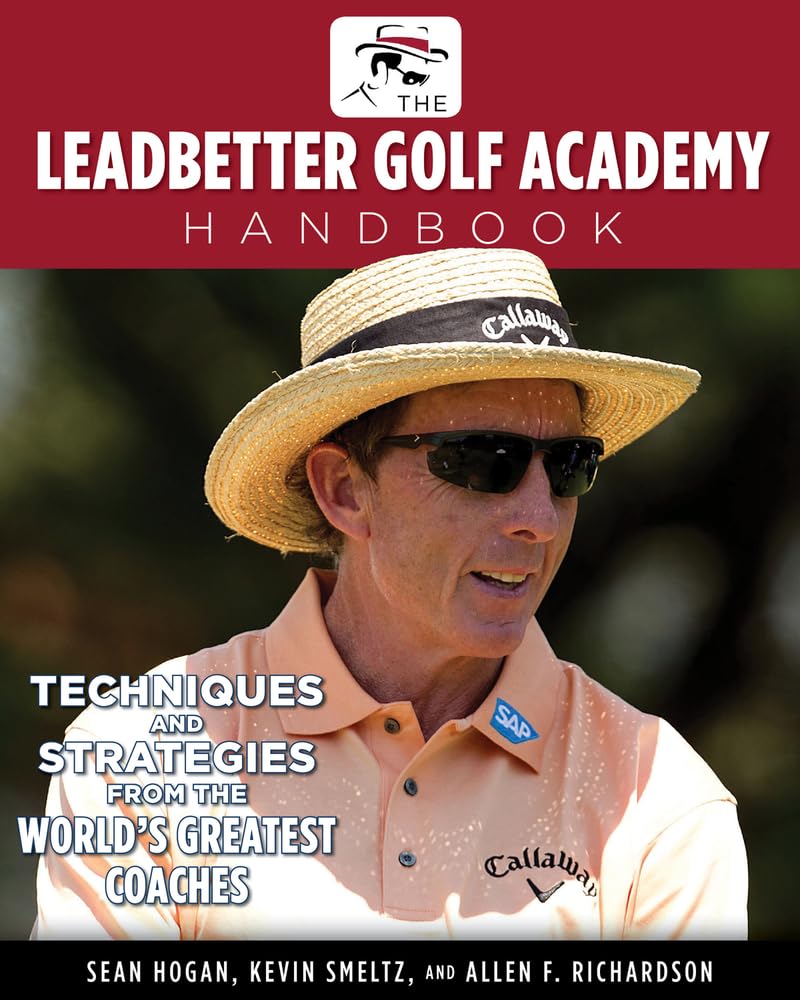
The Leadbetter Golf Academy Handbook: Techniques and Strategies from the World's Greatest Coaches
$10.98
by S.A. Hogan



Certified instructors Sean Hogan and Kevin Smeltz, along with championship golfers Suzann Pettersen and Ian Poulter and World Golf Hall of Fame inductee Nick Price, provide invaluable advice on how to improve upon every aspect of the golf game by gaining a clear and concise understanding for each key element of the sport. The book shows golfers how to improve their full swing, short game, practice routines, and how to better their mental and physical conditioning strategies. The Leadbetter Golf Academy Handbook is a collection of successful blueprints by top-notch players and instructors that will help players of all levels improve their understanding and performance. Sean Hogan is the director of instruction at the David Leadbetter Golf Academy at the ChampionsGate Golf Resort in Florida. He has watched and assisted David Leadbetter with players such as Ernie Els, Nick Faldo, Charles Howell, and Nick Price. Kevin Smeltz is a former assistant to David Leadbetter and the former director of instruction at the David Leadbetter Golf Academy at the Ishizaka Golf Club in Japan. He has been named a Best Young Teacher by Golf Digest . He lives in Hilton Head, South Carolina. Allen F. Richardson is an award-winning journalist who has worked in the United States and overseas. He is the author of four books on golf instruction, including Golf Tips: The Complete Guide to Improving Your Game . He lives in Old Greenwich, Connecticut. The World's #1 Golf Instructor and coach to countless PGA Tour, European PGA Tour, LPGA Tour, and Champions Tour players, David Leadbetter is known throughout the world for his innovative and creative teaching techniques. He lives in ChampionsGate, Florida. The Leadbetter Golf Academy Handbook Techniques and Strategies from World's Greatest Coaches By Sean Hogan, Kevin Smeltz, Allen F. Richardson Triumph Books Copyright © 2014 Sean Hogan and Kevin Smeltz All rights reserved. ISBN: 978-1-60078-690-7 Contents Foreword by David Leadbetter, Acknowledgments, Section One. The First P: Preparation, 1. The Grip, 2. The Address Position: Balance, Alignment, Ball Position, and Posture, 3. The Pre-Shot Routine, Section Two. The Swing, 4. The Second P: The Pivot, 5. The Third P: Positioning, 6. The Fourth P: Putting It All Together, Section Three. The Short Game, 7. Putting: The Game within the Game, 8. Chipping, 9. Pitching: A Small Version of the Full Swing, 10. Bunker Play: Imagination, Feel, and Bounce, Section Four. Shotmaking, 11. Advanced Techniques, 12. Playing Out of Trouble, Section Five. Holistic Golf, 13. Peak Mental Performance, 14. Having More Fun on the Golf Course, 15. Practicing to Get Better, 16. Fitness & Nutrition for a Better Game, 17. Equipment, 18. Club fitting, 19. Choosing the Right Golf Ball, 20. Junior Golf, 21. Effective Training Aids, 22. Game Improvement via Technology, CHAPTER 1 The Grip by Kevin Smeltz Make no mistake about it, a good grip is vital to executing a good swing, since the hands are the only part of the body in contact with the club. Correctly placing the hands on the club — at what is called the "grip end" — enables the golfer to swing through the ball so the path of the clubhead travels down the target line, and the clubface is square to that target line at impact. Further, a good grip helps the golfer maintain a consistent angle of attack throughout the swing. Do it right every time and you will produce that elusive ingredient known as clubhead speed. Or, to put it more precisely — since everyone generates some clubhead speed — the golfer needs a solid grip in order to bring any number of swing elements together in a way that produces accelerated clubhead speed. For example, a PGA Tour player hits the ball with a driver at about 112 mph of clubhead speed, versus the average club player, who is lucky to get up to around 80 mph. In short, when it comes to golf — and improving one's game — speed is a good thing. And, it certainly does not kill, except in the colloquial sense of "killing the ball," something every golfer wants to do. A proper grip also allows the golfer to hit a variety of shots, as and when needed. For instance, after picking a target, judging the wind, and factoring in what hazards or slopes lie between the ball and the target, a golfer might decide that he or she needs to hit a draw — where the ball curves from right to left. Alternatively, the golfer might choose to hit a fade — where the ball curves from left to right. In each case, in order to pull off these advanced shots, the golfer needs to make small adjustments in his or her alignment and ball position to change the angle of the clubface to the path of the club. (We'll explain further how this is done later in the book.) But one thing remains constant: the foundation for these advanced techniques, as with any other standard golf swing, is a solid grip. For now, we want to concentrate on what is called the "neut