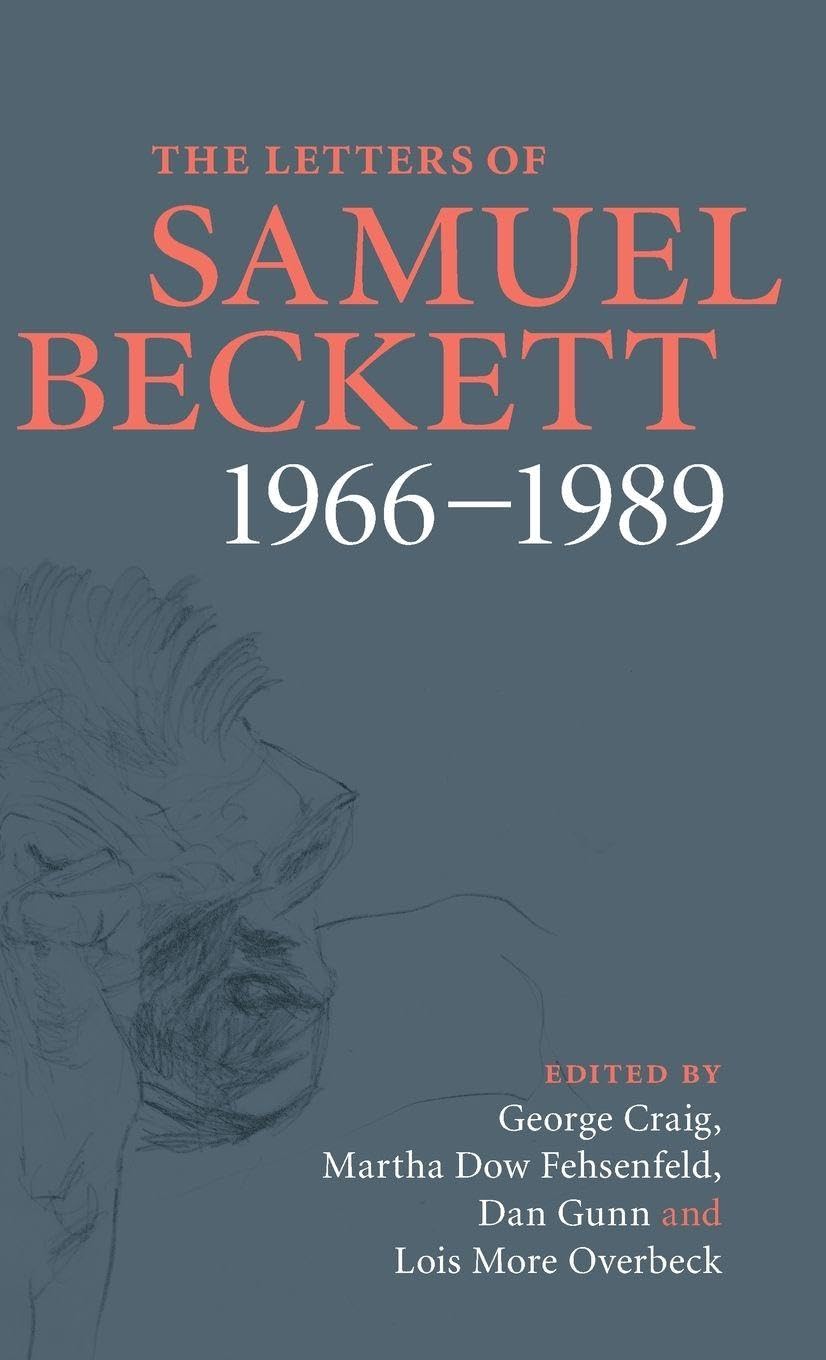



This fourth and final volume, which completes the Cambridge edition of The Letters of Samuel Beckett, covers the final twenty-four years of what was, as Beckett saw it, a surprisingly long life. During these years he produced many of his finest and most concentrated works for theatre, plays that included Not I, Ohio Impromptu, and Catastrophe; for television he wrote Eh Joe and Ghost Trio; while in prose, he produced the late 'trilogy' that comprises Company, Ill Seen Ill Said, and Worstward Ho. In 1969, Beckett was awarded the Nobel Prize in Literature, and the letters from this period show him struggling to cope with the pressures created by his ever-growing international fame. The letters reveal how, later, he turned his mind to his legacy, as seen through his interactions with biographers and archivists. This volume also provides chronologies, explanatory notes, translations, and profiles of Beckett's chief correspondents. 'Here is a book which, as soon as I could get sight of a copy, I could not stop myself reading straight through, nothing being more urgent to me … The temptation is only to quote. There is so much here of great value to those who study Beckett … Every word Beckett wrote as only he could write it. That is why, as Dan Gunn says in his excellent introduction to this final volume, though the writing of letters can seem like a diversion from, or even obstruction of, his work, ‘the writing of letters is also that work’. Now we can read them. This is a great piece of publication.' David Sexton, The Evening Standard 'The editing of this volume, as of the previous three, is phenomenal in its thoroughness, doggedness and clarity. The editors explain abbreviations, so that, by 'Kind PA on HD. DM could direct', Beckett means: 'Kind of Peggy Ashcroft to ask to play Winnie in Happy Days. Donald McWhinnie could direct it.' Their loving (it is the only word) attentiveness makes you feel you know the modernist dinosaur better than before. And feel absurdly pleased that he comes across as a good man.' John Walsh, The Sunday Times 'Krapping away here to no little avail,’ writes Beckett to the actor Patrick Magee in September 1969. To ‘no little avail’, note, not to ‘little or no’: there is a difference. It’s the difference that Beckett makes - I can’t go on, I’ll go on, and all that … a lifetime’s correspondence that stands as a necessary complement to Beckett’s published work.' Ian Sansom, The Spectator 'In spite of a few flashes of his earlier manner (one message to a producer reads, in its entirety, ‘No’), the letters are mostly in awe-inspiring accordance with his late-life image as Saint Samuel of the Void. Whether he’s discussing French grammar with the postman, quietly giving his Nobel winnings to needy artists, or lavishing polite attention on his younger colleagues’ avant garde manuscripts (‘I don’t see how you can cut the poem … All I meant was that its association with the bacon-stroking seemed unadvisable’), it’s hard not to think of his tribute to Joyce: ‘heroic work, heroic being’.' Christopher Taylor, Financial Times 'Volume IV, despite an inevitable, general lessening, has its many moments of illumination, indeed of splendour, even as the light of Beckett’s life and work dims … As always with Beckett, of course, laughter, however bleak, will keep breaking through. His wordplay becomes, if anything, more ingenious and mordantly funny the older he gets … In this volume we are also offered repeated instances of Beckett’s unfailing kindness and generosity … it would be churlish and ungrateful, here at the end, not to acknowledge the dedication, hard work and love that have gone into the making of this splendid monument to a great artist.' John Banville, The Daily Telegraph 'It will be a most difficult job,' Samuel Beckett writes to Martha Dow Fehsenfeld in March 1985, authorising her to edit his letters. And indeed it has been. The letters published in the 750 pages of this fourth volume represent only a fraction of those available. For each one Beckett’s notoriously illegible handwriting had to be deciphered, his oblique references to people and places glossed, his glancing literary quotations hunted down in English, French, German and Italian. So all praise to the editorial team: Fehsenfeld herself; Lois More Overbeck, the general editor; Dan Gunn, who contributed the magisterial introduction to this volume; and George Craig, with his brilliant French translator’s preface. No one will envy them their 31 years’ hard labour; all readers will appreciate their extraordinary achievement.' Nicholas Grene, The Irish Times 'I was close to tears reading these last letters: especially since Beckett’s fixation on death features so prominently in much of his work. A writer of Beckett’s magnitude and originality only comes along once every few centuries. Therefore any words they put down on paper ought to be of significant interest to global literary culture, and to posterity. And this final volu