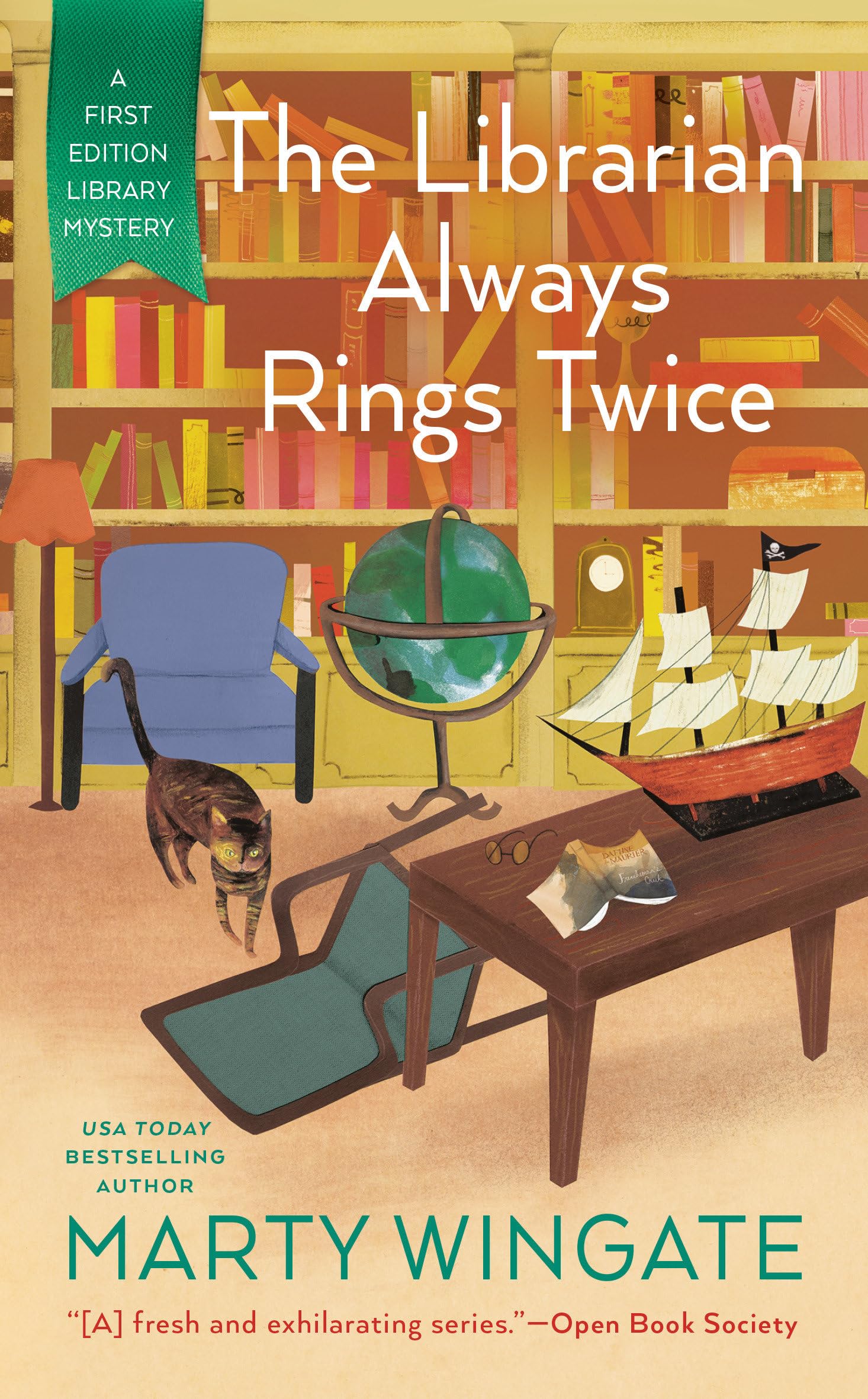



When a mysterious stranger turns up making claims that threaten Lady Fowling’s legacy, Hayley Burke must dig deep into her late benefactor’s history to uncover the truth and catch a conniving killer in this new mystery from USA Today bestselling author Marty Wingate, now in paperback. It has been nearly a year since I took up my position as curator of Lady Georgiana Fowling’s collection of Golden Age of Mystery writers’ first editions at her library in Middlebank House. I have learned that I need to take the good with the bad. The good: I have finally convinced Mrs. Woolgar to open up the collection to the public one day a week so that they too can share in Lady Fowling’s passion. The bad: although he would not be my first, or even tenth, choice, at the insistence of the board Charles Henry Dill, Lady Fowling’s unscrupulous nephew, is now my personal assistant. On one of our first days open to the public, Mr. John Aubrey shows up at Middlebank House and insists that Lady Georgiana Fowling is his grandmother. Mrs. Woolgar is scandalized by his claims, and Charles Henry, who feels he has been cheated out of his rightful inheritance as Lady Fowling’s heir, is furious. I do not know that I believe Mr. Aubrey, yet he has knowledge of Lady Fowling’s life and writings that few possess. To further complicate matters, an associate of Mr. Aubrey’s intends to help us uncover the truth of John’s story. But before he can do that, he is murdered and the police have reason to suspect Charles Henry. As much as I would like to lock up Charles Henry and throw away the key, I cannot believe he is a killer. And I also know there is something dead wrong about Mr. Aubrey’s tales regarding his “grandmother” Lady Fowling. I will need to make sense of her past in order to suss out the true villain of this story. A Seattle native, Marty Wingate is a member of the Royal Horticultural Society and leads garden tours through England, Scotland, and Ireland when she is not killing people in fiction. 1 "Shall I be Mother?” Charles Henry Dill didn’t wait for a response, but reached across the library table for the pot, the sleeve of his baby-blue linen jacket pulling up and exposing his hairy arm. He poured, managing to splash tea into the saucers and onto the highly polished walnut surface before, at last, hitting the cups. Beside me, Mrs. Woolgar flinched and leapt up to get a towel— either that or she was about to go for his throat, a prospect I found not all that unappealing. I stood. “No, let me.” Mrs. Woolgar sat down again as I retrieved a small towel from the trolley by the door. I mopped up the spill as Charles Henry distributed tea round the table, after which each of us poured the excess from the saucers back into the cups before adding milk. I noticed he had handed board member Maureen Frost, sitting next to him, a saucer with no spills. “Well, now,” Dill said, with a smirk of self-importance, “let me just say I’m ever so glad to be joining you here at Middlebank House and the First Edition Society, and I look forward with eager anticipation to working with our esteemed curator, Ms. Burke, in my new role as her assistant and, I daresay”—he chortled—“general dogsbody.” How had it come to this? It had started on Monday. My boyfriend and I had returned from a week in Deal—a lovely seaside town in Kent—and I was ready and rested for the First Edition library’s inaugural public open hours in two days’ time. It was the logical next step to increasing the awareness of the Society, gaining new respect and members, and contributing to the overall knowledge base about those wonderful women writers from the Golden Age of Mystery. But a library open to the public had been a shocking proposition— at least to the Society’s secretary, Mrs. Glynis Woolgar. It took a fair bit of song and dance on my part to convince her that our founder, the late Lady Georgiana Fowling, had intended for her impressive collection of first editions—as well as rare and unusual printings—to be enjoyed, not hidden away. The secretary had agreed, but with reservations. On my first day back at work, I had expected to find Mrs. Woolgar with her knickers in a twist about the launch of the Wednesday-afternoon opens, but instead, at our morning briefing, I had been met with an ashen face across the desk from me. Even before we had exchanged “good mornings,” she made the pronouncement: “It’s about Charles Henry.” Rarely was any news that involved Charles Henry Dill, Lady Fowling’s lout of a nephew, good news, unless it was that he was out of the country. Because when he wasn’t out of the country, he applied himself to his life’s goal of trying to get more, more, more money out of his aunt’s estate. Mrs. Woolgar had told me his latest scheme was to become my assistant, and when I could find my voice again, I said, “But surely the board wouldn’t allow it? Mr. Rennie wouldn’t allow it?” Duncan Rennie, the Society’s solicitor, did his best to keep Dill and