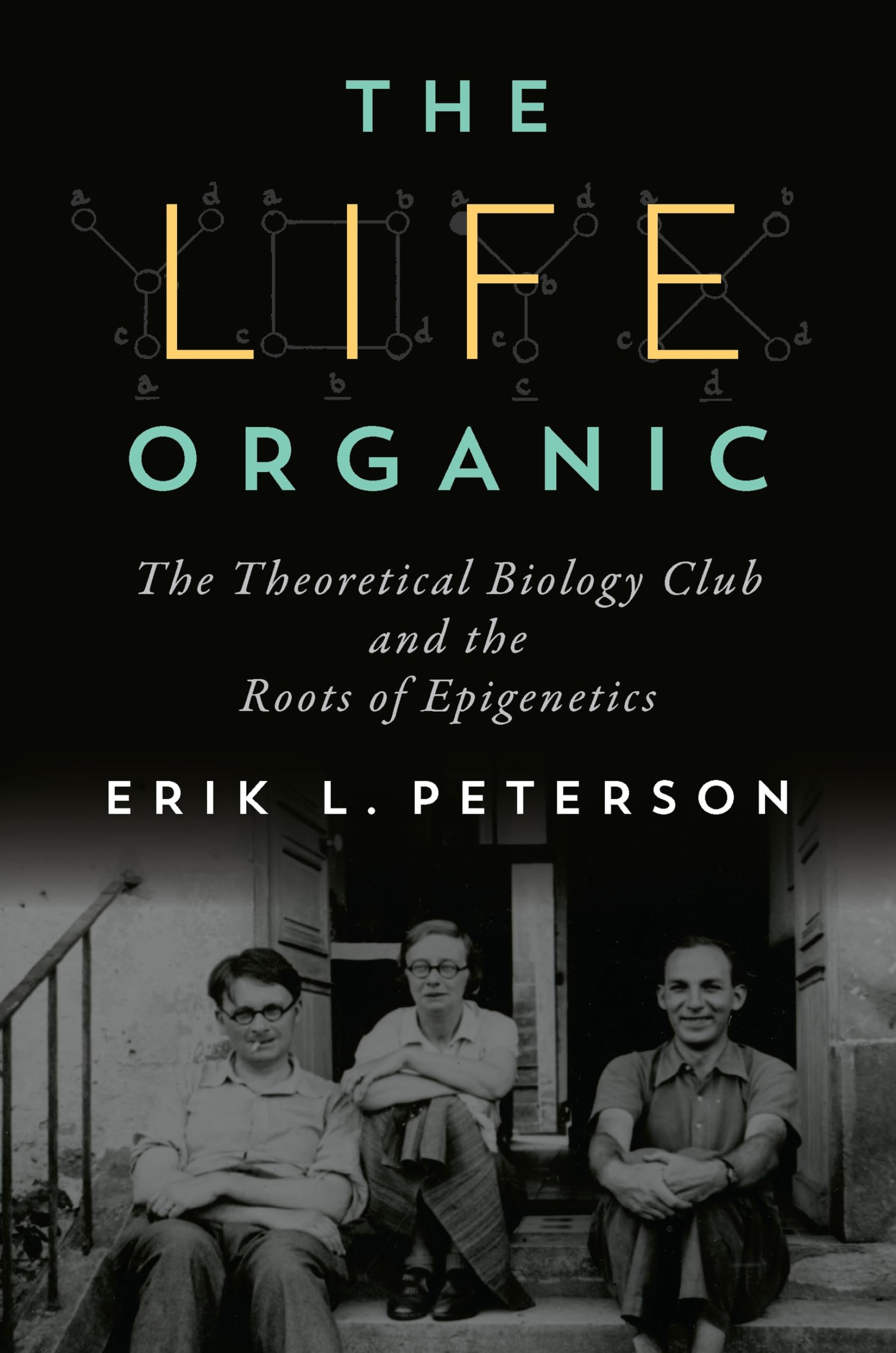
The Life Organic: The Theoretical Biology Club and the Roots of Epigenetics
$40.00
by Erik L. Peterson



As scientists debated the nature of life in the nineteenth century, two theories predominated: vitalism, which suggested that living things contained a “vital spark,” and mechanism, the idea that animals and humans differed from nonliving things only in their degree of complexity. Erik L. Peterson tells the forgotten story of the pursuit of a Third Way in biology, known by many names, including “the organic philosophy,” which gave rise to C. H. Waddington’s work in the subfield of epigenetics: an alternative to standard genetics and evolutionary biology that captured the attention of notable scientists from Francis Crick to Stephen Jay Gould. The Life Organic chronicles the influential biologists, mathematicians, philosophers, and biochemists from both sides of the Atlantic who formed Joseph Needham’s Theoretical Biology Club, defined and refined Third-Way thinking through the 1930s, and laid the groundwork for some of the most cutting-edge achievements in biology today. By tracing the persistence of organicism into the twenty-first century, this book also raises significant questions about how we should model the development of the discipline of biology going forward. This is an excellent history of a debate that continues today. . . . The Life Organic is an excellent tour of the evolution of "reductionist" and "systems" approaches to biology in the 20th century. ― Choice Peterson’s The Life Organic is a fascinating history of the development of the theoretical biology of organicism in the late nineteenth and early twentieth centuries. ― Process Studies From the perspective of history, The Life Organic provides much-needed answers to what should be a proverbial question but is not: What went missing in science and its history with the rise of genetics and gene triumphalism over the past century, starting in 1909, the year the ‘gene’ was named by Wilhelm Johannsen, Peterson's book answers this question and is thus a major contribution to the history of biology in the twentieth century, explaining to hungry readers who seek to know the origins of lines of thinking and areas of expertise of more recent time. ― Interdisciplinary Science Reviews Peterson has made an important contribution to the literature on twentieth century organicism, and one that no one interested in the subject can afford to ignore. Historians, philosophers, and biologists will all find something to enjoy (and to disagree with) in this book. ― Journal of the History of Biology The Life Organic is clearly a landmark in the history of organic biology and philosophy and a must-read for anyone interested in 20th-century biology in general. ― Centaurus The book is highly recommended, especially for all those intrigued by overlooked figures and traditions in the history of biology in the 'age of extremes.' ― Isis Recent years have seen a resurgence of debate in biology around questions believed to have been solved decades ago: the nature of evolution and heredity. And while this debate is by and large taking place within science, historical accounts that take a fresh look on the past events, and especially 'the roads not taken,' provide extremely useful contributions. Erik Peterson’s Life Organic , with its thorough consideration of an idiosyncratic and in the short-run unsuccessful―but ultimately influential―approach to biology, presents an excellent example of how to engage productively in historiographical and scientific discussion. ― Science & Education The most comprehensive engagement of organicist thought from one source in the almost half century since Donna Haraway’s (1976) touchstone Crystals, Fabrics, and Fields . . . . The book’s overall value to the community. . . is substantial. ― History and Philosophy of the Life Sciences The Life Organic is a monumental tour through the history of the organic philosophy―the belief that phenomena of life exhibit higher-order modes of organization rather than simply being the sum of their parts. An outstanding book that will easily become the classic source on organicism and epigenesis. ― Marsha Richmond, Wayne State University This book has undertaken an ambitious and far-reaching survey of debates among vitalists, mechanists, and organicists from the nineteenth through the twentieth century―a formidable task, but one that will be of interest to many scholars in the history and philosophy of biology, and within biology itself. ― Michael R. Dietrich, Dartmouth College Tells the Forgotten Story of the Pursuit of a Third Way in Biology, “The Organic Philosophy” Erik L. Peterson is associate provost and professor at the University of Alabama.